 eigenwallet
Exchange · DEX
eigenwallet
Exchange · DEX

Acechange.io
Communityacechange.io
Privacy-focused non-KYC exchange: crypto-to-crypto swaps
Live preview
acechange.io
▶
https://www.acechange.io
Review
EditorialOverview
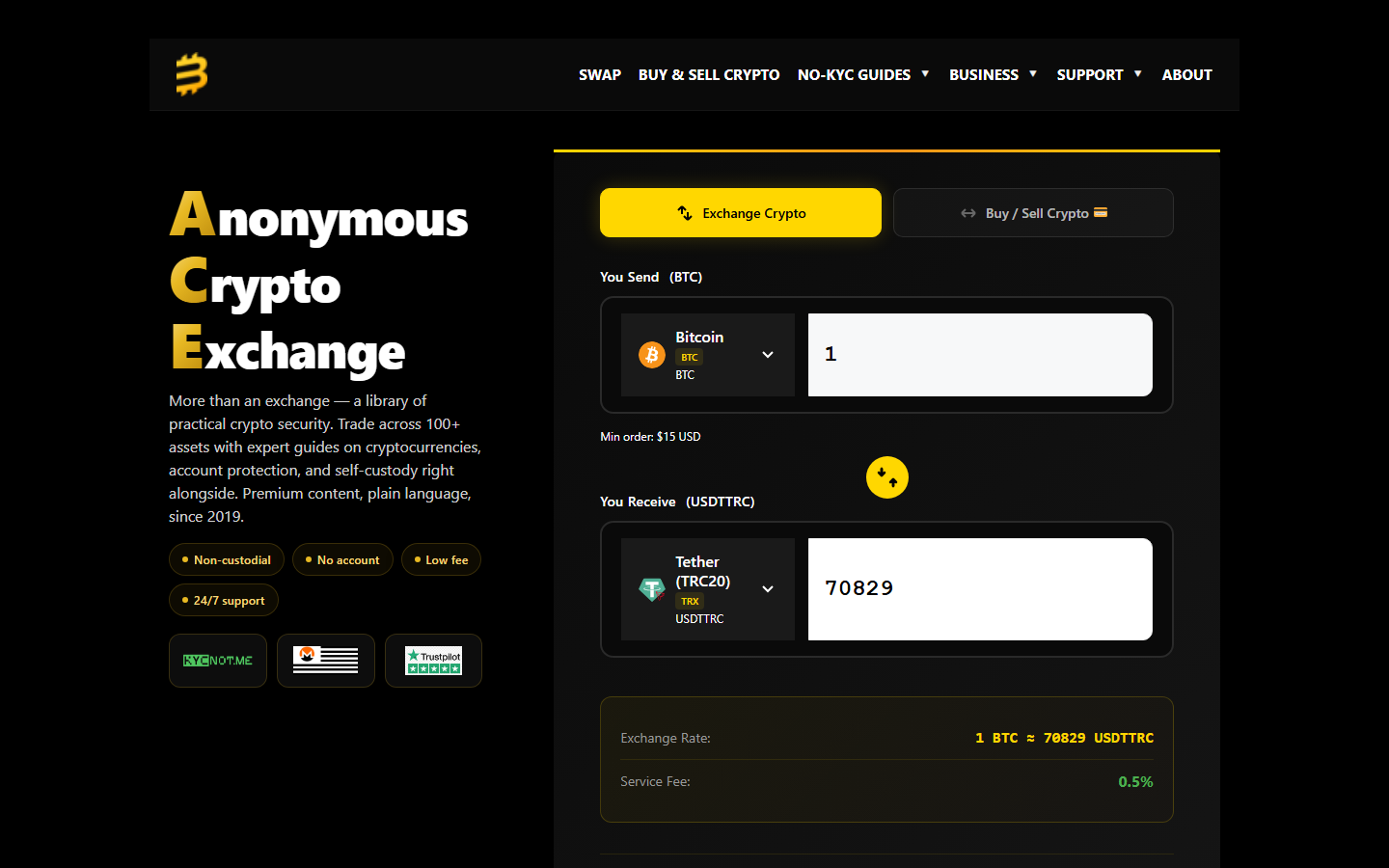
Acechange.io positions itself as a dual-track service for privacy-minded crypto users. Its core offering is a non-custodial, no-KYC crypto swap that lets traders exchange Bitcoin, Monero, Ethereum and over 1,000 other cryptocurrencies without creating an account. Operating since 2019 according to its own branding, the platform aggregates rates from partner liquidity providers and claims average settlement times of roughly five minutes. A separate fiat gateway allows card purchases and sales across 85+ markets, though that channel sits under conventional financial regulations and operates with different privacy rules.
The exchange earns a middling 5/10 overall score in our directory, dragged down by a privacy score of 49/100 and a trust score of 58/100. Those numbers reflect genuine friction: while the swap side is genuinely anonymous, the site itself logs IP addresses, the fiat gateway introduces tiered verification, and the service is ultimately powered by undisclosed third-party exchange APIs that users never directly interact with.
Privacy & KYC
KYC policy on Acechange.io is split by product, not uniform across the board. Understanding the distinction is essential for anyone trying to stay anonymous.
- Crypto Swap (crypto-to-crypto): Marketed as requiring no identity verification, no email, and no phone number. Users enter a destination wallet address, send funds to a one-time deposit address, and receive swapped coins directly. This aligns with an L3 — Tiered classification: KYC is absent below certain thresholds.
- Fiat Gateway (buy/sell with cards): Explicitly described as "regulated" and "standard (regulated)" privacy. The comparison table on the site states that verification "may be required" and that email verification is needed. This channel is not anonymous.
Despite the no-KYC swap branding, the privacy score remains low because IP addresses are logged, the underlying swap infrastructure is outsourced to unnamed third-party exchanges, and users must accept broad Terms of Use and Privacy Policy banners before the widget even loads. For maximum anonymity, pairing the service with Tor or a trusted VPN is advisable, though the site does not appear to promote an onion mirror.
Supported assets & payments
The swap side supports 1,000+ cryptocurrencies across 45+ blockchain networks, including major privacy and mainstream assets: Bitcoin, Monero, Ethereum, Solana, Tether, USDC, BNB, XRP, Cardano, Dogecoin, Litecoin and Avalanche. Payment is crypto-in, crypto-out only.
The fiat gateway narrows the selection to 170+ coins for purchases and 40+ for sales, with card settlement via Visa, Mastercard, Maestro, Apple Pay, Google Pay, UPI and local card schemes. Supported markets span Australia, New Zealand, Canada, Japan, South Korea, Singapore, Hong Kong, Taiwan, UAE, Israel, Switzerland, Brazil, Mexico, India and roughly 70 additional jurisdictions. The gateway is instant for card processing but carries the regulatory baggage noted above.
Fees start from 0.5% on swaps, with both fixed and floating rate options. The site advertises "best rates guaranteed" through aggregation, though actual spreads depend on partner liquidity at the moment of trade.
Security & custody
Acechange.io emphasizes a non-custodial architecture: user funds move directly from the sender's wallet to the blockchain, never sitting in an exchange-controlled pool. This eliminates the honeypot risk of centralized custodians, though it also means no deposit insurance and no recourse if a user fat-fingers a wallet address or sends to the wrong chain.
The platform itself does not appear to hold private keys, but the swap widget is "provided by a third-party crypto exchange." This outsourcing introduces counterparty opacity — users must trust that the unnamed backend partner executes honestly and maintains its own security standards. No proof-of-reserves, open-source code or public audit documentation is referenced on the crawled pages. Human support is available 24/7 via live chat and Telegram with claimed sub-15-minute response times, which is unusual for a no-signup service and suggests at least moderate operational maturity.
Who it's for — verdict
Acechange.io suits two distinct audiences that should not be confused. Pure crypto swappers seeking no-KYC Bitcoin-to-Monero (or similar) trades will find the swap widget genuinely frictionless: no account, no email, no document uploads, and reasonable speed. The 0.5% base fee is competitive among instant swap aggregators. However, the IP logging, third-party backend and lack of transparency around partner exchanges make it a convenience tool rather than a high-assurance privacy station.
Fiat on-rampers get broad geographic coverage and familiar card rails, but they sacrifice anonymity entirely and may face email verification or fuller KYC depending on transaction size and jurisdiction. The 49/100 privacy score and 58/100 trust score reflect this identity split: half the product is anonymous, half is not, and the infrastructure beneath both is only partially visible.
Bottom line: use Acechange.io for quick, low-stakes anonymous swaps if you layer your own network privacy (VPN, Tor, fresh addresses), but do not mistake it for a fully trustless or auditable exchange. For fiat purchases, treat it as any other regulated card gateway and expect identity checks.
Community summary
Acechange.io runs a privacy-first, non-custodial crypto swap desk with no signup required, alongside a separate card-based fiat gateway that may trigger identity checks.
Pros
- + True no-signup, no-email crypto swaps for 1,000+ coins
- + Non-custodial flow: funds never held by the platform
- + Competitive 0.5% starting fees with fixed or floating rates
- + Broad fiat gateway coverage: 85+ markets, multiple card and local payment methods
- + 24/7 human support with sub-15-minute response claims
- + Monero and Lightning supported alongside major assets
Cons
- − IP logging undermines privacy despite no-KYC swap branding
- − Swap infrastructure outsourced to undisclosed third-party exchanges
- − Fiat gateway requires email and potentially full KYC, splitting the product identity
- − No public audits, proof-of-reserves or open-source verification
- − Trust and privacy scores below directory median
Attributes
13 signalsStrengths
Personal info is not verified
P+9
Accepts Monero
P+5
No registration needed
P+5
Non-custodial wallet
P+3 T+5
Mature service
T+5
Cautions
Community contributed
Third-Party Liquidity
Refunds may require KYC
P-3 T-3
KYC depends on partners
P-5
Shotgun KYC
P-15
Informational
Basic Customer Support
T+1
API available
Some countries are restricted
Related
4 services
eigenwallet
Exchange · DEX
 Bisq
Exchange · P2P
Bisq
Exchange · P2P
 BasicSwap
Exchange · P2P
BasicSwap
Exchange · P2P
 RoboSats
Exchange · P2P
RoboSats
Exchange · P2P