 SHOPINBIT
Shopping
SHOPINBIT
Shopping

AnonymousLabels
Communityanonymouslabels.com
Buy shipping labels, ship from lockers in major EU countries, without KYC.
Live preview
anonymouslabels.com
▶
https://anonymouslabels.com
Review
EditorialOverview
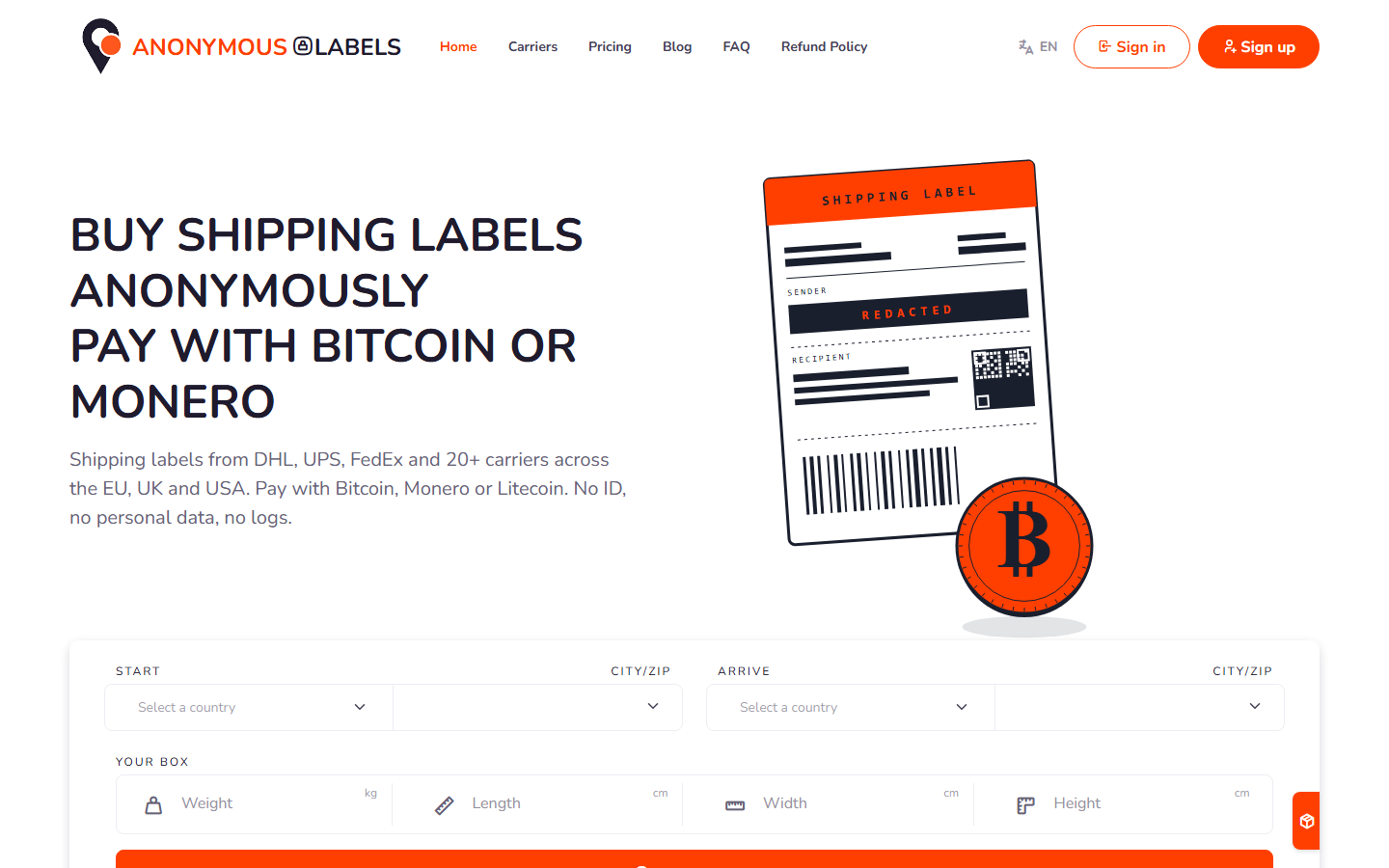
AnonymousLabels operates in the narrow but growing niche of anonymous logistics — a no-KYC shopping service that turns cryptocurrency into printable shipping labels for mainstream carriers. Founded around the principle that shipping a package should not require a bank account, government ID or permanent address, the platform aggregates live rates from over 20 couriers including DHL, UPS, FedEx, USPS, DPD, Royal Mail, GLS, InPost and regional operators across the EU, UK and USA. Users fund a euro-denominated balance with Bitcoin, Monero or Litecoin, then compare real-time quotes by weight, dimensions and route before generating a prepaid PDF label. The service is accessible both on the clearnet and via a Tor onion mirror, reinforcing its positioning for users who treat operational security as a baseline rather than an afterthought.
The business model is straightforward: top up once, spend incrementally, print at home or at a library, and drop off at any carrier location or locker. There are no subscription fees, no per-account charges and no markup surprises after checkout — the rate shown is the rate deducted. Starting prices sit around €4–€5 for basic domestic tiers, scaling with distance and parcel size. For high-volume shippers, custom pricing is available on request. In 2026, AnonymousLabels remains one of the few practical bridges between crypto-native privacy culture and the legacy postal infrastructure that still moves physical goods worldwide.
Privacy & KYC
AnonymousLabels sits at KYC Tier L1 — fully anonymous (pseudonymous) access. Registration demands only an email address and password. No government ID, no phone number, no proof of address and no banking credentials are collected. The operator explicitly states "no logs" as a design goal, though prospective users should note that IP addresses are logged on the clearnet portal. The availability of a Tor gateway mitigates this exposure for the paranoid, letting route origin and session metadata fall outside the platform's visibility.
- KYC requirement: None. Pseudonymous accounts only.
- Email required: Yes, for account recovery and support ticketing.
- IP logging: Active on clearnet; Tor users bypass this vector.
- Data retention: Claims no personal data storage beyond functional minimums.
The privacy score of 70/100 reflects solid policy architecture but also the reality that any service handling physical logistics must interact with carrier APIs that inherently see origin and destination postcodes. AnonymousLabels cannot blind courier backends to route data, so the anonymity it offers is front-end — shielding the shipper's identity from the platform and, by extension, from casual data brokers. For users shipping sensitive materials, combining Tor access with burner emails and locker drop-offs provides a defensible, if not absolute, privacy stack.
Supported assets & payments
AnonymousLabels accepts Bitcoin (BTC), Monero (XMR) and Litecoin (LTC) for balance top-ups. Notably, the platform does not support Lightning Network deposits despite mentioning "Lightning" in some early collateral — on-chain BTC and standard LTC transfers are the operational reality. Balances are denominated in euros, which insulates label pricing from post-deposit crypto volatility. At the moment of top-up, the user's coin is converted at a live exchange rate; thereafter, the EUR balance behaves like stable purchasing power.
This model carries a subtle trade-off. Crypto-purists may dislike the fiat-unit accounting, but it eliminates the frustration of watching a label price swing 5% between funding and purchase. Network fees apply only to the inbound transaction — there are no withdrawal or conversion charges beyond the miner fee the user already paid. Refunds, when approved, return to the AnonymousLabels balance rather than to the original wallet, preserving the euro-denominated accounting and simplifying compliance.
Security & custody
AnonymousLabels operates a custodial balance system. Funds sit on the platform until spent on labels; users do not hold private keys to their euro balances. This is functionally necessary for instant label generation — a non-custodial escrow per label would introduce unacceptable latency — but it does concentrate counterparty risk. The trust score of 50/100 signals that the operator has not undergone public audits, published proof-of-reserves or established a long enough track record to earn deep confidence. Users should treat balances as working capital, not savings: deposit only what you intend to ship within days or weeks.
Security hygiene on the user side is conventional. Password-based accounts with email recovery represent the weakest link; enabling strong unique credentials and compartmentalized email addresses is essential. There is no evidence of two-factor authentication, hardware-key support or multisig treasury architecture. The Tor mirror does add a layer of transport security for users who distrust clearnet TLS termination, but it does not change the custody model itself.
Who it's for — verdict
AnonymousLabels serves a specific persona: the privacy-conscious individual or small operation that needs to move physical goods across borders without embedding identity into the supply chain. Journalists shipping sensitive documents, vendors in grey-market niches, digital nomads without fixed addresses, and ordinary citizens evading surveillance capitalism all fit the profile. The service is less suited to casual ecommerce sellers who value chargeback protection and integrated accounting over anonymity, or to users who cannot tolerate any custodial risk.
The overall score of 6/10 is fair. AnonymousLabels delivers exactly what it promises — no-KYC shipping labels paid in crypto — but the modest trust score, IP logging on clearnet and custodial balances prevent a higher rating. For users willing to layer Tor, burner emails and locker drop-offs, it is a genuinely useful tool in the anonymity stack. For everyone else, it is a niche convenience with acceptable but not exceptional risk parameters. In 2026, as carrier APIs tighten and postal regulations shift, services like AnonymousLabels will either harden their privacy guarantees or face attrition; for now, it remains a functional, if cautious, recommendation.
Community summary
AnonymousLabels is a pseudonymous shipping-label marketplace that lets privacy-focused users purchase courier labels with Bitcoin, Monero or Litecoin and ship from EU lockers without submitting ID.
Pros
- + True no-KYC signup — only email and password required
- + Tor onion mirror available for metadata-sensitive users
- + 22+ carriers with live rate comparison and instant PDF generation
- + Euro-denominated balances shield label prices from crypto volatility
- + Competitive starting rates from €4 with no hidden subscription fees
Cons
- − Custodial balances concentrate counterparty risk
- − IP addresses logged on clearnet portal
- − No Lightning Network support despite early mentions
- − Trust score reflects unaudited, unproven-reserve operation
Attributes
4 signalsStrengths
No KYC mention
P+15
Accepts Monero
P+5
Has Onion or I2P URLs
P+5
Cautions
Community contributed
Related
4 services


User reports
★ 5/5 · 1 ratings
Swapuz ✅ (Support at Swapuz)
5/5
AnonymousLabels is ghost-grade shipping flow — buy labels, ship from EU lockers, no KYC, no friction. Surface web or onion, sovereign logistics for burner ops and stealth commerce. 📦🕶️