 eigenwallet
Exchange · DEX
eigenwallet
Exchange · DEX

Atomic Monero
Communityatomicmonero.com
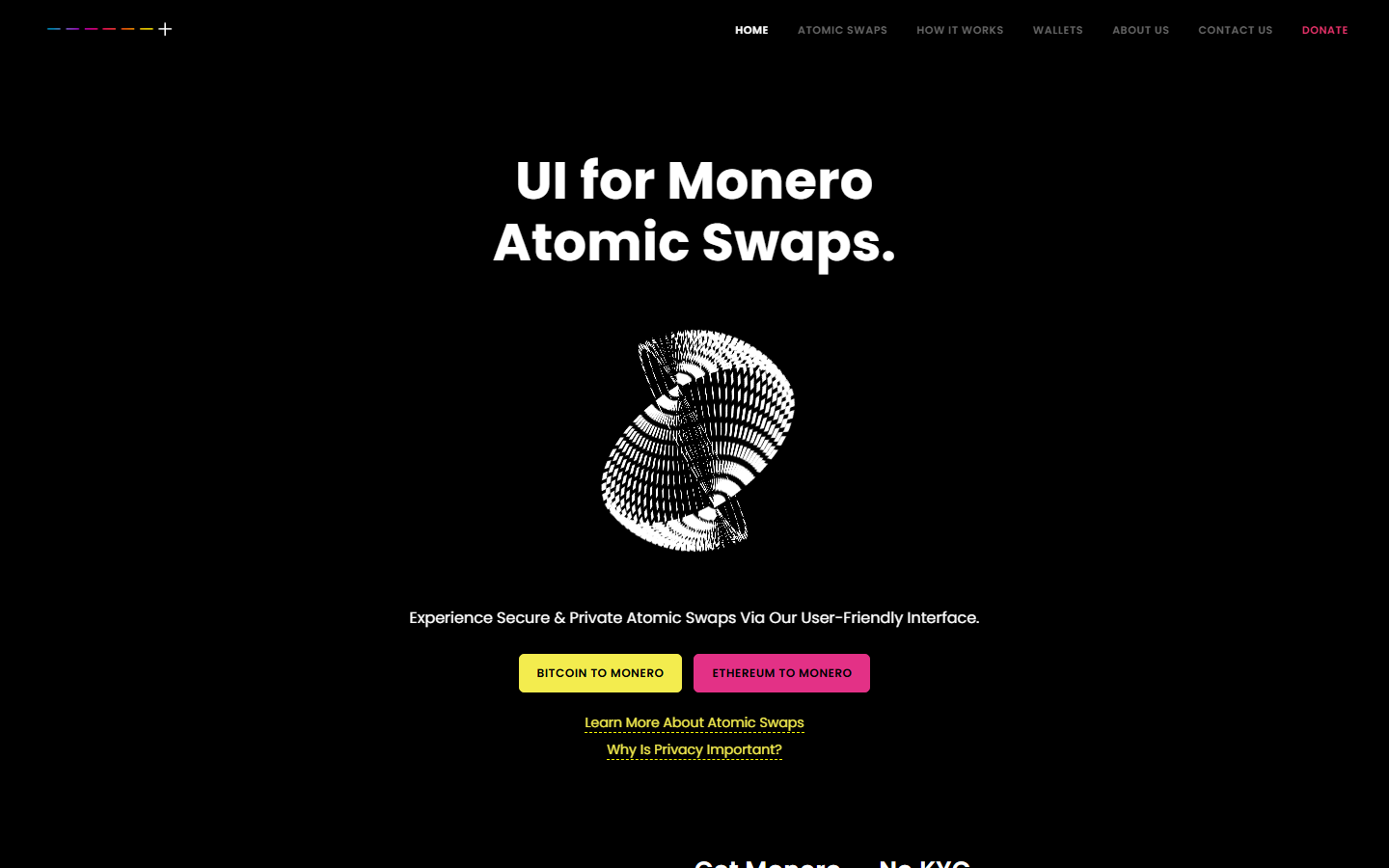
Experience Secure & Private Atomic Swaps Via Our User-Friendly Interface.
Live preview
atomicmonero.com
▶
https://www.atomicmonero.com
Review
EditorialOverview
Atomic Monero is a privacy-focused exchange service built around a single compelling idea: making cross-chain atomic swaps accessible through a clean web interface rather than intimidating command-line tools. Launched as a wrapper around the open-source COMIT protocol developed in collaboration with the Monero team, the platform targets users who want to convert Bitcoin into Monero—or vice versa—without surrendering personal data to a centralized exchange. The service runs individual instances of the atomic swap client on its own servers, abstracting away the technical complexity while theoretically preserving the zero-trust guarantees of the underlying protocol.
The concept is genuinely innovative. Where most no-KYC exchanges operate as custodial intermediaries or require some form of communication with traders, atomic swaps execute entirely on-chain through cryptographic lock contracts. Either both parties complete the exchange, or the protocol refunds everyone automatically. Atomic Monero's contribution is primarily UX-layer: QR-code scanning, simple address input, and automatic provider matching. For privacy advocates who find Bisq too cumbersome or centralized exchanges too surveillance-heavy, this middle ground holds obvious appeal.
Privacy & KYC
Atomic Monero sits at the most permissive end of the KYC spectrum. No email, no username, no identity documents—users connect wallets and execute swaps without creating any persistent account. The service scores well on privacy fundamentals: swaps occur directly between blockchains, leaving no centralized ledger of transactions, and the company claims its atomic swap servers restart every 24 hours to wipe residual data. The protocol itself is designed so that even Atomic Monero's operators cannot intercept funds or trace swap histories.
- KYC tier: L0 — Trustless. Absolutely no verification required.
- Email requirement: None.
- IP logging: Status unclear from public disclosures; server-side processing necessarily involves transient IP visibility.
- Privacy score caveat: The 70/100 rating reflects strong protocol design but deducts points for opacity around server jurisdiction, operator identity, and whether any analytics or logging persists beyond the advertised 24-hour wipe cycle.
Users seeking maximum anonymity should layer Tor or VPN protection, as the web interface requires connecting to Atomic Monero's infrastructure. The protocol is sound; the implementation trust assumptions are less auditable than the CLI alternative.
Supported assets & payments
The asset selection is deliberately narrow: Bitcoin (BTC) and Monero (XMR) only. The homepage references Ethereum-to-Monero swaps in passing, but the live interface and protocol implementation focus squarely on the Bitcoin-Monero pair. This limitation is arguably a feature rather than a bug—narrow scope reduces attack surface and simplifies liquidity matching. However, users looking to swap stablecoins, altcoins, or any asset beyond these two privacy-relevant base layers will need to look elsewhere.
Payment mechanics are straightforward. Users send Bitcoin from any wallet to a swap address (via QR code for mobile convenience), and Monero arrives at their specified XMR address upon protocol completion. No fiat on-ramps exist. No wrapped tokens, no liquidity pools, no yield mechanics. The service is a pure conversion utility.
Security & custody
Atomic Monero's custody model is technically non-custodial during the swap itself—funds never sit in a company-controlled wallet. The protocol's hashed time-locked contracts (HTLCs) enforce that either the trade executes atomically or both parties receive automatic refunds. This eliminates the exit-risk endemic to centralized exchanges.
Yet the trust score of 35/100 signals serious reservations. The platform operates as an opaque service rather than an open-source project with visible contributors. Users must trust that the web interface actually runs unmodified COMIT code, that servers are indeed wiped daily, and that the anonymous operators will not simply vanish during a failed swap. Community reports compound this unease: multiple users describe swaps stuck for 24-48 hours with unresponsive support, suggesting either thin operational staffing or infrastructure brittleness when automatic resolution fails.
The "zero risk" marketing is accurate for protocol-level failures but potentially misleading for operational failures—refunds require the server to remain online and functional. A disappeared operator means a manual recovery process that most users lack the technical skill to execute.
Who it's for — verdict
Atomic Monero occupies a niche for technically literate privacy enthusiasts who value Monero acquisition without KYC exposure and find CLI atomic swaps prohibitively complex. The web interface genuinely lowers barriers, and the L0 KYC tier is increasingly rare in 2026's regulatory climate. For small-to-medium swaps where protocol-level security matters more than institutional backing, it functions as intended.
However, the abysmal trust score and scattered reports of failed swaps with ghosted support make it unsuitable for significant sums or users needing reliability guarantees. The service sits in an awkward middle ground: more convenient than running COMIT directly, yet less trustworthy than established decentralized alternatives with visible development communities. Treat it as an experimental tool rather than a primary exchange—test with amounts you can afford to troubleshoot manually, and verify refund transactions on-chain before considering larger trades.
Community summary
Atomic Monero provides a web-based frontend for trustless Bitcoin-to-Monero atomic swaps with zero registration, though its operational transparency and support responsiveness remain significant concerns.
Pros
- + True L0 no-KYC: no account, email, or identity required
- + Non-custodial atomic swap protocol eliminates counterparty risk
- + Clean web interface removes CLI complexity for beginners
- + Direct blockchain settlement leaves no centralized transaction record
- + Bitcoin-to-Monero focus serves core privacy use case efficiently
Cons
- − Extremely low trust score (35/100) due to opaque operators
- − Reports of stuck swaps and unresponsive customer support
- − Narrow asset selection: BTC and XMR only
- − Requires trusting that web interface runs unmodified protocol code
- − No visible team, audit reports, or open-source frontend verification
Attributes
4 signalsStrengths
Guaranteed no KYC
P+25
Accepts Monero
P+5
Red flags
Potential risk
P-10 T-15
Cautions
Community contributed
Related
4 services
eigenwallet
Exchange · DEX
 Bisq
Exchange · P2P
Bisq
Exchange · P2P
 BasicSwap
Exchange · P2P
BasicSwap
Exchange · P2P
 RoboSats
Exchange · P2P
RoboSats
Exchange · P2P
User reports
★ 2.8/5 · 3 ratings
balding_flagship_7700
1/5
Waiting for 24hours my funds... Still nothing! Tried contact, nobody answer.
undue_firm_4903
1/5
Atomic Monero has not transferred funds for more than two days and has not responded to messages.
Swapuz ✅ (Support at Swapuz)
5/5
Atomic Monero is like a handshake between chains — no witnesses. Atomic swaps, no KYC, no noise, no compromise. Clean interface, max privacy. Pure OG vibes
Trêvoid ✅ (Owner at Trêvoid's Crypto Swaps)
Is this service free from KYC (Know Your Customer) and AML (Anti-Money Laundering) requirements? I cannot find information about whether these compliance checks are required