 eigenwallet
Exchange · DEX
eigenwallet
Exchange · DEX
BasicSwap
Verifiedbasicswapdex.com
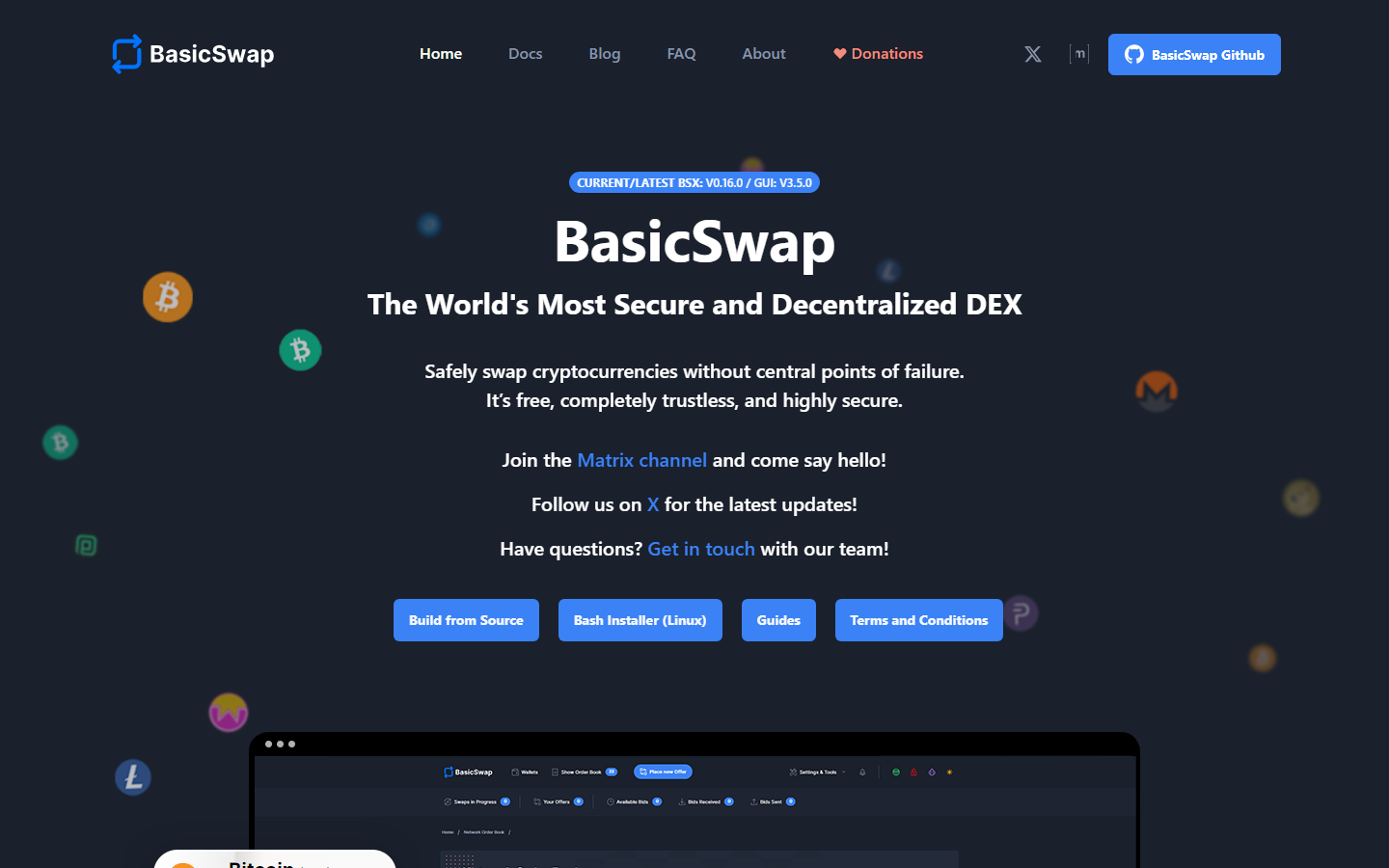
Cross-chain trading exchange (DEX) peer-to-peer trading of cryptocurrencies like Bitcoin and Monero. It uses Particl's network, atomic swaps, and scriptless scripts for transactions without third-party involvement.
Live preview
basicswapdex.com
▶
https://basicswapdex.com
Review
EditorialOverview
BasicSwap positions itself as the most radically decentralized exchange available to privacy-focused traders in 2026. Built atop the Particl network, the platform strips away every conventional intermediary: no company holds funds, no smart contract governs deposits, and no account system captures user data. Traders interact through a distributed order book, negotiating cross-chain swaps directly with counterparties using atomic-swap technology and scriptless scripts. The current release stack runs BSX v0.16.0 with GUI v3.5.0, reflecting steady iteration since launch.
The trade-off for this sovereignty is unmistakable. Installation demands technical literacy—users build from source, run a Bash installer on Linux, or use a Windows .EXE that the project itself cautions is less recommended. Blockchain synchronization is mandatory before any order can be placed or taken. For those willing to climb the learning curve, BasicSwap offers something increasingly rare: a trading environment where custody, pricing, and settlement remain entirely in user hands.
Privacy & KYC
BasicSwap operates at KYC Tier L0, the highest privacy classification. No email, no phone number, no identity document—no account of any kind—is requested or accepted. The exchange never touches user funds, so there is no deposit address linked to a registered identity and no withdrawal whitelist tied to personal data.
- Network-layer protection: Tor integration and SMSG (secure message) network relaying obscure IP addresses and communication metadata.
- On-chain privacy: Adaptor signature atomic swaps leave no permanent blockchain footprint connecting the two sides of a trade, reducing forensic traceability compared to conventional DEX transactions.
- No IP logging policy: The architecture inherently resists logging because there is no central server infrastructure to record sessions.
This design earns BasicSwap a privacy score of 99/100—among the highest of any operational exchange. The only theoretical deductions stem from user-side operational security: if a trader leaks their own IP outside Tor or reuses addresses across chains, the protocol cannot compensate.
Supported assets & payments
BasicSwap specializes in base-layer cryptocurrencies with strong privacy or decentralization credentials. The live order book and recent activity confirm active trading in Bitcoin (BTC), Monero (XMR), Litecoin with MimbleWimble extension blocks (LTC MWEB), Bitcoin Cash (BCH), Dash, Decred (DCR), PIVX, Firo, Dogecoin (DOGE), Particl (PART), and Wownero. This selection deliberately excludes ERC-20 tokens and wrapped assets, keeping swaps native and eliminating bridge risk.
Pricing is purely peer-determined. Makers set their desired rate; takers accept or negotiate. There are no platform trading fees whatsoever—users pay only the respective blockchain network fees for the two chains involved in the swap. Community feedback consistently flags this as the cheapest route for BTC↔XMR conversion, even when accounting for the liquidity premium sometimes embedded in maker prices. Liquidity, however, remains thin compared to centralized alternatives; large orders may sit unfilled or require patience.
Security & custody
BasicSwap is fundamentally non-custodial. Private keys reside exclusively on the user's local machine, embedded within the integrated wallets that synchronize with each blockchain. No smart contract escrows funds, no multi-sig federation holds deposits, and no arbitration mechanism can seize or redirect a swap. Atomic-swap hash time-locked contracts (HTLCs) enforce trade execution: either both parties receive their coins within the timelock window, or the trade aborts and original funds return to each sender.
This architecture eliminates exchange hacks as a risk category—there is no hot wallet to drain. The trust score of 91/100 reflects the robustness of the cryptographic guarantees and the transparency of open-source code. Deductions likely owe to the operational burden on users: lost keys mean unrecoverable funds, and a misconfigured local environment could expose wallets to local malware. The project provides no insurance, no support ticket resolution for failed swaps, and no recourse against a counterparty who ghosts after contract initiation (though the HTLC design makes such abandonment financially neutral, not exploitative).
Who it's for — verdict
BasicSwap is not a mass-market product, and it does not pretend to be. It serves advanced users, cypherpunks, and sovereignty-maximizers who prioritize permissionlessness over convenience. If your threat model includes exchange surveillance, asset freezes, or KYC data breaches, BasicSwap is among the strongest defensive tools available in 2026. The combination of zero registration, Tor-routed messaging, adaptor-signature privacy, and native-chain settlement creates a trading experience that centralized competitors cannot replicate without compromising their business models.
For casual traders or those needing immediate deep liquidity, the friction is real. Installation time, sync delays, and sparse order books will frustrate users accustomed to one-click swapping on custodial platforms. Alternatives like Haveno Reto offer gentler onboarding with comparable privacy, though often with weaker decentralization guarantees. We award BasicSwap 10/10 overall for unwavering commitment to its design philosophy, with the explicit caveat that this score reflects ideological purity and technical integrity rather than universal accessibility. Choose BasicSwap if you would rather trade slowly and privately than quickly and transparently.
Community summary
BasicSwap is a fully non-custodial, account-free DEX enabling direct peer-to-peer atomic swaps between Bitcoin, Monero, and other assets—no registration, no intermediaries, and no trading fees beyond blockchain costs.
Pros
- + True L0 KYC — no account, email, or identity data required
- + Zero trading fees; only native blockchain network costs apply
- + Non-custodial architecture eliminates exchange hack risk
- + Tor and SMSG messaging protect network-level privacy
- + Adaptor signature atomic swaps minimize on-chain traceability
- + Open-source codebase permits independent audit and coin integration
Cons
- − Steep technical setup — build from source or run Linux installer required
- − Thin liquidity limits speed and size of trades
- − Windows .EXE installer exists but is officially discouraged
- − No customer support or arbitration for user errors
- − Onion mirror reliability has been reported as inconsistent
Attributes
12 signalsStrengths
Guaranteed no KYC
P+25
Strict no-log policy
P+5 T+3
Accepts Monero
P+5
No registration needed
P+5
Atomic Swaps
P+3 T+8
Non-custodial wallet
P+3 T+5
Peer to peer network
P+2 T+5
Verified
T+10
Open source code
T+7
Peer to peer market
T+4
Informational
No JavaScript needed
P+1
Currently in beta
T-1
Related
4 services
eigenwallet
Exchange · DEX
 Bisq
Exchange · P2P
Bisq
Exchange · P2P
 RoboSats
Exchange · P2P
RoboSats
Exchange · P2P
 AnChat
P2P
AnChat
P2P
User reports
★ 4.6/5 · 10 ratings
afraid_repayment_511
The platform is improving steadily. Very nice.
ready_legitimation_5925
5/5
This is currently the cheapest way to swap BTC to XMR and vice versa, while still being one of the most secure options. However, installation is still difficult (although it’s getting easier as development progresses) and the UX is a bit complicated. Liquidity is still small, but growing.
aspiring_trickster_757
3/5
good platform overall, no aml flags
upright_ability_5173
5/5
swap has been executed fastly without any problem. Also a good point is low fees. 1k$+ transaction.
skinny_metronome_5501
5/5
good swap overall, but low liquiduty.
nutritious_juggler_6586
5/5
I see here BasicSwapDEX(Particl) and BlockDX(Blocknet decentralized-exchnages as very competitors and amazing projects. - both have atomic swaps - both have highly open and decentralized concept - both have nice design - BSDEX has XMR but Blocknet has more coins also privacy coin ie PIVX... - From my point Blocknet has DexInstaller which could be used to turn whole Debian/Ubuntu machine from scratch system into node operator environment used to provide liquidity by generated highly customizable working trading pair strategies and managed very easy by Screen terminal multiplexer defined interface or VNC over SSH. - Blocknet has advanced trading API. - BSDEX has chain prune support but Blocknet has XLite wallet working on top of decentralized Blocknet system, so basic users could use it as well( all in public development) - Hopefully Particl DEX will list $BLOCK coin as well as Blocknet DEX listed $PART - cooperation is crucial. - Anyone from BasicSwapDEX team here to initiate cooperation/alliance between BasicSwapDEX and BlockDX?
heated_angel_1758
onion mirror has not been working for a long time
fringed_strut_7919
if u have an installer for windows which is not recomended u shouldnt offer but improve them.
intoxicating_samovar_4245
5/5
Very sovereign, pure atomic swap with 0 middlemen, no arbitrators or anything. Tho it's very hard for non techy users, things need to done in this sense for liquidity to improve. It's not a fiat on ramp, just atomic swaps.
purplish_gland_3671
2/5
Commits the fatal sin of making you go through a github page if you want to use it, thus annihilating any chance of true adoption. Remember: anything other than a simple "install" or "start trading" button on the front page will make you lose 90% of people. When you go to their site you're greeted with 5 choices: "Github", "Build from source", "Bash Install (Linux)", "Guides" and "Terms and Conditions". Scrap all that shit and put a simple "Download and start trading" button.
foreign-policy_laugh_4116
2/5
Top rated but ultimately it's a not easy to setup and when I finally did there was no trades so I just wasted time, I gave up and used Haveno Reto which deserves this spot, sorry :/ Kudos for the nice design though it does looks great, the guy who got paid from the CCS to make it / owns it scams and plays dirty with other developers though, so for that reason I give 2 stars this time.... Kewbit posted a bunch of proof, I find it hard to argue against his points too.
land-based_quadrant_6418
5/5
A bit hard to setup for non techy users. But it's the best product pure atomic swap. Zero intermediaries zero arbitration zero permission. Need more liquidity and more awareness for this amazing product !
4rkal ✅ (Owner at CypherGoat)
5/5
Very good exchange, although quite hard to setup. Perfect for advanced users