 eigenwallet
Exchange · DEX
eigenwallet
Exchange · DEX

Bitania
Communitybitania.com
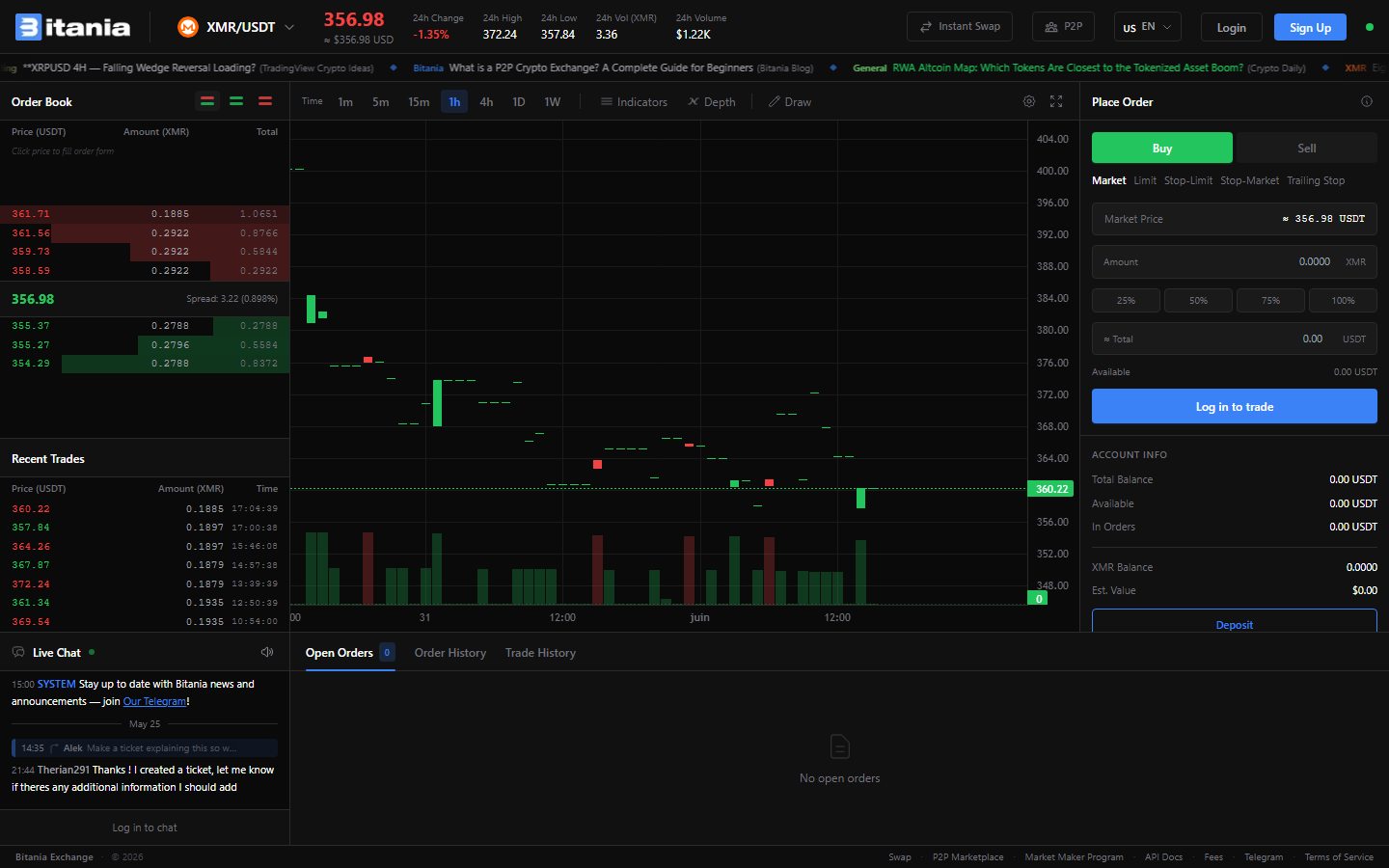
Anonymous No-KYC crypto exchange. A privacy-focused platform for buying and selling Litecoin, Monero, Bitcoin, USDT to any Fiat methods.
Live preview
bitania.com
▶
https://bitania.com
Review
EditorialOverview
Bitania positions itself as a rare breed in the 2026 crypto landscape: a genuinely trustless exchange that demands nothing from users beyond an email address. The platform facilitates direct peer-to-peer swaps between privacy-centric digital assets and fiat cash methods, eliminating the surveillance apparatus that defines mainstream centralized exchanges. With an overall score of 8/10 and a flawless privacy rating, Bitania caters to users who prioritize anonymity over convenience, though its modest trust score of 61/100 signals room for improvement in transparency or operational history.
The service strips away virtually every friction point associated with traditional onboarding. There are no identity checks, no proof-of-address demands, and no multi-day verification queues. Users arrive, specify their swap parameters, provide a receiving address, and execute trades through a streamlined interface that reflects the platform's minimalist philosophy.
Privacy & KYC
Bitania achieves a perfect 100/100 privacy score through its L0 KYC tier — the most permissive classification possible. This trustless model means no account creation is required whatsoever, placing Bitania among the vanishingly small cohort of exchanges that operate without any user registration system. The platform collects only an email address, presumably for transaction notifications or dispute resolution, and does not appear to log IP addresses based on available data.
- Zero identity verification: No government ID, selfie, or proof of residence at any volume threshold
- Minimal data collection: Email address only; no persistent account database to breach or subpoena
- No IP logging: Reduces correlation risks for users accessing through VPN or Tor
- Peer-to-peer architecture: Trades execute directly between counterparties rather than through a centralized order book
This architecture renders Bitania functionally invisible to chain-analysis firms and regulatory data-gathering frameworks that depend on exchange cooperation. For journalists, activists, or ordinary citizens in jurisdictions with hostile crypto policies, this represents a genuine sanctuary.
Supported assets & payments
Bitania's asset selection deliberately emphasizes privacy-preserving and widely-recognized cryptocurrencies. The platform accepts Monero (XMR), Bitcoin (BTC), and Cash as core trading instruments. This curated approach prioritizes depth of anonymity over breadth of altcoin speculation — Monero's ring signatures and stealth addresses provide transactional privacy that Bitcoin's transparent ledger cannot match, while cash settlement eliminates bank trail entirely.
The fiat integration through cash methods distinguishes Bitania from automated swap services that require electronic payment rails. Users can theoretically complete end-to-end cycles: cash in, privacy coin out, with no financial institution acting as intermediary or witness. However, the limited coin roster drew consistent community feedback requesting expansion. Users specifically noted satisfaction with execution speed and fee competitiveness, while expressing desire for additional cryptocurrency options beyond the current trio.
Security & custody
Bitania's non-custodial design fundamentally reshapes the security equation. The platform never takes possession of user funds, eliminating the honeypot risk that has plagued centralized exchanges from Mt. Gox to contemporary hacks. Swaps execute through atomic or escrow mechanisms where control remains with participants until settlement completes.
This model shifts responsibility squarely to users. There is no password recovery team, no insurance fund, and no customer support representative who can reverse a fat-fingered address entry. The trust score of 61/100 suggests users should exercise heightened diligence: verify addresses meticulously, start with smaller test transactions, and maintain independent backups of trade records. The peer-to-peer nature introduces counterparty risk that automated instant exchanges avoid, though escrow protections presumably mitigate this.
Who it's for — verdict
Bitania serves a specific but growing demographic: privacy absolutists, unbanked individuals, and anyone operating under financial surveillance they consider illegitimate. The platform excels where mainstream exchanges fail — enabling immediate, undocumented access to censorship-resistant money. Its peer-to-peer structure and cash compatibility make it particularly valuable in regions with restricted banking access or capital controls.
The tradeoffs are explicit. Users sacrifice the regulatory protections, coin variety, and polished interfaces of centralized alternatives. The 61/100 trust score warrants caution; treat Bitania as a specialized tool rather than a primary trading venue. For those who genuinely require anonymity, however, few 2026 competitors match this combination of zero-KYC policy, non-custodial architecture, and Monero integration. Bitania earns its place in the no-KYC ecosystem as a functional, if deliberately limited, privacy gateway.
Community summary
Bitania operates as a fully trustless, no-account exchange where users can swap Monero, Bitcoin and Cash without submitting any identity documents or even creating a login.
Pros
- + True trustless operation with no account required
- + Perfect 100/100 privacy score with minimal data collection
- + Supports Monero for maximum transactional anonymity
- + Cash payment compatibility eliminates bank surveillance
- + Non-custodial model removes exchange hack risk
- + Low fees with instant swap execution per user reports
Cons
- − Limited to three supported assets (Monero, Bitcoin, Cash)
- − 61/100 trust score indicates transparency or track record concerns
- − No account system means no recovery options for user errors
- − Peer-to-peer trades carry counterparty risk absent from automated swaps
Attributes
16 signalsStrengths
Guaranteed no KYC
P+25
Identity-Free registration
P+10
Refunds do not require KYC
P+5 T+5
Accepts Monero
P+5
No registration needed
P+5
Peer to peer network
P+2 T+5
Escrow available
T+6
Peer to peer market
T+4
Red flags
Service Termination Policy
T-4
Cautions
May suspend your account
T-4
Unclear refund policy
T-4
Community contributed
Informational
Legally registered
T+2
Basic Customer Support
T+1
Some countries are restricted
Account required
P-1
Related
4 services
eigenwallet
Exchange · DEX
 Bisq
Exchange · P2P
Bisq
Exchange · P2P
 BasicSwap
Exchange · P2P
BasicSwap
Exchange · P2P
 RoboSats
Exchange · P2P
RoboSats
Exchange · P2P
User reports
★ 5/5 · 1 ratings
haggard_ligament_1311
5/5
I've used Bitania a few times now for swaps, swap was instant and fee is low as they claimed, they just need to have more coins option