 eigenwallet
Exchange · DEX
eigenwallet
Exchange · DEX

BitJeton
Communitybitjeton.io
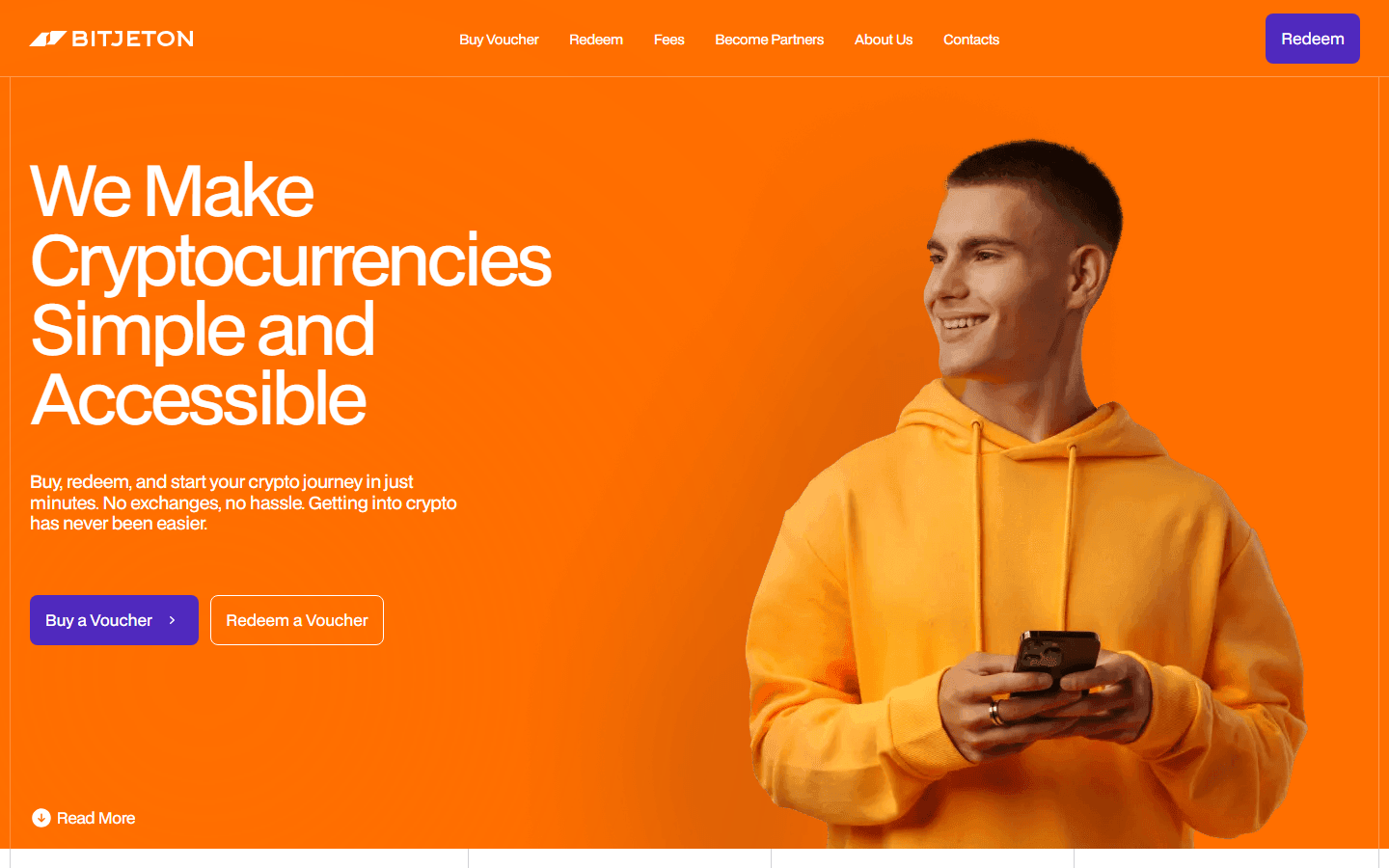
BitJeton vouchers work just like a traditional gift card or your favourite voucher. Instead of giving you store or game credit, It gives you cryptocurrencies. You can buy a BitJeton voucher from ecommerce stores and gaming marketplaces kyc-free such Eneba, G2A and many others. and redeem it for your favourite cryptocurrency without registering to our platform
Live preview
bitjeton.io
▶
https://bitjeton.io
Review
EditorialOverview
BitJeton operates as a crypto voucher aggregator and exchange that bridges traditional retail gift-card infrastructure with cryptocurrency acquisition. Rather than functioning as a conventional trading platform, it produces prepaid vouchers sold through established ecommerce marketplaces like Eneba and G2A, plus regional retailers that may accept cash in select locations. Users purchase a voucher code, then redeem it directly for cryptocurrency sent to a self-custody wallet—no exchange account required.
The model deliberately targets newcomers who find centralized exchanges intimidating or inaccessible. With voucher denominations starting around $10, BitJeton frames itself as a low-friction on-ramp. The redemption process is streamlined: enter the code, select from roughly twenty supported cryptocurrencies across multiple network options, provide a wallet address, and confirm. The company emphasizes speed, claiming most redemptions complete in under a minute.
Privacy & KYC
BitJeton advertises a no-signup redemption flow, which is accurate for routine transactions. However, the KYC posture is tiered and conditional, not unconditionally anonymous. According to its published FAQ, ID verification generally remains off the table for standard redemptions, but three specific triggers can escalate a user to full KYC:
- A distribution partner mandates verification for its own compliance obligations
- The transaction pattern exhibits unusually high or suspicious volume
- The voucher or wallet address appears in fraud reports or blacklisted databases
These exceptions are framed around European AML obligations, suggesting BitJeton maintains compliance infrastructure that can be activated retroactively. For privacy-conscious users, this means pseudonymity is the practical ceiling, not guaranteed anonymity. The platform does not clarify whether IP addresses are logged during redemption, though the no-account model reduces the data surface compared to email-and-password exchanges. Our privacy score of 42/100 reflects this conditional, trigger-dependent architecture rather than a hard no-KYC guarantee.
Supported assets & payments
The asset roster spans major Layer-1 blockchains, stablecoins, meme tokens, and niche categories including privacy coins and interoperability protocols. Verified offerings include Bitcoin, Ethereum, Solana, Avalanche, BNB, Cardano, XRP, Dogecoin, Tron, Litecoin, TON, Polkadot, Chainlink, Shiba Inu, Pepe, Floki, and Trump meme token, among others. Many assets carry multiple network options—Ethereum-native USDC versus alternative routes, for example—giving users flexibility on fee optimization.
Payment methods for acquiring vouchers depend entirely on the retail partner. Online buyers typically use credit or debit cards through familiar voucher marketplaces. In select regions, cash purchases may be available through local merchants, though BitJeton does not publish a definitive geographic list. Redemption supports any valid wallet address for the chosen chain; there is no custodial wallet requirement.
Fees & limits
BitJeton discloses a two-component fee structure. The platform charges a flat 5% fee on the voucher face value. Separately, a network fee combines the underlying blockchain gas cost with exchange-execution spreads BitJeton incurs to source the asset. This network fee is fixed per transaction regardless of voucher size, though it fluctuates with market conditions. A sample $100 voucher after all fees typically delivers approximately $94-95 in coin value, though the exact figure varies by asset and chain congestion. Users should compare this all-in cost against no-KYC decentralized exchanges and P2P platforms, where spreads and gas may differ materially.
Security & custody
BitJeton employs a non-custodial redemption model that is structurally safer than leaving funds on an exchange. Because coins move directly to the user-provided wallet, BitJeton never holds customer balances beyond the instant of swap execution. This eliminates the catastrophic exchange-hack risk that plagues centralized custodians. The primary vulnerability shifts to voucher code security—lost or stolen codes function like cash, irreversible and unrecoverable. Users must treat voucher codes with the same physical security they would apply to paper currency. The platform itself does not offer multi-signature, insurance, or recovery mechanisms for compromised codes.
Who it's for — verdict
BitJeton suits two overlapping audiences: crypto-curious newcomers who want a gift-card experience without exchange onboarding, and privacy-seeking users who can tolerate conditional KYC risk in exchange for no-account convenience. It is less appropriate for high-volume traders, fee-sensitive arbitrageurs, or individuals requiring absolute anonymity guarantees. The 5/10 overall score reflects a service that executes its narrow use case competently but carries meaningful trade-offs in fee transparency, privacy robustness, and geographic availability. For 2026, BitJeton remains a viable if imperfect bridge between legacy retail payments and permissionless crypto access.
Community summary
BitJeton offers prepaid crypto vouchers you can buy from third-party retailers and redeem without creating an account, though AML triggers may force KYC under certain conditions.
Pros
- + No account registration required for standard redemptions
- + Non-custodial delivery to user-controlled wallets
- + Broad asset selection including major and niche tokens
- + Available through familiar ecommerce and gaming marketplaces
- + Low minimums around $10 make it accessible for beginners
Cons
- − Conditional KYC triggered by volume, partner rules, or risk flags
- − 5% platform fee plus variable network fees stack up quickly
- − No cash purchase clarity or universal geographic coverage
- − Voucher codes are bearer instruments with no theft recovery
Attributes
5 signalsStrengths
No registration needed
P+5
Peer to peer network
P+2 T+5
Aggregator provides guarantees
T+4
Cautions
Community contributed
Shotgun KYC
P-15
Related
4 services
eigenwallet
Exchange · DEX
 Bisq
Exchange · P2P
Bisq
Exchange · P2P
 BasicSwap
Exchange · P2P
BasicSwap
Exchange · P2P
 RoboSats
Exchange · P2P
RoboSats
Exchange · P2P