 NightTrader Exchange
Aggregator · Exchange
NightTrader Exchange
Aggregator · Exchange

bitrequest
Communitybitrequest.io
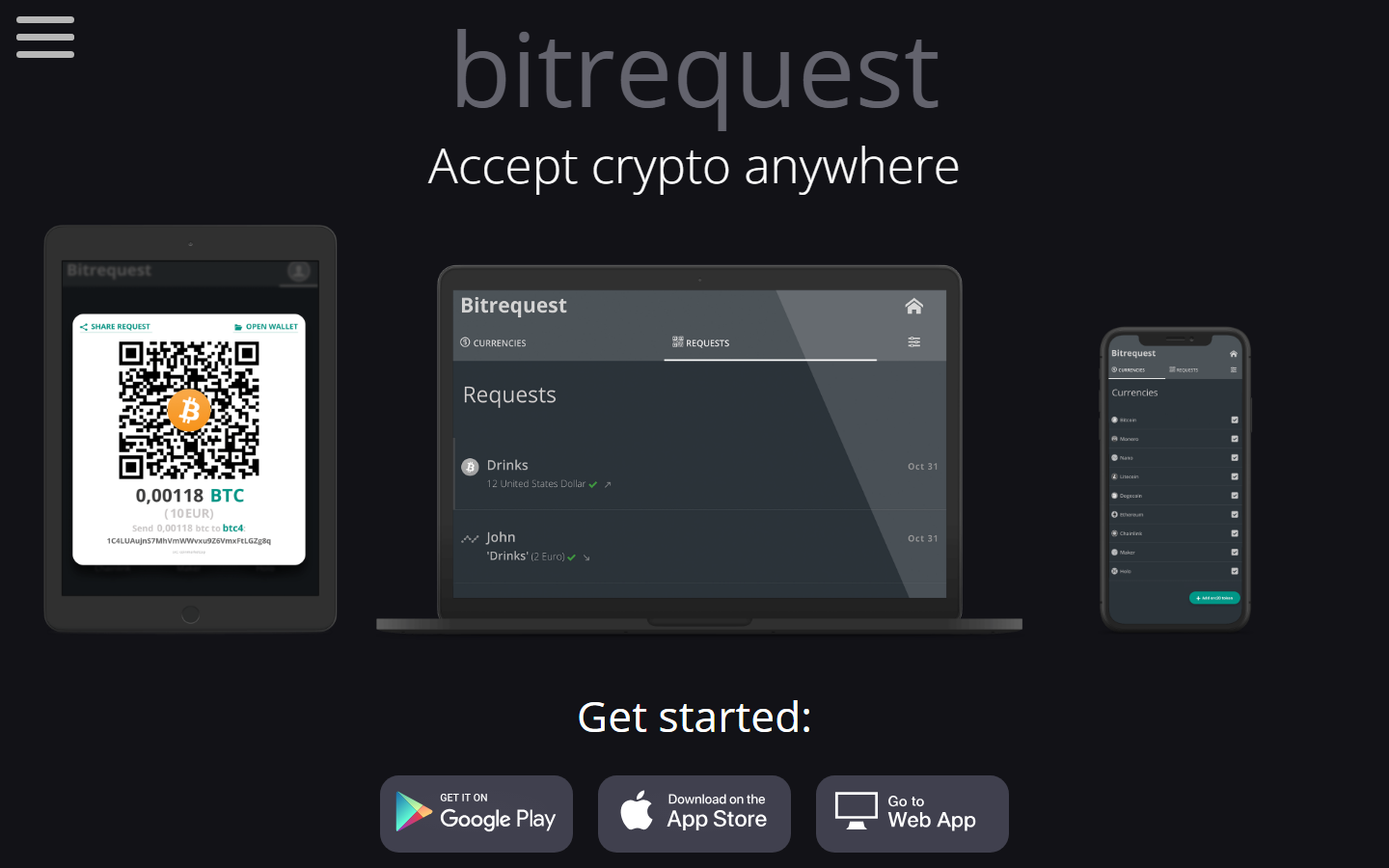
Accept crypto anywhere. Point of Sale / Send crypto payment requests to your friends!
Live preview
bitrequest.io
▶
https://www.bitrequest.io
Review
EditorialOverview
Bitrequest is a lightweight, privacy-centric payment infrastructure tool built for sovereign merchants, freelancers and everyday crypto users who want to accept digital assets without friction or surveillance. Functioning primarily as an aggregator rather than a traditional exchange or wallet, it stitches together point-of-sale functionality, invoicing and peer-to-peer payment requests into a single installable application. Users can generate payment links, QR codes or NFC-triggered requests denominated in over 170 fiat currencies while settlement occurs natively on-chain. The service operates entirely without user accounts—there is no email gate, no phone verification and no central database storing transaction histories. This architecture makes it one of the more genuinely anonymous options in the merchant crypto space, though its trust and privacy scores reflect the trade-offs inherent in relying on third-party block explorers and optional light wallet servers for certain coin integrations.
Privacy & KYC
Bitrequest sits squarely in KYC Tier L1 — Anonymous. Access is pseudonymous: no personal data is collected at onboarding, no identity documents are requested and the application functions offline after initial installation. This positions it as a rare no-KYC solution in an increasingly regulated payments landscape.
- Local-first data architecture: All sensitive material—cryptocurrency addresses, extended public keys, Monero view keys, Lightning node credentials, request histories and even BIP39 seed phrases—resides encrypted on the user's device using AES encryption. Nothing is synced to a central server.
- Optional network privacy: The app supports TOR routing for users seeking additional obfuscation of their IP address and transaction fetching patterns.
- Third-party leakage risks: By default, exchange rates are pulled from CoinMarketCap, CoinGecko, Fixer and similar public APIs, while blockchain data relies on BlockCypher, mempool.space, Blockchair and others. Users can eliminate much of this exposure by connecting personal Electrum, Ethereum RPC, Monero or Lightning nodes.
- Monero view key handling: For Point-of-Sale scanning, view keys remain local. For shared payment requests, they are sent to a configured Light Wallet Server—meaning users must trust that server or run their own for maximum confidentiality.
The privacy score of 65/100 likely reflects these optional but commonly used third-party dependencies rather than any fundamental custodial or KYC flaw.
Supported assets & payments
Bitrequest supports a deliberately curated mix of base-layer coins, privacy assets and scaling solutions. The current lineup includes Bitcoin (with full Lightning Network support via LND, LNbits, LNURL and Boltcard/NFC), Ethereum plus major L2 networks (Base, Arbitrum, Polygon, BSC) and ERC-20 tokens, Litecoin, Monero, Kaspa, Bitcoin Cash, Dogecoin, Dash (with InstantSend), Nano and Nimiq. This selection covers high-capacity retail use cases—Bitcoin and Lightning for mainstream adoption, Monero for privacy-preserving transactions, Nano for feeless settlement and Ethereum L2s for DeFi-adjacent commerce.
Payment flows are flexible. Merchants can lock request amounts to fiat values to shield customers from volatility during the payment window. Real-time notifications confirm settlement instantly at the point of sale. For e-commerce operators, the tool offers embeddable checkout integration. All requests generate shareable URLs, scannable QR codes or NFC handoffs, making it practical for everything from farmers market stalls to remote freelance invoicing.
Security & custody
Bitrequest is explicitly non-custodial. The application does not hold funds, cannot initiate spends and has no technical capacity to move user assets. It is purely a monitoring and request-generation layer. Private keys and seed phrases never leave the device unless the user voluntarily exports an encrypted backup to file or Google Drive.
Lightning integration reinforces this security model: Bitrequest only accepts read-only macaroons and invoice-only API keys, permitting invoice creation and status checks while rendering fund drainage impossible. Admin and cashier PIN modes allow tiered access for business environments. The codebase is open source under AGPL-3.0, enabling independent audit and self-hosting for the technically inclined.
However, the trust score of 50/100 suggests caution. The project lacks the institutional backing, bug bounty scale or longevity of more established payment processors. Users must verify builds themselves or trust the distribution channels (web install, App Store, Google Play). The reliance on user-managed node connections for optimal privacy and security also shifts operational burden squarely onto the individual merchant.
Who it's for — verdict
Bitrequest fills a specific niche: privacy-conscious merchants, unbanked entrepreneurs and peer-to-peer sellers who need to accept crypto without identity exposure, monthly SaaS fees or custodial risk. It is particularly compelling for Monero-accepting vendors, Lightning-native businesses and anyone operating in jurisdictions with heavy financial surveillance. The open-source, offline-capable design appeals to cypherpunks and sovereignty maximalists.
That said, the 6/10 overall score and modest trust rating indicate it is not yet a fire-and-forget solution for mainstream retail chains. The need for manual node configuration to achieve top-tier privacy, the absence of fiat off-ramps and the DIY backup model all presuppose a technically competent user base. For those willing to invest setup time, Bitrequest offers one of the cleaner anonymous payment flows available in 2026. For casual users expecting Stripe-like abstraction, the learning curve may prove steep. We classify it as a powerful specialist tool rather than a mass-market platform.
Community summary
Bitrequest is a non-custodial, open-source payment aggregator that lets merchants and individuals accept Bitcoin, Monero and Lightning payments without registration, KYC or surrendering custody of funds.
Pros
- + True no-KYC, no-account onboarding with pseudonymous access
- + Non-custodial architecture—funds remain entirely under user control
- + Broad Lightning and Monero support with NFC, Boltcard and view-key scanning
- + Open-source AGPL-3.0 codebase enabling self-hosting and audit
- + Offline functionality after install with optional TOR routing
Cons
- − Trust score reflects limited institutional validation or longevity
- − Optimal privacy requires self-hosted nodes, adding technical overhead
- − No native fiat off-ramp or stablecoin settlement layer
- − Shared Monero requests may leak view keys to third-party LWS by default
Attributes
3 signalsStrengths
No KYC mention
P+15
Accepts Monero
P+5
Cautions
Community contributed
Related
4 services
NightTrader Exchange
Aggregator · Exchange
 OpenMonero
Aggregator · Exchange
OpenMonero
Aggregator · Exchange
 AntiKYC
Aggregator
AntiKYC
Aggregator
 BIM Exchange
Aggregator · Exchange
BIM Exchange
Aggregator · Exchange
User reports
★ 5/5 · 1 ratings
Swapuz ✅ (Support at Swapuz)
5/5
bitrequest is crypto-native PoS and payment request flow — send invoices, accept BTC anywhere, frictionless. Built for sovereign merchants and peer-to-peer payers. 🧾⚡