 eigenwallet
Exchange · DEX
eigenwallet
Exchange · DEX

BitSwitch.io
Communitybitswitch.io
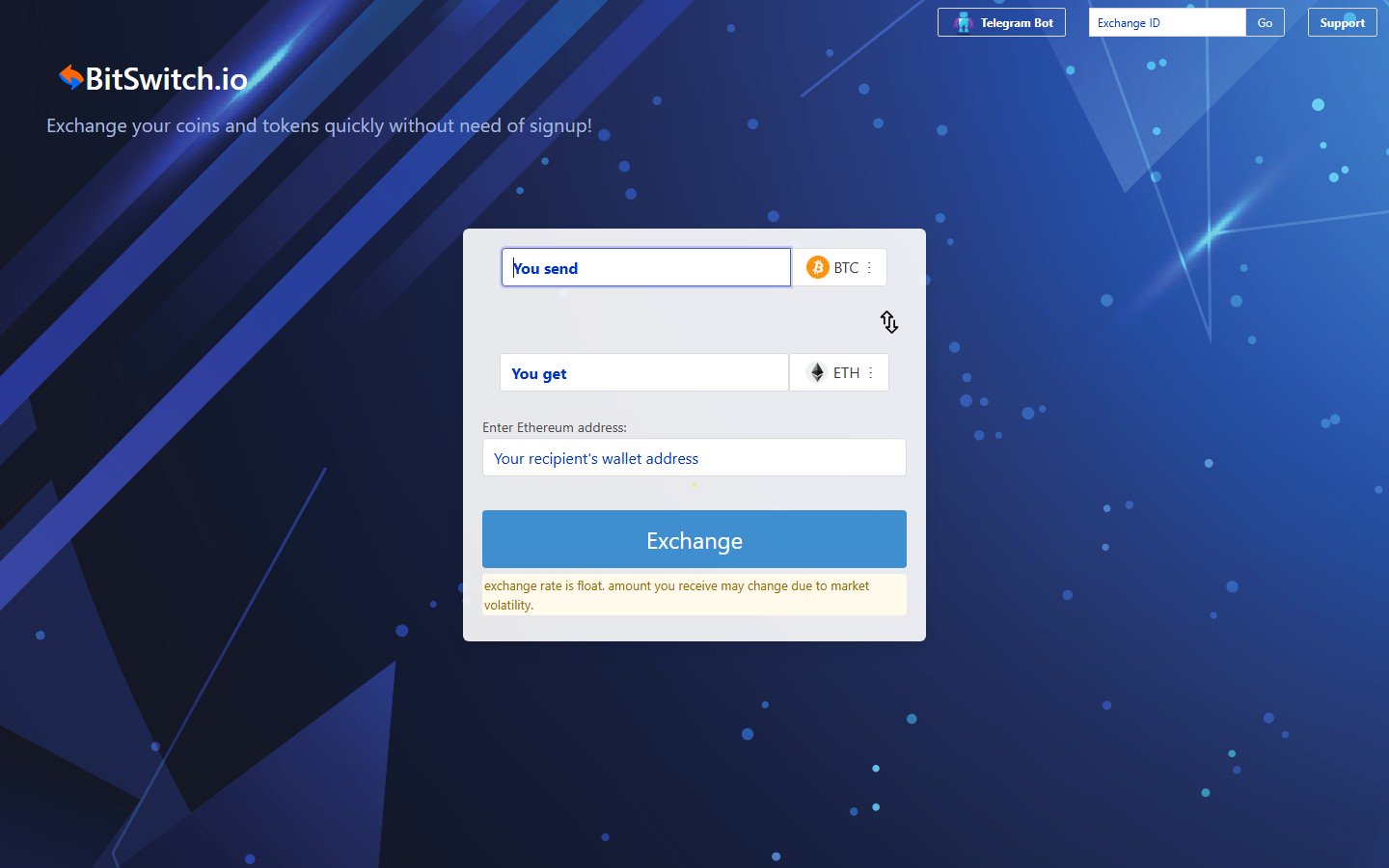
Exchange your coins and tokens quickly without need of signup from our telegram bot or website!
Live preview
bitswitch.io
▶
https://www.bitswitch.io
Review
EditorialOverview
BitSwitch.io operates as a no-signup crypto exchange accessible through both its website and a Telegram bot, positioning itself in the crowded field of instant swap services for privacy-minded users. The platform emphasizes speed and simplicity: visitors select their input and output coins, enter a receiving address, and execute the trade without ever registering an account. This frictionless approach appeals to traders who value discretion over the feature depth of larger centralized exchanges. However, BitSwitch.io earns only a 5 out of 10 overall score in our directory, reflecting significant gaps in transparency and trust infrastructure that competitors in the no-KYC space have addressed more thoroughly.
The exchange's terms date to October 2022, suggesting limited ongoing investment in public-facing documentation. While the service lists dozens of cryptocurrencies across multiple chains, the actual swap experience relies on floating rates rather than fixed quotes, meaning users bear full exposure to market volatility between initiation and settlement. This rate structure is common among instant exchangers but demands extra diligence from traders moving large amounts.
Privacy & KYC
BitSwitch.io employs a tiered KYC model officially designated as L3, where verification becomes mandatory only above certain transaction thresholds rather than at the first dollar. This places it in a middle ground: genuinely useful for small, occasional swaps, yet ultimately not a fully anonymous exchange for users with meaningful volume. The policy text visible in crawled pages begins with "AML/KYC is not mandatory to..." before truncating, implying an unfinished or deliberately vague disclosure that should concern privacy advocates.
- Privacy score: 54/100 — mediocre, dragged down by unclear logging practices and threshold-based identity collection.
- Trust score: 47/100 — below average, reflecting sparse operational transparency and aged legal documentation.
- Email requirement: Unconfirmed; the no-signup architecture suggests none for base swaps, but email may be requested for support or higher tiers.
- IP logging: Unconfirmed; the privacy policy referenced in terms is not fully crawled, leaving a critical gap in our assessment.
For users seeking genuinely anonymous crypto exchange options, these uncertainties around data collection represent a material risk. The platform's Telegram bot integration adds convenience but also introduces third-party metadata exposure that pure web interfaces avoid.
Supported assets & payments
BitSwitch.io supports an impressively broad roster of cryptocurrencies spanning major networks. Monero (XMR) and Bitcoin (BTC) headline the selection, reinforcing its appeal to privacy-focused traders, while Ethereum, Polkadot, TRON, Solana, Cardano, and numerous ERC-20, BEP-20, and TRC-20 tokens fill out the catalog. Notable inclusions encompass privacy-adjacent coins like Zcash and Verge alongside meme tokens such as SHIBA INU and PEPE, plus infrastructure plays like Filecoin, Internet Computer, and Near Protocol.
The multi-chain support is practical rather than deep: users can swap across disparate ecosystems without managing native wallets for each, though network-specific variants (AVAX vs. AVAX-C, INJ across three standards) require careful selection to avoid lost funds. No fiat on-ramp is evident, keeping BitSwitch.io firmly in the crypto-to-crypto exchange category. The floating-rate mechanism noted on the homepage means quoted amounts are estimates; slippage during volatile periods could substantially alter received values.
Security & custody
The custody model for BitSwitch.io remains unconfirmed in available data, a significant omission for any exchange review. Instant swap services typically operate non-custodially for the user — holding funds only during the brief settlement window — but without explicit policy disclosure or technical audits, this cannot be assumed. The absence of verifiable security practices, insurance mentions, or bug bounty programs contributes directly to the sub-50 trust score.
Users entrust the platform with temporary custody of their deposits during swaps, yet receive no transparency around key management, cold storage ratios, or incident response protocols. For a service pitching itself to privacy-conscious traders, this information asymmetry is a liability. The 2022-era terms permit immediate termination "for any reason whatsoever," language that offers zero procedural protection if funds become inaccessible.
Who it's for — verdict
BitSwitch.io suits casual traders needing quick, small-volume crypto swaps without account creation overhead, particularly those prioritizing Monero or Bitcoin accessibility across dozens of altcoin pairs. The Telegram bot integration will appeal to users already embedded in that ecosystem for price alerts and community coordination.
It is not recommended for: users requiring guaranteed anonymity at any transaction size; security-conscious holders seeking audited, transparent infrastructure; or anyone swapping amounts likely to trigger the undisclosed KYC threshold. The combination of floating rates, unclear logging, dated documentation, and below-average trust metrics makes BitSwitch.io a convenience tool rather than a reliable pillar of a privacy-first trading stack. Competitors with published audits, fixed-rate options, and fully non-KYC policies offer stronger protection for the genuinely paranoid.
Community summary
BitSwitch.io lets users swap cryptocurrencies without creating an account, though its tiered KYC policy and moderate privacy scores mean it falls short of fully anonymous trading.
Pros
- + No account registration required for basic swaps
- + Extensive multi-chain coin selection including XMR and BTC
- + Telegram bot integration for mobile convenience
- + Tiered KYC may preserve privacy for small transactions
Cons
- − Aged terms and incomplete policy disclosures
- − Floating exchange rates expose users to slippage
- − Below-average trust and privacy scores
- − Undisclosed KYC thresholds create uncertainty
- − No verifiable security audit or custody transparency
Attributes
8 signalsStrengths
Personal info is not verified
P+9
Accepts Monero
P+5
No registration needed
P+5
Cautions
May Freeze or Seize Funds
T-3
Community contributed
Shotgun KYC
P-15
Informational
API available
Telegram bot available
Related
4 services
eigenwallet
Exchange · DEX
 Bisq
Exchange · P2P
Bisq
Exchange · P2P
 BasicSwap
Exchange · P2P
BasicSwap
Exchange · P2P
 RoboSats
Exchange · P2P
RoboSats
Exchange · P2P