 eigenwallet
Exchange · DEX
eigenwallet
Exchange · DEX
BitValve P2P
Communitybitvalve.com
BitValve P2P Crypto Exchange offers a multi-crypto marketplace for P2P trading
Live preview
bitvalve.com
▶
https://www.bitvalve.com
Review
EditorialOverview
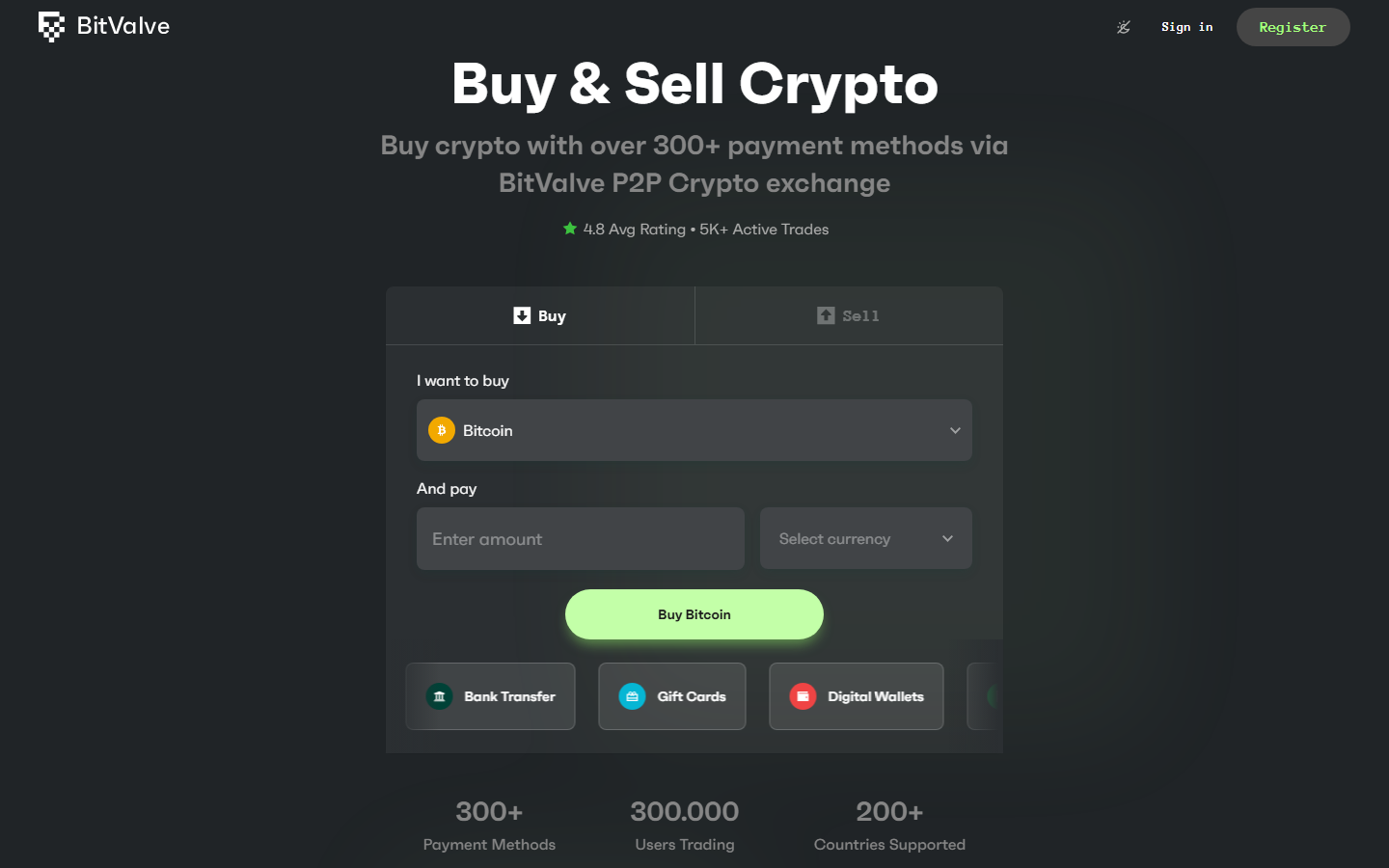
BitValve P2P presents itself as a peer-to-peer cryptocurrency exchange where buyers and sellers connect directly to trade Bitcoin and other digital assets. The platform supports fiat currency settlements and advertises cash-in-person transactions among its payment methods. At first glance, this structure suggests the flexibility and privacy that P2P marketplaces typically offer. However, the operational reality diverges sharply from that expectation. Every user must complete full identity verification before accessing any trading functionality, placing BitValve in direct opposition to the privacy-preserving ethos that draws users to P2P platforms in the first place. The exchange also maintains custodial control over funds during trades, further centralizing what should be a decentralized interaction.
Privacy & KYC
BitValve imposes L5 — Mandatory KYC, the most restrictive tier on our scale. This means every trader must submit government-issued identification, proof of residence, and undergo full identity verification regardless of trade size or frequency. There is no anonymous browsing tier, no elevated limits for unverified users, and no gradual verification ladder.
- Email address required for account creation
- IP address logging confirmed
- Full identity documents mandatory for all users
- No pseudonymous or reduced-KYC pathway available
For privacy-conscious individuals seeking to acquire Bitcoin without linking personal identity to wallet addresses, this policy renders BitValve functionally unusable. The platform collects and retains sensitive documentation that creates permanent linkage between real-world identity and on-chain activity. This data concentration presents an attractive target for breaches, subpoenas, or regulatory overreach.
Supported assets & payments
BitValve facilitates trading in Bitcoin as its primary cryptocurrency, with fiat currency support enabling direct national-currency settlements. The platform emphasizes cash as a payment option, theoretically allowing in-person exchanges without bank intermediaries. This cash capability would ordinarily appeal to users prioritizing financial privacy, yet the mandatory KYC framework neutralizes this advantage entirely. Gift card trading appears among the platform's advertised categories, expanding payment flexibility for verified users. The multi-crypto marketplace structure suggests additional digital assets beyond Bitcoin may be available, though traders should verify current listings directly. Payment method diversity exists in form but not in substance for anonymity seekers, since every payment rail ultimately connects to a fully identified account.
Security & custody
BitValve operates on a custodial model, meaning the exchange controls user funds during active trades rather than enabling direct wallet-to-wallet settlement between counterparties. This design introduces counterparty risk into transactions that P2P architecture should theoretically eliminate. The platform holds cryptocurrency in escrow while fiat settlements process, creating a trusted third party where none should exist. Custodial handling contradicts the self-sovereignty principles underlying Bitcoin's creation. Users cannot verify reserve backing or audit smart contract logic governing escrow releases. The trust score of 47/100 reflects substantial community and analytical reservations about platform reliability. While no specific security incidents appear in available data, the structural combination of mandatory identity collection and custodial fund management concentrates risk in ways that privacy-advocating users should scrutinize carefully.
Who it's for — verdict
BitValve P2P earns a 3/10 overall score and a privacy score of merely 12/100 on our directory. These ratings reflect fundamental misalignment with no-KYC and minimal-KYC objectives. The platform may suit traders who value P2P price discovery and cash payment options but have already accepted comprehensive identity verification as non-negotiable. Regulated exchange refugees seeking slightly more flexible payment methods might find utility here. However, individuals specifically searching for anonymous Bitcoin exchange, no-KYC P2P trading, or private cryptocurrency acquisition should exclude BitValve from consideration entirely. The mandatory L5 verification, custodial architecture, and IP logging create a surveillance profile comparable to centralized exchanges without delivering equivalent liquidity or regulatory clarity. For 2026, superior alternatives exist for every use case BitValve targets.
Community summary
BitValve P2P operates a multi-crypto peer-to-peer marketplace, but mandates complete identity verification for all users, disqualifying it from genuine no-KYC use.
Pros
- + Cash-in-person payment option available
- + P2P marketplace structure with flexible pricing
- + Fiat currency support for direct national-currency trades
- + Gift card trading category expands payment options
Cons
- − Mandatory full KYC for all users — no anonymous tier
- − Custodial fund control during trades
- − IP address logging confirmed
- − Low trust score (47/100) and privacy score (12/100)
- − Misleading P2P branding for privacy-seeking users
Attributes
13 signalsStrengths
Escrow available
T+6
Peer to peer market
T+4
Red flags
May require KYC/SOF by policy/law
P-6 T-4
Mandatory KYC
P-25
Cautions
Community contributed
Transaction monitoring
P-1
Custodial wallet
P-3 T-5
Seller wallet is custodial
P-3 T-3
Informational
Source code is private
T-1
Email required
JavaScript needed
Telegram bot available
Mobile app available
Related
4 services
eigenwallet
Exchange · DEX
 Bisq
Exchange · P2P
Bisq
Exchange · P2P
 BasicSwap
Exchange · P2P
BasicSwap
Exchange · P2P
 RoboSats
Exchange · P2P
RoboSats
Exchange · P2P