 SHOPINBIT
Shopping
SHOPINBIT
Shopping

bookit
Communityjoin.bookit.com
Membership based marketplace offering discount luxury retail goods, flights, resorts, hotels, cruises, wines, and experiences from 2M+ merchants. With our Payments infra partner Spree, we can accept over 3k+ cryptocurrencies as payment, so that you can bring utility to the memecoins in your bag. No KYC. Of note: The team purchased the URL from a previous group that has no relation to the present project.
Live preview
join.bookit.com
▶
https://join.bookit.com
Review
EditorialOverview
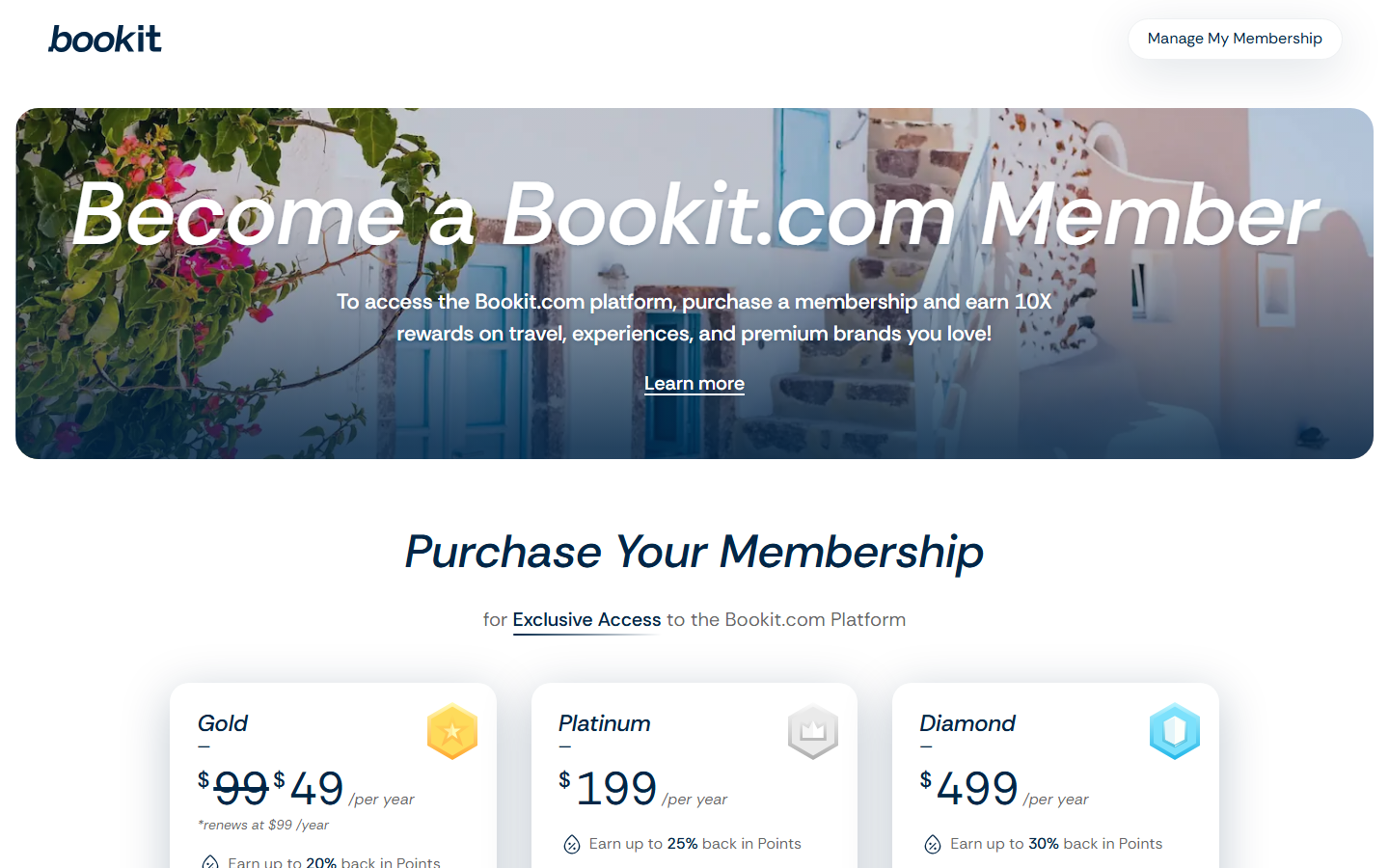
Bookit operates at join.bookit.com as a membership-driven platform promising access to discounted luxury retail, flights, resorts, hotels, cruises, wines, and curated experiences drawn from a network of over two million merchants. The service layers a crypto payment rail—via infrastructure partner Spree—atop traditional e-commerce, claiming support for more than three thousand digital assets including memecoins. Three membership tiers structure access: Gold at $49 introductory ($99 recurring annually), Platinum at $199 yearly, and Diamond at $499 yearly, with each step unlocking higher reward-point earnings and premium perks. All memberships are explicitly nonrefundable, and the platform requires full identity verification despite marketing that suggests otherwise.
Prospective members should note a significant lineage issue: the current team acquired the Bookit URL from an unrelated prior project. This domain handoff introduces ambiguity about operational continuity and brand trust that privacy-conscious shoppers must weigh carefully.
Privacy & KYC
Bookit's privacy positioning collapses under scrutiny. The platform enforces L5 — Mandatory KYC, demanding complete identity verification before any membership activation or transaction. This is the strictest tier in no-KYC circles and directly contradicts surface-level marketing that emphasizes crypto utility and minimal friction.
- Email required: A valid email address is mandatory for account creation.
- IP logging: The service logs user IP addresses, adding another surveillance vector.
- Privacy score: Bookit scores a dismal 31 out of 100 on our privacy index, reflecting aggressive data collection and weak anonymity guarantees.
- Trust score: At 51 out of 100, user confidence remains tepid—buoyed slightly by brand recognition but dragged down by verification demands and domain history concerns.
For shoppers specifically seeking anonymous crypto marketplaces or no-KYC travel booking, Bookit's mandatory documentation regime places it firmly outside the viable options list. The platform collects substantially more personal data than competitors that genuinely operate without identity checks.
Supported assets & payments
Bookit's payment architecture centers on Bitcoin as the confirmed accepted asset, routed through Spree's processing infrastructure. Marketing materials tout compatibility with over three thousand cryptocurrencies, suggesting broad memecoin and altcoin utility, though verifiable specifics beyond Bitcoin remain thin in crawled documentation. Members pay subscription fees in fiat—USD-denominated annual charges—then presumably settle individual purchases with crypto at point-of-sale. The "no signup" feature referenced in source data appears limited to browsing or ancillary functions, since actual membership purchase demands verified identity. Reward points earned on travel and merchandise purchases offset costs for active users, with earn rates scaling from 20% back on Gold through 30% back on Diamond tier.
Security & custody
Bookit functions as a custodial commerce platform rather than a self-custodial marketplace. Users do not control private keys for any crypto held or transacted; Spree and Bookit manage payment flows. This arrangement mirrors conventional fintech apps—convenient for mainstream shoppers but antithetical to cypherpunk principles of sovereign asset control. No evidence of multi-signature protections, open-source auditing, or cryptographic proof-of-reserves appears in available documentation. The 2026 copyright notice on official pages suggests active maintenance, yet transparency around security architecture remains minimal. Members trusting Bookit with transaction data and identity documents rely entirely on corporate security practices rather than verifiable technical safeguards.
Who it's for — verdict
Bookit targets affluent travelers and luxury shoppers who want to spend crypto without deep privacy requirements, not users who prioritize anonymity. The membership model rewards high-volume purchasers—those booking multiple vacations or merchandise orders annually—through escalating point-earning tiers. However, the mandatory KYC wall, IP logging, and poor privacy score make it unsuitable for the no-KYC audience this directory primarily serves.
Our 4 out of 10 overall score reflects this fundamental mismatch: Bookit borrows crypto-native language while implementing TradFi-level surveillance. If you seek genuinely anonymous travel booking or no-KYC luxury retail, alternatives with lighter verification burdens exist. Bookit only merits consideration if you value point rewards and merchant discounts above privacy, and if you accept full identity disclosure as a non-negotiable cost of platform access.
Community summary
Bookit markets itself as a membership-based marketplace for luxury travel and retail, accepting Bitcoin through a crypto payment partner, yet its mandatory full identity verification and poor privacy protections make it a weak choice for anonymity-seeking users.
Pros
- + Broad merchant network spanning travel, experiences, and luxury retail
- + Spree integration theoretically enables thousands of crypto assets beyond Bitcoin
- + Tiered membership rewards up to 30% back in points for heavy users
- + No browsing friction or signup required for initial platform exploration
Cons
- − Mandatory L5 full KYC contradicts no-KYC and anonymous crypto marketplace positioning
- − Extremely poor privacy score (31/100) with active IP logging
- − Nonrefundable annual membership fees create sunk-cost lock-in
- − Domain acquisition from unrelated prior project raises trust questions
- − Weak transparency on custody practices and security architecture
Attributes
8 signalsStrengths
Refunds do not require KYC
P+5 T+5
No registration needed
P+5
Red flags
Mandatory KYC
P-25
Cautions
Can't analyse ToS
T-3
Community contributed
Refunds may need personal information
P-3
Informational
Currently in beta
T-1
Account required
P-1