 Stealths
Cards · e-SIM
Stealths
Cards · e-SIM

Coinsbee
Communitycoinsbee.com
Purchase Gift Cards with Bitcoin or Monero. Similar to Bitrefill. Based in germany. No KYC under 10k euro (total account value). Some products may require KYC.
Live preview
coinsbee.com
▶
https://coinsbee.com
Review
EditorialOverview
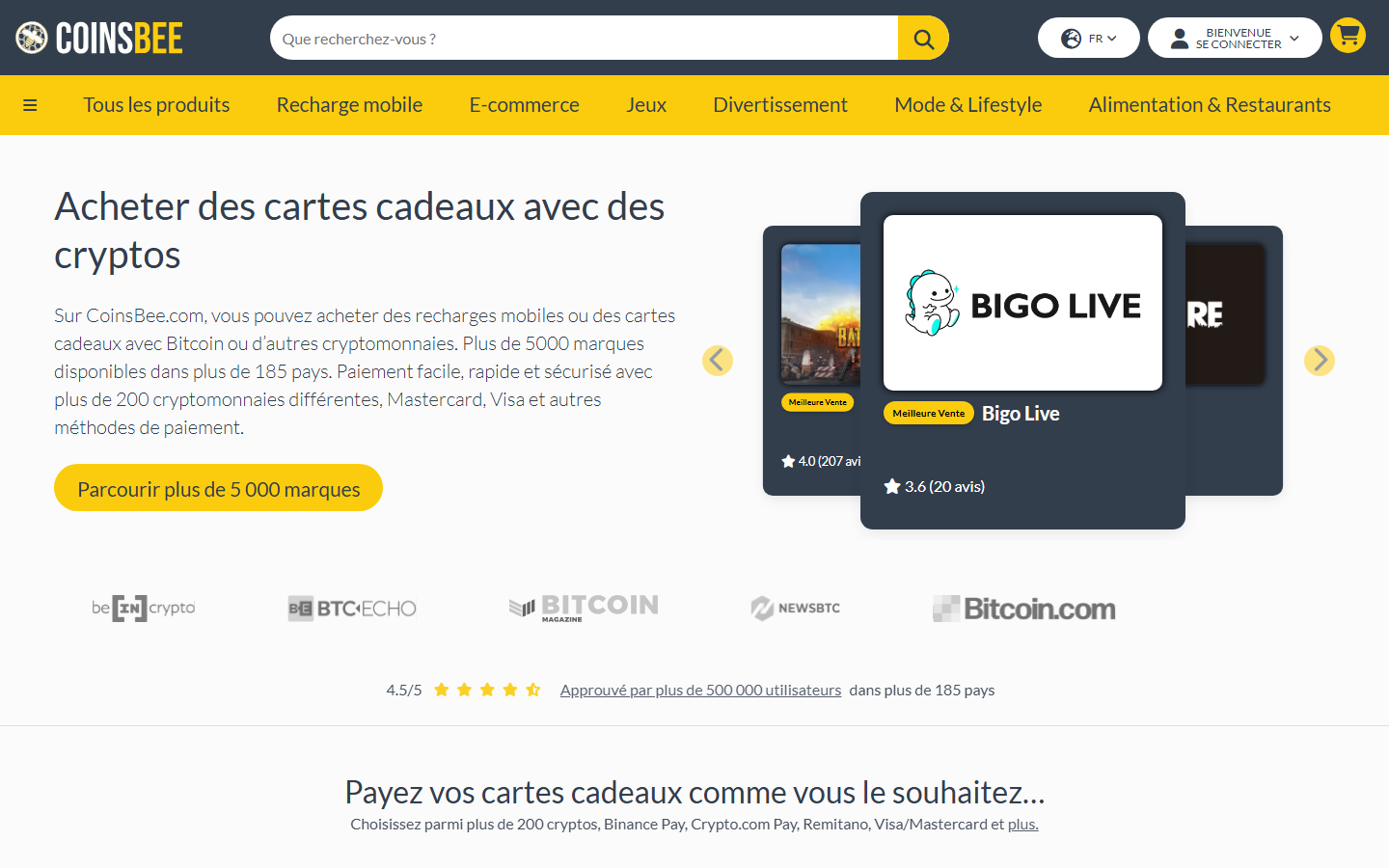
Coinsbee operates as a crypto-native gift card broker in the mold of Bitrefill, but with a distinctly European footprint. Headquartered in Germany, the platform connects privacy-conscious users with more than 5,000 digital gift card brands spanning e-commerce, gaming, travel, mobile top-up and everyday retail. The service emphasizes speed and accessibility: shoppers select a product, pay with cryptocurrency, and receive the voucher code via email shortly after blockchain confirmation. No user account is necessary for routine orders, which aligns well with the no-KYC ethos of the privacy community. The site also integrates traditional payment rails—including Visa, Mastercard, Binance Pay and Crypto.com Pay—making it a hybrid on-ramp for users who want flexibility without surrendering anonymity on the crypto side.
With over 500,000 registered users across 185 countries and support for more than 200 cryptocurrencies, Coinsbee has built measurable scale since its launch. The platform's catalog covers practical spending categories that matter to sovereign users: Amazon and Netflix vouchers, Steam and PlayStation credits, prepaid mobile refills for 440 carriers, and even charitable donations. A recent promotional tie-in with Binance Pay offers 4% cashback on orders exceeding $40, capped at $40 per transaction, which signals active partnership development in 2026.
Privacy & KYC
Coinsbee's privacy architecture is conditionally favorable rather than unconditionally anonymous. The critical threshold is €10,000 in lifetime account value: remain below this cumulative spending limit and the platform does not require identity verification. This tiered structure places Coinsbee in the L3 — Tiered KYC category of our directory, meaning KYC is not blanket-mandatory but is triggered by volume. For low-value, occasional gift card purchases, users can transact with minimal data exposure.
However, several caveats merit attention:
- Email delivery is required for voucher codes, so a burner or aliased email is strongly advised.
- IP addresses are logged, making VPN or Tor usage prudent for users seeking stronger unlinkability.
- Certain high-risk product categories or jurisdictions may impose additional verification requirements independent of the €10k threshold.
- The platform is custodial in operation: funds are sent to Coinsbee-controlled addresses before voucher issuance, not held in non-custodial escrow.
Community feedback consistently notes smooth experiences for sub-threshold transactions, with multiple long-term users reporting two or more years of service without KYC friction. The primary complaints center on fee transparency and checkout UX rather than privacy policy enforcement.
Supported assets & payments
Coinsbee's payment diversity is a genuine strength. The platform accepts Bitcoin, Monero and 200+ additional cryptocurrencies, placing it among the more inclusive gift card services for altcoin holders. Privacy advocates will particularly value XMR support, which remains rare in the gift card vertical and enables ring-confidential transactions that obscure sender details on-chain. Fiat settlement via Visa, Mastercard and regional payment processors is also available, though using these rails naturally compromises anonymity.
The checkout flow permits cryptocurrency selection after cart confirmation, with real-time exchange rate locking. Users should note that fees are not always transparently displayed early in the purchase path; the effective exchange spread and network fee only become fully visible at final checkout. Community reports describe difficulty copying exact payment amounts before reaching this stage, which can complicate wallet preparation and introduce timing risk during volatile market conditions.
Security & custody
Coinsbee operates on a fully custodial model: cryptocurrency payments are sent to platform-controlled wallets, and voucher delivery is executed by Coinsbee's backend infrastructure. There is no multisig escrow, no smart contract mediation, and no user-controlled key architecture. This design prioritizes speed—codes typically arrive within minutes—but concentrates counterparty risk with the operator. Users must trust that Coinsbee maintains adequate reserves, security practices and business continuity planning.
The Germany-based incorporation provides a baseline of EU regulatory oversight, though this cuts both ways: jurisdictional stability offers some consumer protection, yet also creates compliance pressure that could tighten KYC thresholds or expand data collection in future enforcement actions. No public audit of reserves or security infrastructure is currently available. For risk mitigation, we recommend treating Coinsbee as a hot wallet interaction: send only the exact payment amount, confirm voucher delivery before considering the transaction complete, and avoid building large cumulative balances that approach the €10k KYC trigger.
Who it's for — verdict
Coinsbee earns its place in the no-KYC gift card niche for users who need practical, everyday spending utility without immediate identity surrender. It is best suited for: privacy-conscious shoppers making sub-€10k annual purchases; Monero holders seeking real-world utility without chain tracing; travelers and digital nomads needing localized mobile top-ups across 166 countries; and gamers purchasing Steam, PlayStation or in-game credits without linking bank accounts.
The platform's 5/10 overall score reflects genuine capability offset by meaningful limitations. The €10k KYC threshold is generous but not unlimited; custodial architecture demands trust; fee transparency and checkout friction remain pain points; and Germany's regulatory environment poses long-term policy risk for anonymous services. Users demanding unconditional anonymity should treat Coinsbee as a convenience tool rather than a core privacy infrastructure layer, rotating with competitors and never approaching the verification threshold. For occasional, low-value, crypto-denominated spending, however, it delivers functional utility that few mainstream alternatives match.
Community summary
Coinsbee is a Germany-based gift card marketplace that lets privacy-minded shoppers spend Bitcoin, Monero and 200+ cryptocurrencies on 5,000+ brands across 185 countries, with no account required for most purchases and KYC only triggered above a €10,000 lifetime threshold.
Pros
- + No account required for standard purchases
- + Monero and 200+ crypto assets accepted
- + 5,000+ brands across 185 countries
- + €10k lifetime KYC threshold suits light users
- + Fast email delivery of voucher codes
- + Binance Pay cashback promotions available
Cons
- − Custodial payment model concentrates counterparty risk
- − Fees and spreads lack upfront transparency
- − IP logging undermines strong anonymity
- − Checkout UX makes exact amount copying difficult
- − Germany/EU regulatory jurisdiction poses future tightening risk
Attributes
13 signalsStrengths
Refunds do not require KYC
P+5 T+5
Accepts Monero
P+5
No registration needed
P+5
Cautions
May Freeze or Seize Funds
T-3
Community contributed
Transaction monitoring
P-1
Data Sharing
P-3
Shotgun KYC
P-15
Informational
Source code is private
T-1
Legally registered
T+2
JavaScript needed
Mobile app available
Some countries are restricted
Related
4 services
Stealths
Cards · e-SIM
 Trocador
Aggregator · Cards
Trocador
Aggregator · Cards
 XMRVCC
Cards · e-SIM
XMRVCC
Cards · e-SIM
 Laso Finance
Cards · Gift cards
Laso Finance
Cards · Gift cards
User reports
★ 4.7/5 · 4 ratings
wiry_relativity_1530
4/5
Never had any issues with KYC, only 4 stars because their fees are quite high, it's not easy to copy paste the amount before you get to checkout and the price may change slightly when you go to checkout which makes it hard to compare prices without having to go through the checkout flow. A big improvement would be to make it easier to see the fees on each product.
Swapuz ✅ (Support at Swapuz)
5/5
Coinsbee is crypto-native gift card flow — BTC and XMR checkout, no KYC under €10k, Bitrefill-style UX. Based in Germany, built for sovereign spenders and ghost-grade gifting. 🎁🕶️
biographical_buffalo_9383
4/5
Used them for 2+ years now. Never had any issue with KYC, but just like the other comment I've only ordered low value cards. Bought a few Steam games as well as IRL gifts for friends with them.
friendly_efficacy_5036
4/5
I bought about 3 gift cards on the same service/platform with XMR and they arrived the same day as expected. They were low-value cards, so I haven't had any experience with more expensive purchases. With my limited knowledge, I didn't find any apparent problems with lack of privacy or KYC practices