Silent Node
VPS · Hosting
Silent Node
VPS · Hosting

crypadvise
Communitycrypadvise.com
Instantly launch servers with Crypadvise without KYC. Pay hourly, with Bitcoin and other cryptocurrencies.
Live preview
crypadvise.com
▶
https://crypadvise.com
Review
EditorialOverview
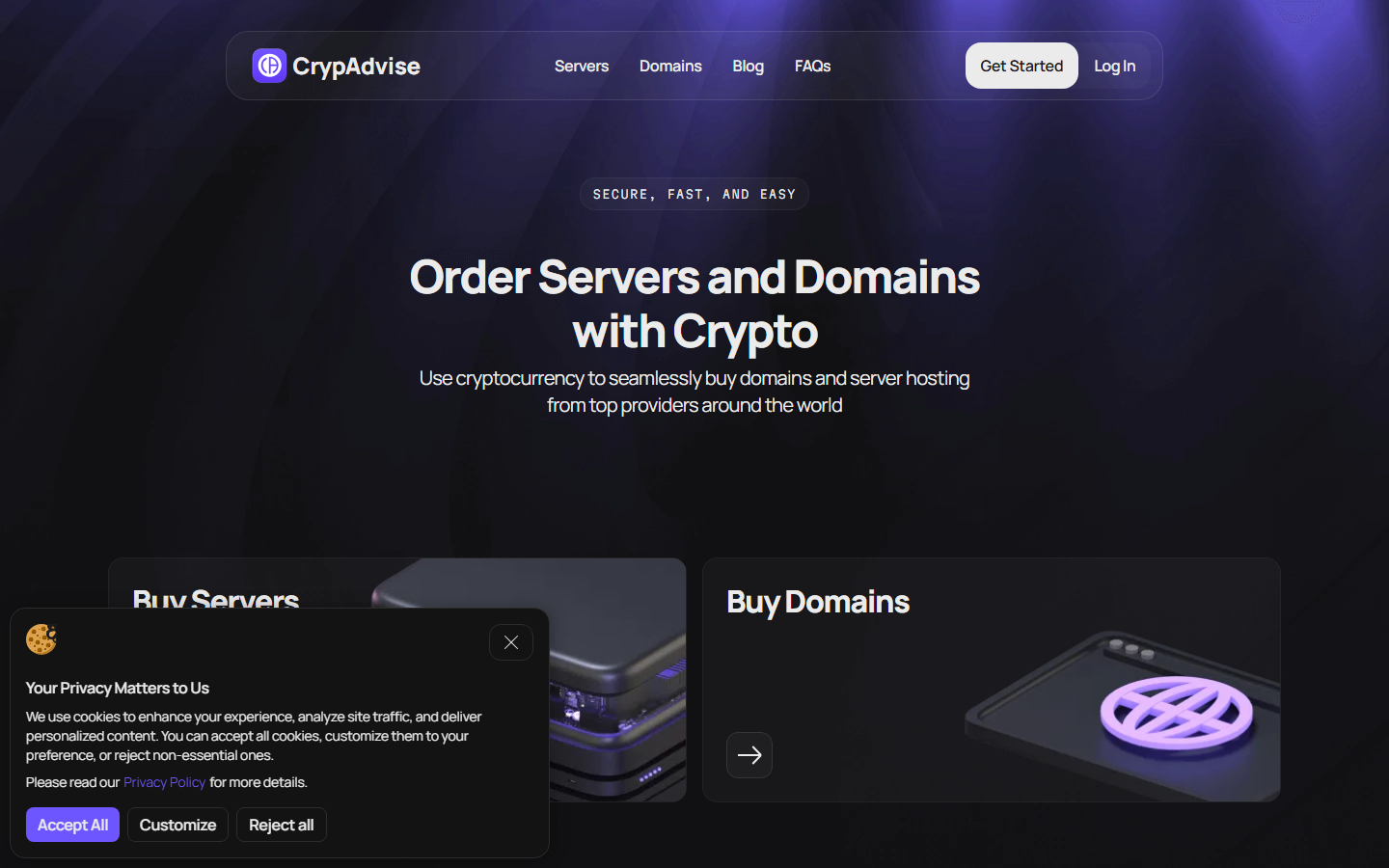
CrypAdvise positions itself as a gateway for privacy-minded users to rent virtual private servers, dedicated hardware, and domain names using cryptocurrency. Rather than operating its own datacenters, the service acts as a reseller — provisioning infrastructure through established providers including DigitalOcean, Linode, Vultr, OneProvider, and WorldStream while handling the payment layer independently. This model allows users to access familiar hosting platforms without directly linking personal financial instruments to those accounts.
The service launched with a clear pitch: instant server deployment without identity verification, paid for with digital assets. Entry-level VPS plans start at approximately $5 monthly with hourly billing, scaling through GPU servers at $150 monthly up to dedicated servers beginning at $50 monthly. Domain registration is also available, with .xyz domains starting near $2.99 and standard TLDs like .com and .net priced around $12.99. However, the "no KYC" branding requires significant qualification — the platform implements a tiered verification system that triggers identity requirements above certain usage thresholds.
Privacy & KYC
CrypAdvise advertises anonymous VPS hosting, yet our assessment places its privacy protections at a concerning 35 out of 100. The KYC framework operates on an L3 tiered model: basic provisioning may proceed without documentation, but elevated usage or account activity triggers mandatory identity verification. This structure creates a compliance trap for users who assume persistent anonymity — accounts can be frozen mid-operation if thresholds are crossed unexpectedly.
- IP logging confirmed: The platform records connection IP addresses as standard practice
- Email required: Account creation mandates a valid email address, eliminating truly pseudonymous registration
- Threshold-triggered KYC: Identity verification activates after unspecified usage limits, not disclosed transparently in pre-signup documentation
- Payment privacy partially mitigated: In-house processing generates unique addresses per transaction, preventing address reuse that could link payments
The tiered approach is arguably more honest than platforms promising absolute anonymity while secretly enforcing verification, yet it still misleads users expecting consistent no-KYC service. For journalists, activists, or researchers operating under threat models requiring guaranteed non-attribution, this conditional framework introduces unacceptable uncertainty.
Supported assets & payments
CrypAdvise maintains an in-house cryptocurrency payment processor supporting Bitcoin, Ethereum, and USDC directly. This internal infrastructure represents a genuine privacy advantage over services routing through commercial payment gateways that harvest transaction metadata. For altcoin holders, the platform integrates flyp.me as a conversion bridge, enabling payments originating from Bitcoin Cash, Dogecoin, Litecoin, and additional assets by swapping into supported currencies.
The billing architecture operates on a prepaid balance system. Users fund accounts with cryptocurrency, which converts to USD-denominated credit deducted hourly. A monthly cap ensures predictable costs — the displayed monthly rate represents maximum liability regardless of hourly fluctuations. Notably, each funding request generates a fresh receiving address, a best practice that limits blockchain analysis opportunities. However, the conversion to internal USD accounting creates an auditable record within CrypAdvise's systems, and network fees remain the user's responsibility with no fee estimation guidance provided.
Security & custody
With a trust score of 50 out of 100, CrypAdvise occupies precarious middle ground. The reseller model introduces dependency risks — infrastructure quality depends entirely on upstream providers, while support and account security rest with CrypAdvise itself. No multi-factor authentication options are documented, and the platform's relatively new market presence means limited operational history to assess resilience against security incidents or financial instability.
Custody arrangements follow predictable patterns: servers are managed through partner control panels, payment custody is internal to CrypAdvise's balance system, and no self-custody options exist for prepaid funds. Users must accept counterparty risk on deposited balances, with no stated segregation or insurance protections. The absence of community-verified audit history or third-party security assessments further dampens confidence for security-critical deployments.
Who it's for — verdict
CrypAdvise serves a narrow demographic effectively: developers and small teams seeking to separate hosting expenses from personal banking records, provided their usage remains below KYC-triggering thresholds. The hourly billing and cryptocurrency payment rails offer genuine utility for short-term projects, testing environments, or jurisdictions with restrictive capital controls. GPU server availability also attracts machine learning practitioners needing ephemeral compute without long-term contracts.
However, the platform fails users requiring robust anonymity guarantees. The combination of IP logging, mandatory email, and conditional KYC creates a profile inconsistent with serious privacy threat models. The 4 out of 10 overall score reflects this fundamental tension between marketing language and operational reality. Users prioritizing convenience over absolute privacy may find acceptable value; those needing verifiable no-KYC commitments should investigate dedicated privacy hosts with transparent zero-verification policies. For 2026, CrypAdvise remains a compromised middle option in an increasingly polarized hosting landscape.
Community summary
CrypAdvise offers cryptocurrency-funded VPS and domain services with tiered KYC requirements, though its privacy protections fall short of true anonymity standards.
Pros
- + In-house crypto payment processor with unique addresses per transaction
- + Hourly billing with monthly caps enables cost-controlled experimentation
- + Reseller access to established providers (DigitalOcean, Linode, Vultr) without direct financial linkage
- + Bitcoin, Ethereum, and USDC supported directly; altcoin bridge via flyp.me
- + GPU and dedicated server tiers available beyond basic VPS
Cons
- − Tiered KYC can trigger mid-usage, breaking anonymity assumptions
- − Mandatory email and IP logging undermine privacy claims
- − No documented MFA or advanced account security features
- − Prepaid balance model creates recoverable financial exposure
- − Limited operational track record and no community audit history
Attributes
2 signalsCautions
Community contributed
Shotgun KYC
P-15