 GoyMail
Email · Email alias
GoyMail
Email · Email alias

CyberFear
Communitycyberfear.com
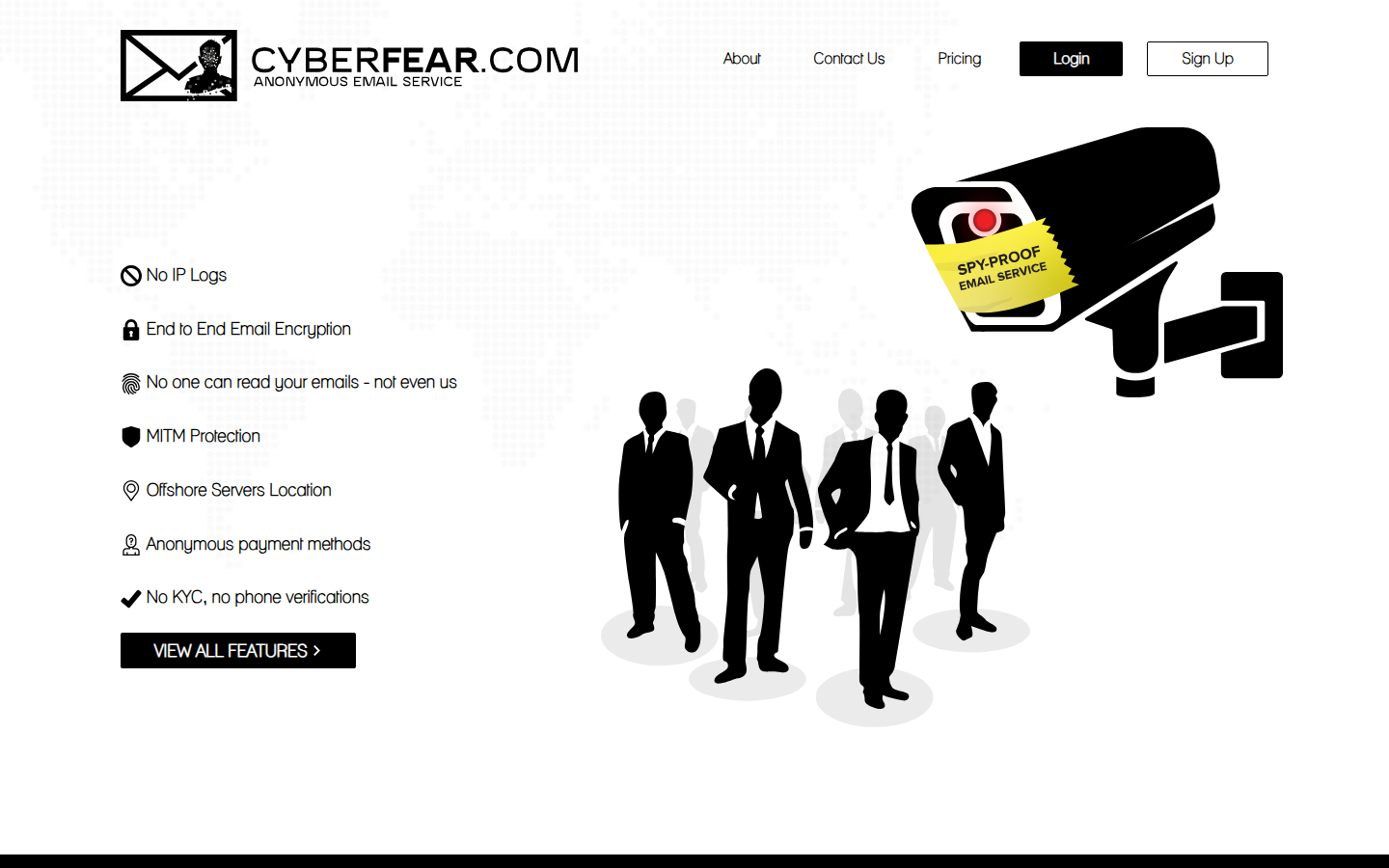
Cyberfear is a tracking-free, and logging-free email service that uses scripts on their own servers only. Anonymous payment methods are available.
Live preview
cyberfear.com
▶
https://cyberfear.com
Review
EditorialOverview
CyberFear positions itself as a sovereign communication layer in an era of surveillance-heavy email providers. Launched as an offshore-hosted alternative to mainstream platforms, the service strips away the data-harvesting infrastructure common to ad-supported competitors. Every script runs on CyberFear's own servers—no third-party analytics, no external captcha frameworks, no embedded tracking pixels. For privacy-conscious crypto natives, this architecture matters: it closes the telemetry gaps that routinely de-anonymize users across supposedly "private" services.
The platform's core pitch is straightforward pseudonymity. Account creation requires no phone number, no government ID, and no real-name policy. Users can fund accounts with Monero or Bitcoin, preserving financial privacy alongside communication privacy. In 2026, this combination remains surprisingly rare; most encrypted email providers still demand card payments or phone verification for anti-abuse purposes, creating an identity trail that undermines their encryption marketing.
Privacy & KYC
CyberFear operates at KYC Tier L1 — Anonymous, meaning fully pseudonymous access with zero personal data collection. This is the highest privacy tier in the NoKYC Directory framework, reserved for services that function without identity verification at any onboarding stage.
- No IP logging: The provider explicitly states it does not store IP addresses, login timestamps, or logout records—removing the metadata layer that typically exposes user location and behavior patterns.
- No external scripts: All code executes on CyberFear-controlled infrastructure, eliminating the cross-site tracking vectors introduced by Google reCAPTCHA, analytics beacons, or CDN-hosted JavaScript libraries.
- MITM protection: The service implements safeguards against man-in-the-middle attacks, hardening the transport layer between user and server.
- Offshore server location: Hosting outside major Five Eyes jurisdictions adds a structural barrier to casual data demands, though users should understand this is not absolute legal immunity.
Our privacy score of 65/100 reflects solid technical foundations tempered by the inherent limitations of any hosted email model. Users must still trust the operator's code and server administration; true zero-knowledge architecture would require client-side encryption with user-controlled keys, which CyberFear does not fully implement for all mail flows.
Supported assets & payments
CyberFear accepts Monero (XMR) and Bitcoin (BTC) for account funding. Monero deserves particular emphasis here: its ring-signature privacy model makes it the strongest on-chain option for users seeking payment unlinkability. Bitcoin acceptance provides convenience for holders, though on-chain transparency means users should coinjoin or use Lightning for equivalent privacy. The absence of fiat payment rails is intentional—it removes the banking compliance hooks that typically trigger KYC waterfalls. For crypto-first users, this is a feature, not a limitation.
Security & custody
CyberFear offers end-to-end encryption for messages sent between CyberFear accounts, with cleartext fallback for external recipients. The encryption model appears to be provider-assisted rather than purely client-side: users can encrypt to other CyberFear users, but the service manages key infrastructure in ways that require some operational trust. This is not a fully custodial model—users retain account control—but neither is it a zero-knowledge architecture comparable to PGP-managed self-hosted solutions.
The trust score of 50/100 signals this middle ground. The operator's logging claims are strong and verifiable in policy, yet without open-source client code or third-party security audits, users must weigh promises against opacity. For high-threat models, pairing CyberFear with manual PGP encryption and Tor browser access provides defense in depth.
Who it's for — verdict
CyberFear earns its 6/10 overall score by nailing the essentials for a specific user archetype: the pseudonymous operator who needs functional email without identity friction. Journalists sourcing tips, crypto traders separating identities, privacy advocates fleeing Gmail's data extraction, and darknet market vendors operating at legal margins all find a tool that removes the usual KYC chokepoints.
It is not for everyone. Users demanding audited zero-knowledge architecture, seamless calendar integration, or large attachment volumes will find better fits elsewhere. The service is deliberately stripped-down—email without breadcrumbs, not email with enterprise features. For those who measure service quality in data not collected rather than features offered, CyberFear remains a credible 2026 option in a shrinking field of genuinely anonymous providers.
Community summary
CyberFear delivers pseudonymous, end-to-end encrypted email hosting with zero IP logging, no external scripts, and anonymous Bitcoin or Monero payments—built for users who treat communication privacy as non-negotiable.
Pros
- + Fully pseudonymous signup with no phone, name, or ID required
- + Monero and Bitcoin payments preserve financial privacy
- + Zero IP logging and no external scripts eliminate common tracking vectors
- + Offshore hosting outside primary surveillance alliances
- + End-to-end encryption available for internal CyberFear communications
Cons
- − No published third-party security audit to verify logging claims
- − Encryption model requires some trust in provider key management
- − Limited feature set compared to mainstream encrypted email competitors
Attributes
3 signalsStrengths
No KYC mention
P+15
Accepts Monero
P+5
Cautions
Community contributed
Related
4 services


User reports
★ 5/5 · 1 ratings
Swapuz ✅ (Support at Swapuz)
5/5
CyberFear is email without breadcrumbs — no tracking, no logging, scripts run only on their own servers. Anonymous payments supported. Built for sovereign comms and ghost-grade inboxes. 📧