 eigenwallet
Exchange · DEX
eigenwallet
Exchange · DEX

DFX
Approveddfx.swiss
DFX Swiss is a centralized crypto on/off-ramp. It supports soft-KYC purchases up to CHF 1000. Full KYC is required for higher amounts.
Live preview
dfx.swiss
▶
https://dfx.swiss
Review
EditorialOverview
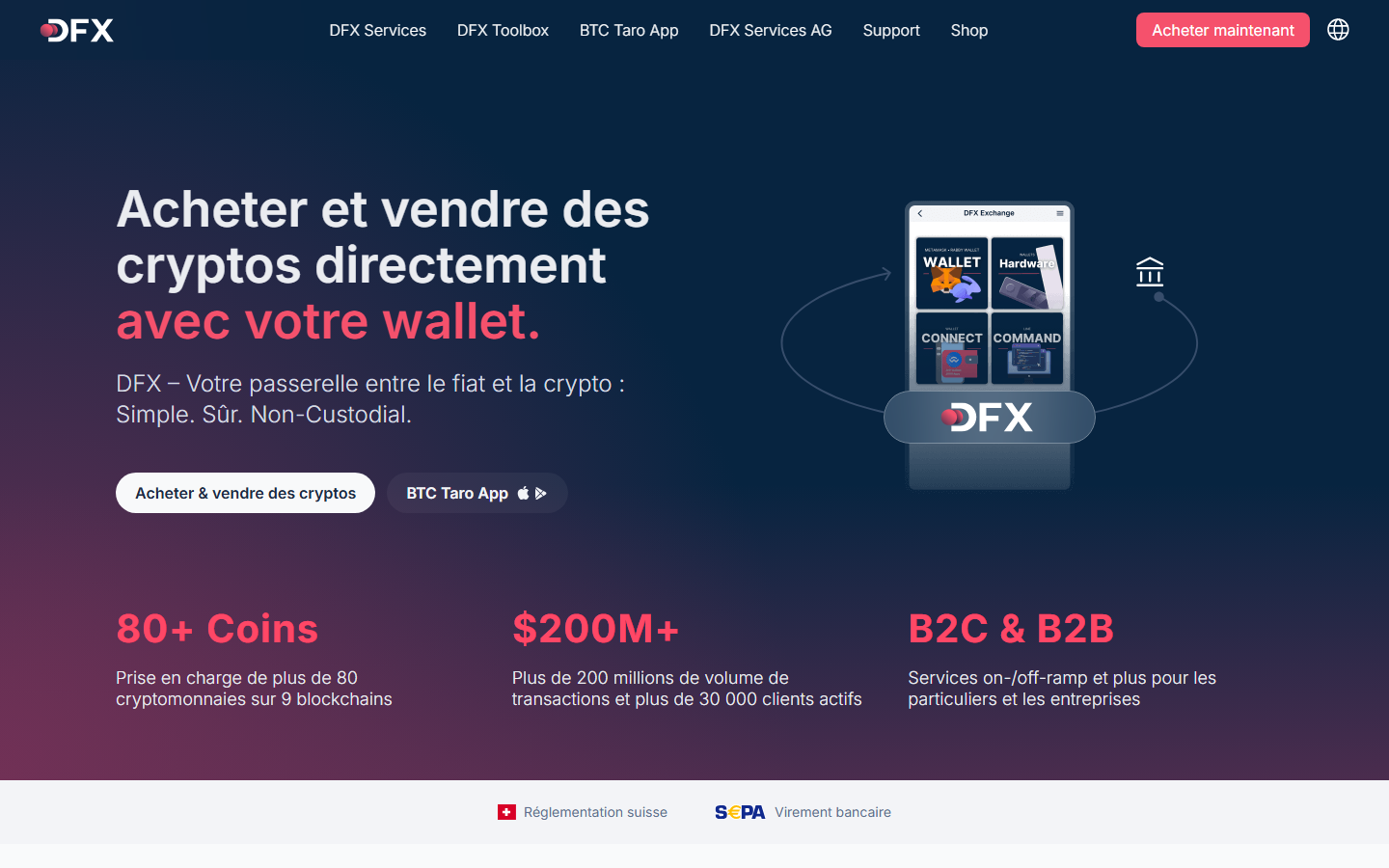
DFX positions itself as a bridge between traditional banking and self-custodial crypto wallets. Operating under Swiss regulation, the service lets users buy, sell, and swap digital assets directly from their bank accounts into personal wallets like MetaMask, Ledger, Trezor, and Rabby. The platform emphasizes its non-custodial architecture—funds never sit on DFX-controlled accounts—and highlights open-source code audited by Grant Thornton and Beyond Audit. With over CHF 200 million in transaction volume and 30,000-plus active customers, DFX has carved out a niche serving both retail users and businesses needing embedded fiat-to-crypto infrastructure.
Beyond basic on/off-ramping, DFX has expanded into payment processing through Open CryptoPay, partnering with SPAR supermarkets and Binance Pay to enable in-store crypto payments across Swiss retail locations. The company also develops the BTC Taro App, a self-custody Bitcoin wallet with Lightning and multisig support, signaling ambitions deeper into the Bitcoin ecosystem.
Privacy & KYC
DFX operates on a tiered KYC model that privacy seekers should scrutinize carefully. For purchases and sales below CHF 1000 cumulatively, the platform applies what it calls "soft KYC"—typically name, email, and basic contact details without full identity document submission. Cross that threshold, however, and full KYC becomes mandatory: government-issued ID, proof of address, and enhanced due diligence follow.
- KYC tier: L3 — Tiered (soft KYC under CHF 1000, full KYC above)
- Email required: Yes
- IP logging: Undisclosed; assume standard server logging applies
- Jurisdiction: Switzerland—strong data protection laws, but also strict AML enforcement
Our privacy score of 35/100 reflects this reality. DFX is not an anonymous service by design. The CHF 1000 soft-KYC buffer offers modest privacy for small experiments, but anyone seeking genuine no-KYC crypto acquisition must look elsewhere. Swiss regulatory compliance is a double-edged sword: it builds institutional trust while systematically stripping transactional anonymity.
Supported assets & payments
DFX supports 80-plus cryptocurrencies across 9 blockchains, including Bitcoin, Monero, and Lightning Network transactions. Fiat on-ramping occurs via bank transfer—SEPA for Eurozone users and Swiss bank transfers for domestic customers. The platform explicitly markets itself as a MetaMask and hardware-wallet companion, with WalletConnect integration extending compatibility to over 300 wallets.
Notable supported integrations include Ledger, Trezor, BitBox, and Rabby Wallet. The inclusion of Monero is significant for privacy advocates, though the KYC friction at the fiat entry point largely neutralizes this benefit. Lightning Network support enables faster, cheaper Bitcoin transactions, particularly relevant for the Open CryptoPay retail initiative.
Security & custody
DFX's core security proposition is non-custodial settlement. Unlike centralized exchanges that hold user deposits, DFX routes purchased crypto directly to the user's connected wallet. This eliminates counterparty risk associated with exchange hacks or insolvency—users maintain private key control throughout.
The company publishes open-source code and has undergone third-party security assessments by Grant Thornton and Beyond Audit. Customer support operates through Telegram moderators and ticket-based systems, with Trustpilot feedback citing responsive, personalized assistance. However, the trust score of 67/100 suggests room for improvement in transparency around operational security practices, server infrastructure, and incident response protocols.
Who it's for — verdict
DFX serves a specific user profile: Swiss and European residents who prioritize self-custody over anonymity, need modest fiat-to-crypto conversion amounts, and value regulatory clarity. The CHF 1000 soft-KYC tier suits newcomers testing crypto waters without immediate full identity surrender. Businesses seeking white-label on-ramp integration may find DFX Toolbox appealing.
For strict no-KYC seekers, DX falls short. The tiered verification, email requirements, and Swiss regulatory environment create a compliance-first experience where privacy is a limited concession rather than a design principle. Users requiring larger volumes face the same KYC rigor as traditional exchanges. Our overall score of 5/10 reflects this middle positioning: competent and secure for its niche, but misaligned with the expectations of privacy-maximalist crypto users.
Community summary
DFX is a Swiss-regulated, non-custodial fiat on/off-ramp that allows soft-KYC purchases up to CHF 1000 before requiring full identity verification.
Pros
- + Non-custodial settlement keeps private keys in user hands
- + Soft-KYC tier allows small purchases without full ID verification
- + Swiss regulatory framework provides institutional credibility
- + Broad wallet integration including Ledger, Trezor, and MetaMask
- + Lightning Network and Monero support
- + Open-source codebase with third-party audits
Cons
- − Full KYC mandatory above CHF 1000 cumulative limits
- − Email registration required even for soft-KYC tier
- − Not suitable for users seeking genuine anonymity
- − Primarily SEPA/Swiss bank transfer—limited global accessibility
Attributes
15 signalsStrengths
Refunds do not require KYC
P+5 T+5
Accepts Monero
P+5
Non-custodial wallet
P+3 T+5
Mature service
T+5
Red flags
May require KYC/SOF by policy/law
P-6 T-4
Cautions
Third-Party Liquidity
Transaction monitoring
P-1
Soft KYC
P-3 T-1
Data Sharing
P-3
Shotgun KYC
P-15
Informational
Approved
T+5
Legally registered
T+2
Email required
JavaScript needed
Some countries are restricted
Related
4 services
eigenwallet
Exchange · DEX
 Bisq
Exchange · P2P
Bisq
Exchange · P2P
 BasicSwap
Exchange · P2P
BasicSwap
Exchange · P2P
 RoboSats
Exchange · P2P
RoboSats
Exchange · P2P
User reports
★ 5/5 · 1 ratings
Swapuz ✅ (Support at Swapuz)
5/5
DFX Swiss is a centralized on/off-ramp with soft-KYC up to CHF 1000 — fiat in, crypto out, with Swiss-grade compliance. For higher amounts, full KYC applies. Built for hybrid flows and regulated exits. 🇨🇭🔁