 eigenwallet
Exchange · DEX
eigenwallet
Exchange · DEX

dolphex
Communitydolphex.io
Russian electronic currency exchange office, you can easily exchange Ethereum, Tether TRC20 USDT and Bitcoin
Live preview
dolphex.io
▶
https://dolphex.io
Review
EditorialOverview
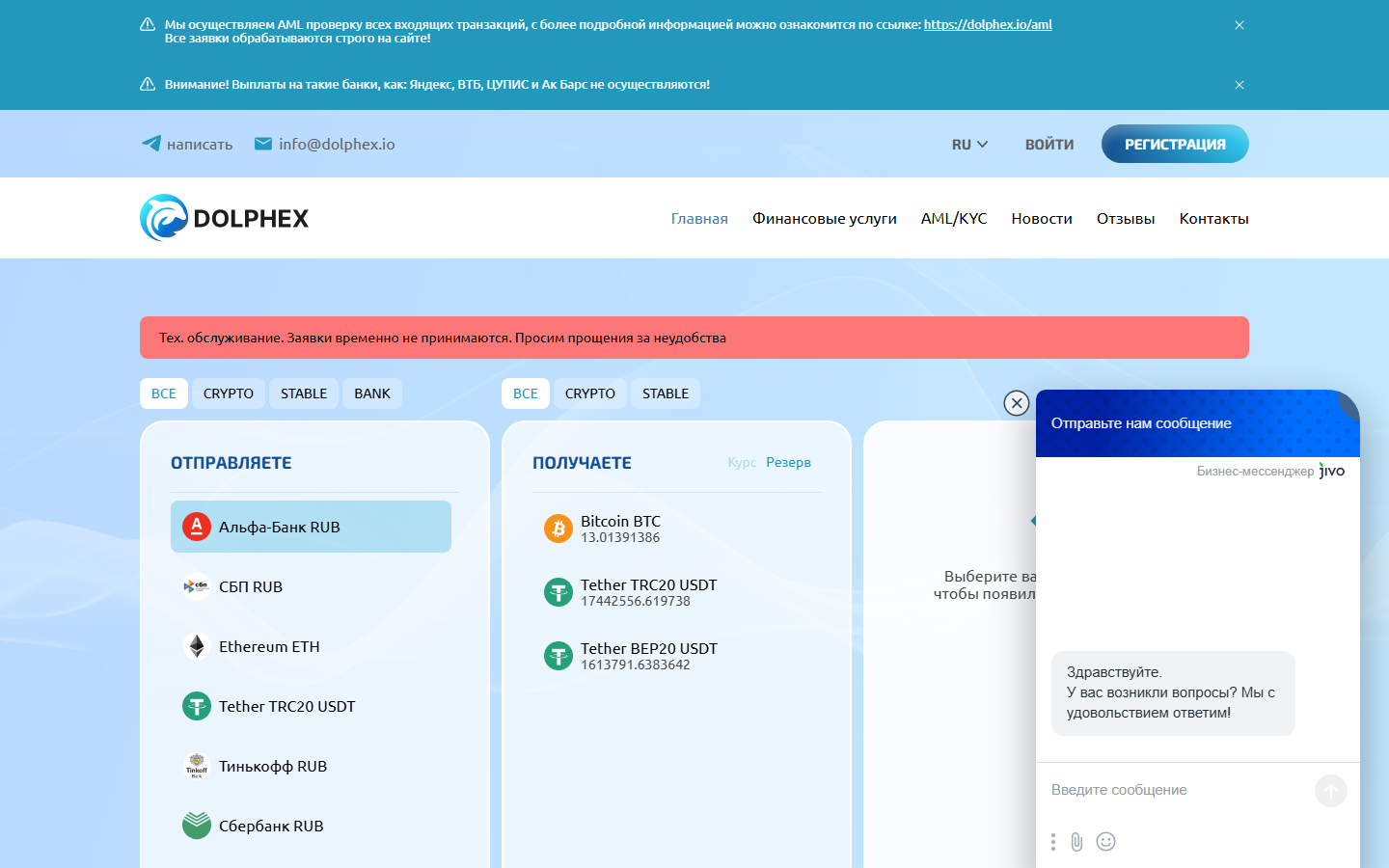
Dolphex.io presents itself as a Russian electronic currency exchange office specializing in crypto-to-fiat conversions. The platform runs in a semi-automatic mode, meaning transactions are not fully instant but instead processed with operator involvement, typically completing between 5 and 360 minutes according to its own estimates. Exchange limits are set from 75,000 to 3,000,000 Russian rubles per transaction, positioning it as a service for medium-sized transfers rather than micro-purchases or institutional volume.
The interface supports both Russian and English, with registration required via email and password. Users must also set a personal PIN code. The site explicitly warns that it conducts AML (Anti-Money Laundering) checks on all incoming transactions, directing visitors to a dedicated AML policy page. This is not a hands-off, permissionless swapping tool—it is a regulated-facing service with compliance infrastructure.
Privacy & KYC
Dolphex falls into KYC Tier L3 — Tiered, meaning identity verification is not universally demanded at signup but kicks in above certain thresholds or under specific risk conditions. For privacy seekers, this is a critical distinction: the service is not no-KYC by default, only selectively so for low-volume users who clear its automated risk scoring.
- Registration requires a working email address and password
- A personal PIN code is mandatory for account access
- IP logging status is unconfirmed but standard for Russian-facing financial services
- All incoming crypto transactions undergo AML screening before processing
- Custodial model means the platform controls funds during the exchange window
The platform's privacy score of 35/100 reflects these constraints. Users seeking genuine anonymity should treat Dolphex as a low-privacy option where transaction history, email, and potentially IP data are collected and subject to compliance review.
Supported assets & payments
Dolphex supports a Bitcoin and fiat-centric mix with notable depth in Russian and Kazakhstani banking rails. Crypto availability includes Bitcoin (BTC), Ethereum (ETH), Tether across TRC20, ERC20, and BEP20 variants, USDC in ERC20 and BEP20 forms, Solana (SOL), TRON (TRX), Binance Coin (BNB), Litecoin (LTC), and Toncoin (TON). Fiat on- and off-ramps cover Sberbank RUB, Tinkoff RUB, Alfa-Bank RUB, SBP (Fast Payment System) RUB, Visa/MasterCard RUB, Raiffeisen RUB, Mir card RUB, and Kazakhstani tenge (KZT) via HalykBank, Kaspi Bank, ForteBank, and Jusan Bank.
Significantly, the platform blocks payouts to specific Russian banks: Yandex, VTB, TSUPIS, and Ak Bars are explicitly excluded. EUR and USD support appears limited compared to the deep RUB/KZT integration. The reserve display shows substantial Tether TRC20 liquidity (over 17 million USDT) and modest Bitcoin holdings (roughly 13 BTC), suggesting the service is primarily a USDT-to-ruble pipeline.
Security & custody
Dolphex operates on a custodial model—users deposit crypto into platform-controlled addresses before the operator releases fiat to the designated bank account. This introduces counterparty risk: funds are not in self-custody during the exchange window, and the semi-automatic nature means human operators mediate every transaction. The trust score of 50/100 indicates middling confidence in operational reliability and transparency.
The platform lists "security of transactions and confidentiality" as selling points, yet provides no public audit records, proof-of-reserves, or insurance fund disclosures. Customer support operates on a fixed schedule—Monday through Friday, 6:30 AM to 10:00 PM Moscow time, with weekend coverage on a "free schedule" basis. This limited window could strand users during urgent issues.
Who it's for — verdict
Dolphex.io serves a narrow niche: Russian-speaking users needing to convert crypto to rubles or tenge through familiar local banks, who accept tiered identity checks and AML screening in exchange for access to legacy payment rails. It is not a fit for privacy purists, as the mandatory email registration, AML policy, and custodial architecture create multiple identity touchpoints.
The overall score of 4/10 reflects these tradeoffs. For no-KYC alternatives, decentralized exchanges or atomic swap protocols offer stronger privacy guarantees, albeit without fiat off-ramps. Users who specifically need ruble liquidity and can tolerate threshold-based verification may find Dolphex functional, but should verify current reserve status and support responsiveness before committing significant volume. As of 2026, the platform's maintenance notice history suggests occasional operational instability—another factor warranting caution.
Community summary
Dolphex.io operates as a Russian-focused crypto-to-fiat exchange desk with semi-automated processing and tiered KYC triggers, though its mandatory AML screening and data collection practices place real limits on anonymity.
Pros
- + Wide selection of Russian and Kazakhstani bank payment rails
- + Substantial USDT TRC20 reserves for ruble liquidity
- + Semi-automatic processing with stated 5-360 minute windows
- + Supports major stablecoins across multiple chains
- + Bilingual Russian/English interface
Cons
- − Tiered KYC triggers erode anonymity at higher volumes
- − Mandatory AML screening on all crypto deposits
- − Custodial model exposes users to operator risk
- − Blocked payouts to several major Russian banks
- − Limited weekend support coverage
- − No public security audits or proof-of-reserves
Attributes
2 signalsCautions
Community contributed
Shotgun KYC
P-15
Related
4 services
eigenwallet
Exchange · DEX
 Bisq
Exchange · P2P
Bisq
Exchange · P2P
 BasicSwap
Exchange · P2P
BasicSwap
Exchange · P2P
 RoboSats
Exchange · P2P
RoboSats
Exchange · P2P