 Mullvad
VPN
Mullvad
VPN
Live preview
duck-protocol.com
▶
https://duck-protocol.com
Review
EditorialOverview
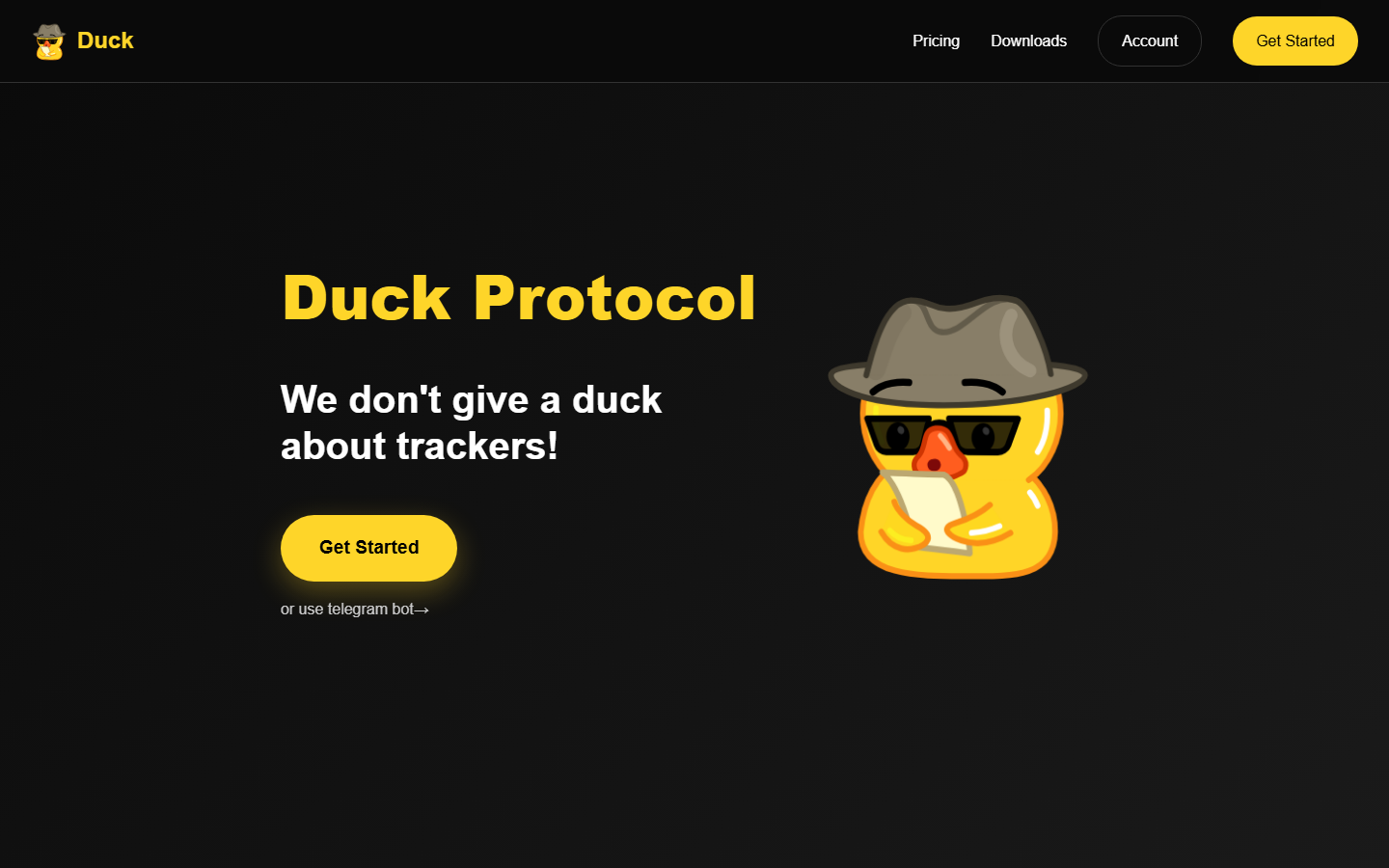
Duck Protocol positions itself as a privacy-first VPN service designed for users who refuse to compromise on anonymity. Launched with a deliberately minimal infrastructure, it strips away every friction point that typically exposes identity—no registration forms, no email collection, no persistent user dashboards. Instead, subscribers pay, receive a unique account number and VLESS Reality configuration, and connect immediately. The service emphasizes unblockability through protocol-level mimicry of genuine HTTPS traffic, making it a standout option in 2026 for users in high-censorship regions.
At a flat $3 per month with unlimited bandwidth and support for up to five simultaneous devices, Duck Protocol undercuts most premium competitors while delivering a feature set that includes automatic ad blocking, traffic noise generation, and a globally distributed server network. The entire experience is engineered around one principle: the provider should know nothing about who you are or what you do.
Privacy & KYC
Duck Protocol operates at KYC Tier L0 — Trustless, the highest anonymity classification in our directory. No account creation is required at any stage. Users do not submit names, email addresses, phone numbers, or social profiles. Payment generates a unique identifier that serves as the sole credential, and even that carries no linkable personal data.
- No email required: The service explicitly states it wants no contact information.
- No IP logging: Duck Protocol maintains a strict no-logs policy with no storage of connection timestamps, traffic destinations, or bandwidth consumption patterns.
- Clean node rotation: Nodes authenticate through frequently changing private addresses, reducing the risk of long-term correlation attacks.
- Traffic noise generation: Background decoy data masks real usage patterns against advanced traffic analysis.
These design choices earn Duck Protocol a 100/100 privacy score in our assessment. The trade-off is a lower 57/100 trust score, reflecting the inherent opacity of a service that deliberately avoids identity verification and publishes minimal corporate information. Users must weigh absolute anonymity against the reduced accountability that comes with it.
Supported assets & payments
Duck Protocol accepts Bitcoin and fiat currency payments, with pricing displayed in both USD and Russian rubles. The Bitcoin option aligns with the service's no-KYC ethos, enabling users to fund subscriptions through non-custodial wallets without linking bank accounts or card details. Fiat payments are presumably processed through conventional channels, though the site emphasizes that even these require no personal identification beyond what the payment processor itself demands.
Post-payment, subscribers receive instant access to download links and configuration files for all supported platforms. There are no tiered plans, no annual-lock discounts, and no upsells—just the single flat rate with full feature parity.
Security & custody
Unlike custodial crypto services, Duck Protocol requires no asset custody at all. It is not an exchange, wallet, or yield platform—users pay for access, not deposit funds. This eliminates an entire category of counterparty risk. Security instead centers on connection integrity and detection resistance.
The VLESS Reality protocol forms the technical core. Rather than merely encrypting traffic, it shapes VPN packets to perfectly imitate standard HTTPS handshakes and flow characteristics. Deep Packet Inspection (DPI) systems deployed by ISPs and state censors therefore classify the traffic as ordinary web browsing. Duck Protocol claims this renders it unblockable even in jurisdictions with the most restrictive internet controls, including China, Iran, and Russia. The Stealth Mode layer adds intelligent background noise to prevent traffic-analysis side-channel attacks.
Additional protections include comprehensive ad and tracker blocking at the network level, covering YouTube pre-roll ads, banner injections, pop-ups, and behavioral tracking scripts. This is not browser-extension filtering but server-side stripping, meaning it functions across all apps and devices routing through the tunnel.
Who it's for — verdict
Duck Protocol is purpose-built for two overlapping audiences: privacy absolutists who reject any identity-linked service, and users in censorship-heavy environments who need reliable, undetectable internet access. Journalists, researchers, activists, and ordinary citizens in restricted regions will find the L0 trustless model and VLESS Reality architecture particularly compelling. The $3 price point and five-device allowance also suit families or small teams sharing a single subscription.
However, the 57/100 trust score signals legitimate caveats. With no corporate transparency, no user community of significant size to generate independent reputation signals, and no recourse if the service disappears, Duck Protocol demands a higher risk tolerance than established competitors. It is not the right choice for users who prioritize audited accountability over anonymity.
Our 8/10 overall score reflects a service that executes its narrow mission with technical sophistication, but within deliberately constrained boundaries. For the no-KYC, no-account VPN niche in 2026, Duck Protocol is among the most ideologically consistent options available.
Community summary
Duck Protocol is a trustless, account-free VPN built on VLESS Reality technology, accepting Bitcoin with zero identity verification required.
Pros
- + True L0 trustless setup with zero identity data collected
- + VLESS Reality protocol effectively mimics HTTPS against DPI censorship
- + Flat $3/month pricing with no bandwidth or speed throttling
- + Network-level ad and tracker blocking across all connected devices
- + Bitcoin payment accepted alongside fiat options
Cons
- − Minimal corporate transparency reduces accountability
- − No community reviews or independent audit documentation available
- − Support limited to Telegram bot and email with no public knowledge base
Attributes
12 signalsStrengths
Guaranteed no KYC
P+25
Identity-Free registration
P+10
Personal info is not verified
P+9
Refunds do not require KYC
P+5 T+5
Strict no-log policy
P+5 T+3
Cautions
New service
T-4
Community contributed
Informational
Legally registered
T+2
Basic Customer Support
T+1
JavaScript needed
Telegram bot available
Mobile app available