 PinToPay
Cards
PinToPay
Cards

FotonCard
Verifiedfotoncard.co
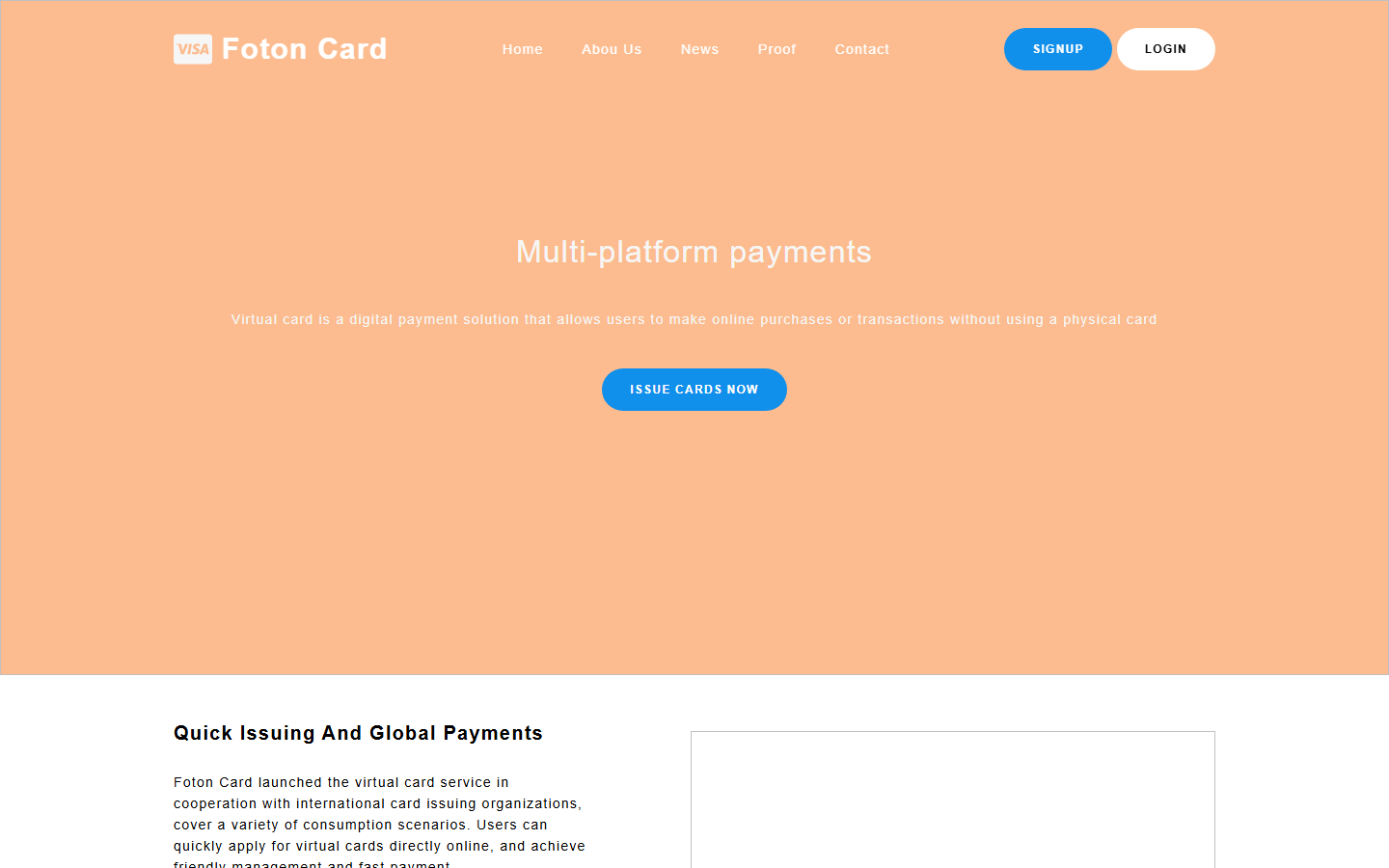
USDT-funded Visa and Mastercard virtual cards (US / HK / Singapore BIN choice), optimised for cross-border e-commerce, digital-ads spend (Google Ads, Meta) and online subscriptions. No KYC at signup, unlimited card generation, $2–3 issuance, free top-ups and no FX markup.
Live preview
fotoncard.co
▶
https://fotoncard.co
Review
EditorialOverview
FotonCard is a USDT-funded virtual-card platform that issues Visa and Mastercard prepaid cards across three distinct BIN jurisdictions — United States, Hong Kong and Singapore — without requiring identity verification at signup. The product targets a sharper audience than most consumer crypto cards: cross-border e-commerce operators, performance marketers running paid campaigns on Google Ads, Meta and TikTok, and global shoppers who need disposable cards per merchant. Access is invitation-coded; once inside, users can spin up cards on demand and fund them from a single USDT (TRC-20) balance.
Privacy & KYC
FotonCard sits at KYC Tier L2 — Discreet. The signup collects an email address and an invitation code; no government ID, no proof of address, no selfie. Card issuance proceeds without any secondary verification, and the platform’s public FAQ states plainly that “no, you don’t need” KYC. This places FotonCard in a small group of card services where the account-level identity surface is genuinely minimal — most “no-KYC” cards still demand phone or ID once load size or card count grows.
Two caveats sit on the privacy side of the ledger. First, FotonCard is custodial: the USDT balance and the card-issuer relationship are both held by the platform, not the user. Second, corporate transparency is light — a Seattle registered address is shown, but the issuing-bank / sponsor-program chain is not fully disclosed publicly. For users coming from KYC-heavy neobanks the privacy posture is a clear win; for users with a strict on-chain threat model the custodial layer remains the binding constraint.
Supported assets & payments
Funding is narrow by design:
- USDT on Tron (TRC-20) — the primary path; near-zero on-chain fees and minute-level settlement
- International wire transfer — supported as a traditional rail for business operators
There is no native BTC, no Lightning, and no Monero top-up. Privacy-coin holders need to off-ramp into USDT before loading the account. Spending happens on the Visa or Mastercard network at the chosen BIN — usable across global online merchants, subscription services, and ad-platform billing. Apple Pay, Google Pay and ATM cash withdrawals are not part of the documented feature set; FotonCard is primarily a card-not-present spending tool, not a day-to-day tap-and-go card.
Fees
- Card issuance: $2–3 per card (varies by network / BIN)
- Top-up: free — full USDT credited to balance
- FX: no platform markup; standard card-network rate
- Monthly / annual fees: none
- Guarantee deposit: $100 refundable, required when issuing batches of 5–10 cards; returned after 45 days
For high-volume ad spend the economics are aggressive: free top-ups plus a $2–3 single-shot card fee yields effective cost-per-spend that is markedly cheaper than dedicated agency-card products, and the multi-BIN choice helps with ad-account approval rates in regions where local-issuer cards perform better.
Security & custody
The model is custodial: USDT sits with FotonCard and the card balance is held by the issuing partner. The signup invitation code acts as the primary access control, with email recovery on top. No self-custody, multisig, or hardware-wallet flow is documented. The trust score of 68/100 reflects this balance — credible operational track record and a meaningful spread of issuance BINs across reputable jurisdictions, tempered by the limited public disclosure of the issuer chain and the invitation-only access pattern that obscures the user funnel.
Who it’s for — verdict
FotonCard is the right fit for a specific, professional user:
- Operators of cross-border e-commerce stores who need disposable cards per supplier or per SaaS subscription
- Performance marketers running Google Ads, Meta or TikTok campaigns from jurisdictions where conventional banks flag crypto-funded ad spend
- Privacy-aware online shoppers who want a Visa or Mastercard for online checkouts without surrendering ID to a neobank, and who already custody value in stablecoins
It is not the right tool for in-store NFC payments, ATM withdrawals, Monero-grade chain privacy, or users who require self-custody at the account level. For its target audience — USDT-holders who need scalable, fast, identity-free virtual card issuance — it earns its 8.4 / 10 overall score as one of the more practical purpose-built no-KYC card platforms in 2026.
Community summary
FotonCard issues Visa and Mastercard virtual cards funded with USDT (Tron TRC-20). No KYC at signup, $2–3 per card, free top-ups, no FX markup, choice of US / HK / Singapore issuance BIN, unlimited card generation. Tailored for cross-border ads spend and online shopping rather than day-to-day in-store use.
Pros
- + No identity verification at signup — just an account + invitation code
- + Choice of card network (Visa or Mastercard) and issuance BIN (US / HK / Singapore)
- + Unlimited card generation — compartmentalise spending per merchant or campaign
- + Free top-ups, no FX markup, no monthly fee
- + USDT TRC-20 funding — fast, near-zero on-chain fees
- + Tailored for digital-advertising spend (Google Ads, Meta) where most VCC providers fail KYC checks
- + Cards usable across global online merchants and subscription services
Cons
- − Virtual only — no physical card, no NFC / Apple Pay / ATM withdrawals confirmed
- − Funding is USDT-only (Tron) — no BTC, no Lightning, no Monero
- − Custodial: funds sit with FotonCard, not the user
- − Invitation-code signup limits open access and obfuscates the funnel
- − $100 refundable guarantee deposit required for batches of 5–10 cards
- − Corporate transparency is light — Seattle registered address, but issuer chain not fully disclosed
- − Clearnet only — no Tor / onion endpoint