 Kusama Shield
Tool · Exchange
Kusama Shield
Tool · Exchange

illumineX
Communityilluminex.xyz
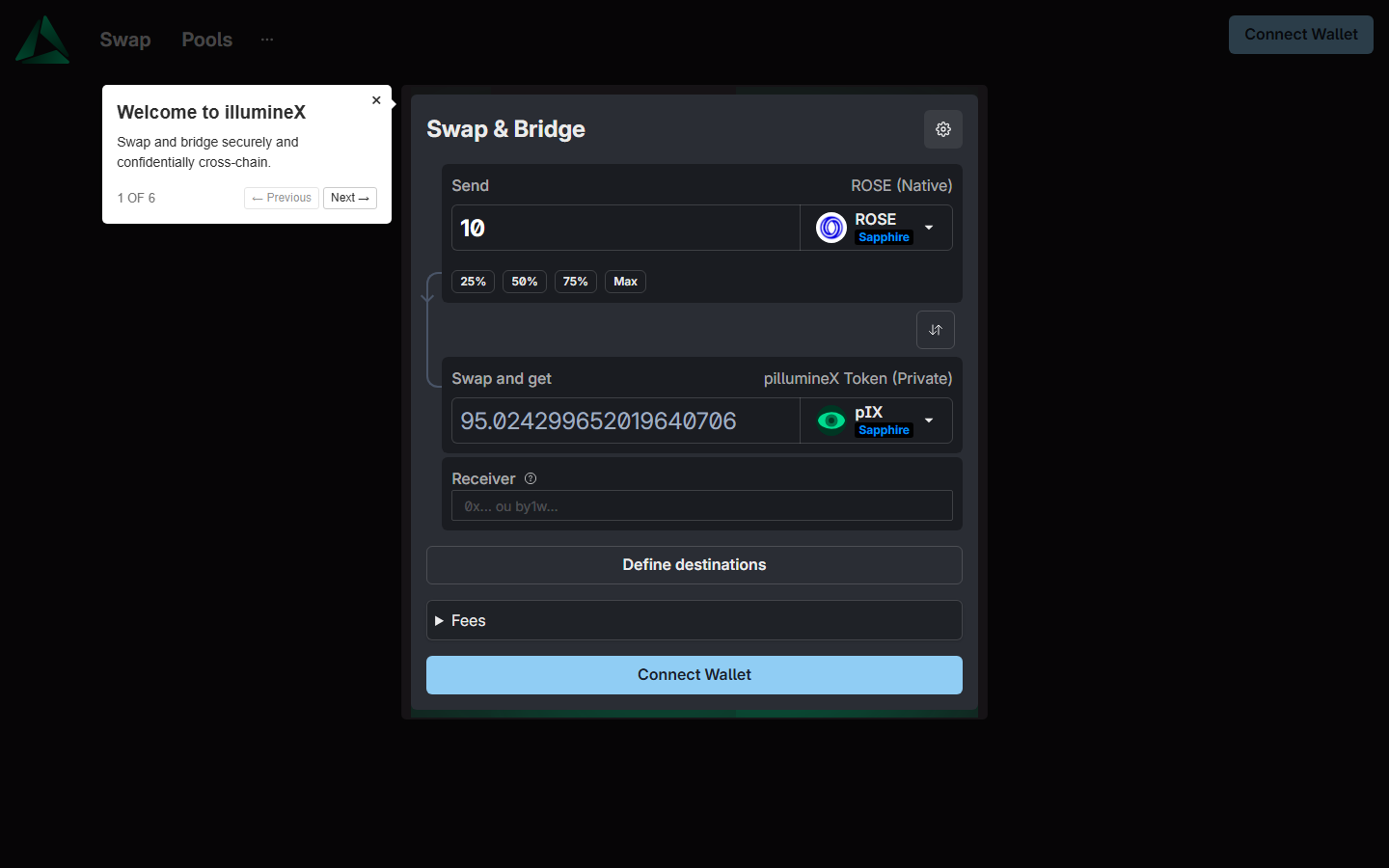
Non-custodial and private cross-chain wallet with integrated swaps. Deposit your BTC, ETH and other assets to instantly make them private, and break the link between depositing and receiving addresses. Web-based, no downloads or registration needed. No KYC.
Live preview
illuminex.xyz
▶
https://illuminex.xyz
Review
EditorialOverview
illumineX pitches itself as a non-custodial, web-based privacy layer for crypto holders who want to sever the trail between deposit and withdrawal addresses. The service operates entirely in the browser — no app downloads, no account creation, and no KYC questionnaire. Users send Bitcoin or other assets into the protocol and receive funds at a fresh address, theoretically breaking the on-chain link. In practice, this makes it a no-KYC tool aimed at anyone seeking anonymous cross-chain swaps without surrendering identity documents. The interface is deliberately minimal: connect, deposit, wait for the privacy set to accumulate, then withdraw to a new wallet. For privacy-conscious users who value speed and simplicity over institutional-grade assurances, this stripped-down approach has obvious appeal. That said, the directory's overall assessment sits at 5 out of 10, signaling that convenience and anonymity claims are tempered by underlying trust and transparency concerns.
Privacy & KYC
On the KYC spectrum, illumineX lands at L2 — Discreet, meaning the service collects minimal data, typically limited to an email address if any contact is required at all. The operator states that no registration is needed, which aligns with a genuinely no-KYC experience for most visitors. However, the privacy score of 45 out of 100 reveals a significant gap between marketing language and verifiable protections.
- IP logging status is unclear from public disclosures; users relying on Tor or a VPN should assume server-side logging is possible.
- The privacy mechanism depends on a pooled liquidity model — your coins sit alongside others' funds, so the strength of the anonymity set scales with volume and time delays.
- There is no published audit, no open-source smart-contract verification, and no transparency report detailing historical data requests or breaches.
- Community commentary is effectively nonexistent, removing the crowd-sourced signal that often flags emerging issues with similar services.
In short, illumineX is discreet by default rather than robustly private by design. Users who need strong cryptographic guarantees — such as those offered by Zcash shielded transactions or Monero ring signatures — will find the obfuscation model here comparatively weaker.
Supported assets & payments
The authoritative data confirms Bitcoin as an accepted asset. The operator's own messaging references BTC, ETH, and other assets, suggesting a broader cross-chain intent even if the verified list remains narrow. Because the service is web-based and wallet-agnostic, users can deposit from any self-custody source — hardware wallets, software wallets, or exchange withdrawals — provided they control the private keys. There is no fiat on-ramp, no credit-card integration, and no bank transfer option, which is consistent with the no-KYC positioning but also limits accessibility for newcomers who hold only traditional currency. Fees are not disclosed in the available data; prospective users should treat cost estimates as variable and confirm any minimums or mining-fee subsidies directly on the platform before initiating a swap.
Security & custody
illumineX advertises a non-custodial architecture, implying that user funds are not held by a centralized entity in a traditional deposit-account sense. Instead, assets enter a protocol-level pool and are redistributed after a privacy delay. This distinction matters: while you may not be trusting a single corporate treasury, you are still trusting the smart-contract or script logic that governs the pool, along with the operational security of the web server serving the interface. The trust score of 50 out of 100 reflects this ambiguity — neither catastrophically low nor reassuringly high. Users should verify SSL certificates, check for DNS hijacking, and ideally access the service through a secure, isolated browser environment. There is no mention of multi-sig controls, insurance funds, or bug-bounty programs in the crawled materials, which leaves redress options unclear if a transaction fails or a withdrawal stalls.
Who it's for — verdict
illumineX fits a specific niche: Bitcoin holders who want quick, registration-free address unlinking without navigating complex command-line tools or custodial exchanges. Journalists, activists, or ordinary users seeking basic financial privacy may find the zero-friction onboarding attractive. Conversely, high-value traders, institutional treasuries, or threat-modeling professionals will likely be deterred by the middling trust and privacy scores, the absence of third-party audits, and the sparse community footprint. As of 2026, illumineX is best viewed as an entry-level privacy utility rather than a hardened operational-security solution. Use it for small-to-moderate amounts, pair it with a VPN or Tor, and never treat the service as a long-term store of value — withdraw promptly to a wallet you control.
Community summary
illumineX offers a browser-based, registration-free route to privatize Bitcoin and break on-chain address links, though its privacy protections come with notable trust trade-offs.
Pros
- + No registration or identity documents required
- + Web-based interface with no software downloads
- + Non-custodial pool design reduces single-point-of-failure risk
- + Cross-chain swap capability for BTC and potentially ETH
- + Minimal data collection aligns with discreet usage
Cons
- − Privacy score of 45/100 indicates weak verifiable protections
- − Trust score of 50/100 signals unresolved operational-security questions
- − No published audits, open-source code, or transparency reports
- − Sparse community feedback makes early warning detection difficult
Attributes
2 signalsCautions
Community contributed
Rare KYC
P-5
Related
4 services
Kusama Shield
Tool · Exchange
 Crawlbase
Tool · Proxy store
Crawlbase
Tool · Proxy store
 Kuno
Tool
Kuno
Tool
 SimpleLogin
Tool · Email alias
SimpleLogin
Tool · Email alias