 Kusama Shield
Tool · Exchange
Kusama Shield
Tool · Exchange

JobsOnBlocks
Communityjobsonblocks.com
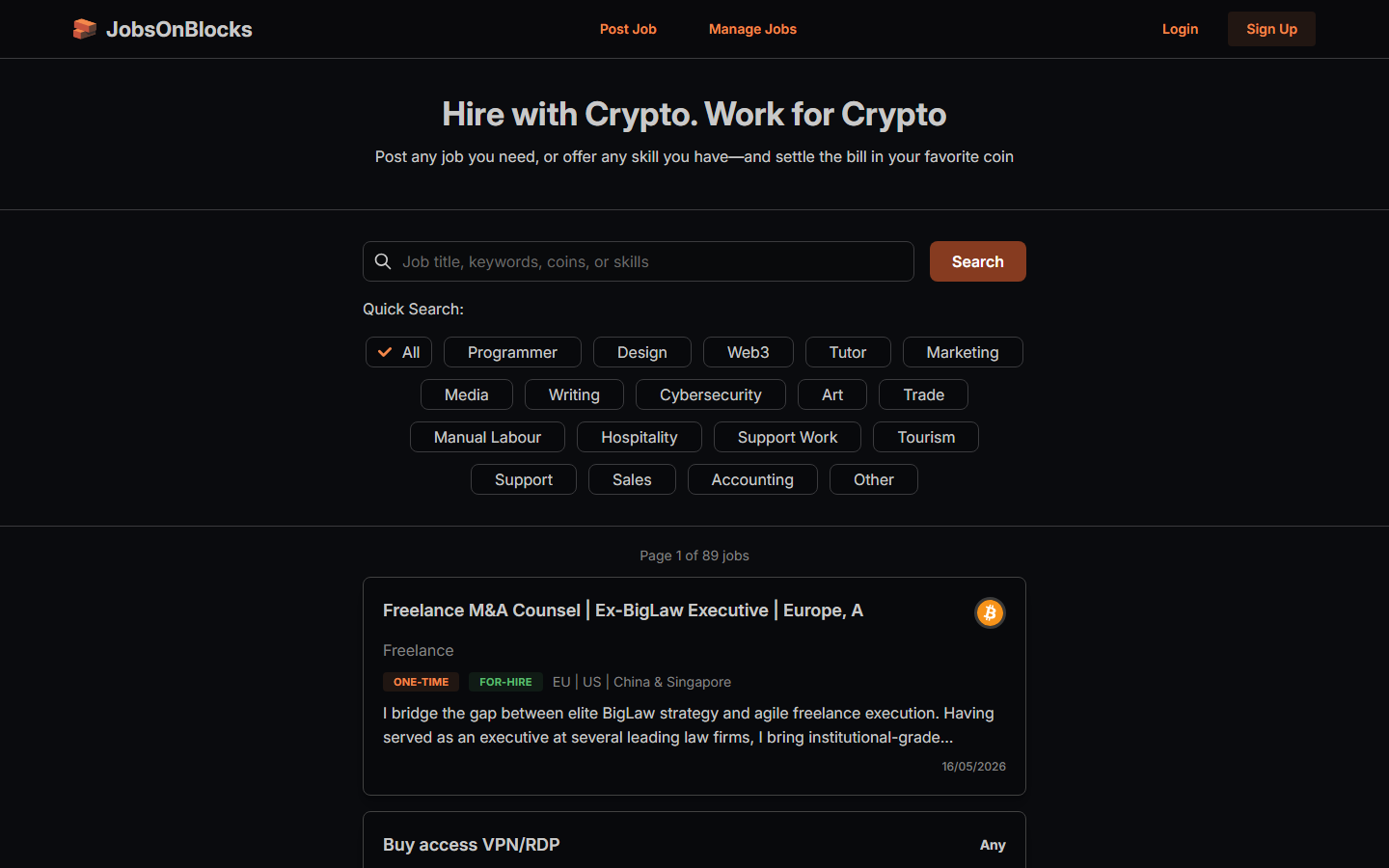
JobsOnBlocks simplifies earning cryptocurrency by offering a comprehensive ecosystem for job seekers and employers to connect and transact in cryptocurrency.
Live preview
jobsonblocks.com
▶
https://jobsonblocks.com
Review
EditorialOverview
JobsOnBlocks pitches itself as a crypto-native employment marketplace where the traditional financial system is optional. The platform operates at jobsonblocks.com and functions as a job board and hiring tool built specifically for digital-asset compensation. Rather than forcing users through banking rails or identity checks, it lets workers and employers connect, negotiate, and settle in cryptocurrency. The concept targets a growing niche: professionals who want to earn outside conventional payroll systems, and companies—especially DAOs, privacy projects, and offshore teams—that prefer to hire without geographic or bureaucratic friction.
The ecosystem covers both sides of the labor market. Job seekers can browse postings and apply without surrendering personal data, while employers can list openings and pay in the privacy coins and layered-2 networks that align with their treasury policies. It is a Tool-category service first, not a full-service freelancer escrow platform, so expectations about dispute resolution and milestone management should be calibrated accordingly.
Privacy & KYC
JobsOnBlocks sits at KYC Tier L1 — Anonymous, the most permissive classification on our scale. Registration is pseudonymous: no government ID, no proof of address, no selfie verification, and no mandatory legal-name collection. This makes it one of the few employment-oriented sites where a user can create a profile, apply for work, and receive payments without ever linking the activity to a real-world identity.
However, the privacy score of 65/100 signals room for improvement. The site does not publish a detailed data-handling or retention policy, and we have not verified whether IP addresses are logged at the server level or whether email is required for account creation. For users operating under serious threat models, we recommend layering additional operational security—Tor or a trusted VPN for browsing, and dedicated Monero or Lightning wallets that are not reused across platforms.
- KYC level: None. Pseudonymous access by default.
- Email required: Unconfirmed in public documentation.
- IP logging: Policy not transparently disclosed.
- Best practice: Use fresh wallets and avoid cross-platform identity leakage.
Supported assets & payments
The platform is built around three payment rails: Monero (XMR), Bitcoin (BTC), and Bitcoin Lightning. This trio is deliberate. Monero provides unlinkable transactions for workers who need maximum financial privacy. On-chain Bitcoin satisfies employers with treasury exposure to BTC. Lightning enables fast, low-fee micropayments that make small gigs and hourly billing economically viable. No stablecoins, alt-L1s, or fiat off-ramps are advertised, which keeps the scope narrow but ideologically consistent with a hard-money, privacy-first user base.
Because JobsOnBlocks does not appear to act as a payment processor or escrow agent, settlement happens peer-to-peer. Employers send funds directly to the worker's provided address. This removes counterparty risk tied to the platform itself, but it also means there is no built-in mediation if a client refuses to pay after deliverables are submitted. Users should negotiate terms—milestone releases, upfront deposits, or smart-contract escrow—outside the site if trust has not been established.
Security & custody
JobsOnBlocks is non-custodial with respect to user funds. Wallets are not hosted on the platform; workers supply their own XMR, BTC, or Lightning addresses and control private keys independently. This is a net positive for security purists, yet it shifts the burden entirely onto participants. There is no insurance fund, no arbitration bond, and no visible bug-bounty program.
The trust score of 50/100 reflects this bare-bones posture. The domain has limited third-party audit history, no published security whitepaper, and sparse community track record compared to established freelance marketplaces. Users should treat the site as a matching layer rather than a trusted intermediary. Verifying employer legitimacy through outside channels—portfolio review, reference checks, or small test tasks—is essential before committing significant labor.
Who it's for — verdict
JobsOnBlocks is best suited for two overlapping audiences: privacy-conscious freelancers who refuse KYC on principle, and crypto-native employers who want to pay from cold-storage or multisig treasuries without triggering compliance workflows. It fits developers, designers, writers, community managers, and auditors who already invoice in Monero or Lightning and do not need fiat conversion.
It is less appropriate for beginners who expect dispute resolution, time-tracking, or automatic tax documentation. The 6/10 overall score acknowledges a compelling concept with thin operational guardrails. If the team adds transparent privacy policies, optional reputation staking, or Lightning-native escrow, the rating could rise materially. For now, it is a useful directory and handshake layer for sovereign work—provided users bring their own risk management.
Community summary
JobsOnBlocks connects freelancers and employers who want to hire and get paid in cryptocurrency without identity verification, running as a pseudonymous tool for sovereign work.
Pros
- + True pseudonymous access with no ID verification required
- + Direct Monero, Bitcoin and Lightning payments without platform custody
- + Crypto-native employer base avoids fiat banking delays
- + Lightning support makes small-task micropayments practical
- + Borderless hiring without geographic restriction
Cons
- − No transparent privacy policy or IP-logging disclosure
- − No built-in escrow or dispute resolution mechanism
- − Thin trust indicators and limited third-party security audits
- − Narrow asset support excludes stablecoin and altcoin treasuries
Attributes
3 signalsStrengths
No KYC mention
P+15
Accepts Monero
P+5
Cautions
Community contributed
Related
4 services
Kusama Shield
Tool · Exchange
 Crawlbase
Tool · Proxy store
Crawlbase
Tool · Proxy store
 Kuno
Tool
Kuno
Tool
 SimpleLogin
Tool · Email alias
SimpleLogin
Tool · Email alias
User reports
★ 5/5 · 1 ratings
Swapuz ✅ (Support at Swapuz)
5/5
JobsOnBlocks is crypto-native employment — connect, earn, and transact in crypto across a full job ecosystem. No banks, no borders, just sovereign work flow. 🧱