 PinToPay
Cards
PinToPay
Cards

Kripicard
Communitykripicard.com
Crypto card platform providing payment infrastructure for creators, businesses, and Web3 projects.
Live preview
kripicard.com
▶
https://kripicard.com
Review
EditorialOverview
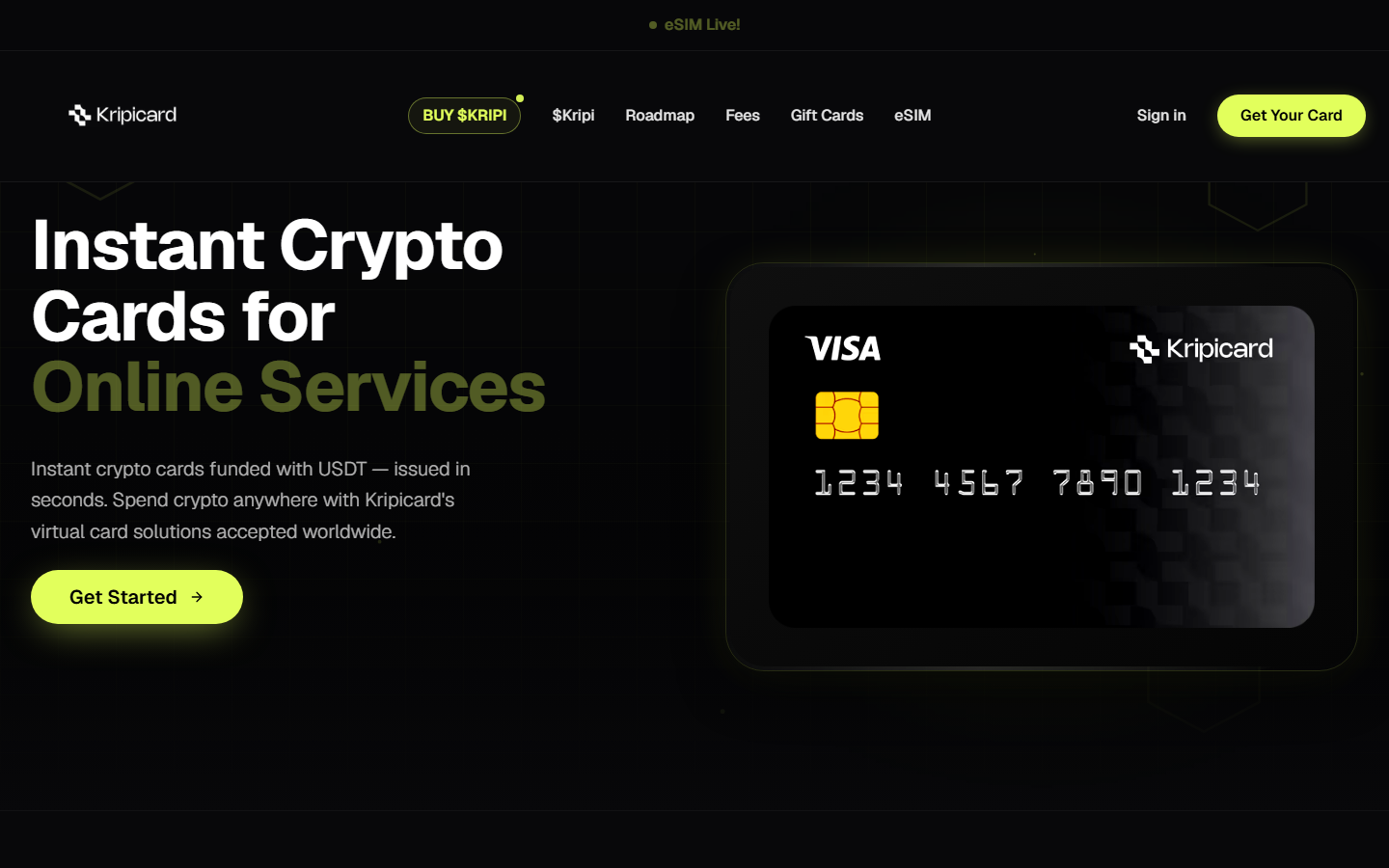
Kripicard positions itself as a crypto-native payment infrastructure layer for creators, agencies, and Web3 projects seeking instant virtual card issuance. The platform's core pitch revolves around converting cryptocurrency into spendable fiat at over 90 million Mastercard and Visa merchants worldwide. Beyond individual consumers, Kripicard markets heavily toward media buyers needing ad spend cards for Facebook, Google, and TikTok campaigns, plus developers wanting programmatic card creation via API. The ecosystem extends into adjacent services: crypto-funded eSIM plans and a growing gift card marketplace covering hundreds of brands. A native $KRIPI utility token on Solana adds a speculative layer, though its practical utility for cardholders remains secondary to the main payment rails.
Privacy & KYC
Kripicard operates on an L3 tiered KYC model, meaning users can access limited functionality without full identity verification but face thresholds that trigger document requirements. This places it in a middle ground: not fully anonymous, not fully surveillance-grade. The platform requires email registration, creating an immediate pseudonymity gap for users seeking zero-footprint onboarding. IP logging status remains unconfirmed in public documentation, adding uncertainty for Tor or VPN-reliant users. The privacy score of 49/100 reflects these compromises—functional for obfuscation-minded users willing to segment identities, but inadequate for strict anonymity.
- Tiered KYC: low limits possible without ID, higher spending triggers verification
- Email mandatory: cannot create cards without valid address
- IP logging policy not transparently disclosed
- Privacy score below median for no-KYC card competitors
Supported assets & payments
Kripicard's funding flexibility exceeds its minimalist branding. Users can deposit USDT, USDC, BTC, ETH, Solana, TON, Litecoin, Tron, Dogecoin, Monero, and BNB across multiple blockchain networks, with the homepage teasing additional assets. This multi-chain approach distinguishes it from single-asset competitors and particularly benefits Monero holders seeking off-ramp utility—though the privacy coin's integration exists within a system that still demands email linkage. Card top-ups execute in seconds after crypto confirmation, converting to fiat-denominated balances. The gift card vertical accepts the same cryptocurrency range, enabling indirect spending at retailers that never touch crypto directly. For 2026, the eSIM and API integrations suggest Kripicard is building toward embedded finance rather than pure consumer cards.
Security & custody
The custody model remains custodial by necessity—funds sit in Kripicard-controlled balances before card issuance, with users trusting the platform's solvency and security practices. The trust score of 59/100 indicates moderate confidence without standout transparency. One concrete positive: Kripicard advertises open-source components, though the extent of code auditability and which repositories are public remains unclear from marketing materials alone. Users should treat balances as hot-wallet exposure: convenient for spending, inappropriate for storage. No hardware security module claims or insurance disclosures appear prominently. For high-volume media buyers or businesses, the API introduces additional attack surface requiring careful key management.
Who it's for — verdict
Kripicard suits privacy-tolerant crypto spenders who prioritize convenience over absolute anonymity. Creators, freelancers, and small agencies needing ad spend cards without traditional banking friction represent the natural fit. Monero users gain rare card-offramp utility but must accept email-based account linkage. Strict no-KYC purists should look elsewhere—the tiered model eventually demands documents, and the 49/100 privacy score signals systemic data collection. The 5/10 overall rating reflects competent execution in a crowded niche without differentiation on trust or transparency. For 2026, Kripicard is a conditional recommendation: functional for segmented identity use cases, inadequate for those refusing any paper trail.
Community summary
Kripicard delivers instant virtual cards and crypto-funded gift cards for global spending, but its tiered KYC and moderate privacy scores make it a conditional choice for anonymity seekers.
Pros
- + Instant virtual card issuance with broad crypto funding
- + Monero and Solana support among 10+ assets
- + API access for programmatic business use
- + Gift card marketplace expands merchant reach
- + Open-source claims suggest partial transparency
Cons
- − Tiered KYC eventually requires identity verification
- − Mandatory email undermines true anonymity
- − Below-average privacy and trust scores
- − Custodial balances carry counterparty risk
Attributes
17 signalsStrengths
Identity-Free registration
P+10
Personal info is not verified
P+9
Accepts Monero
P+5
Open source code
T+7
Audited
T+5
Source available code
T+4
Red flags
Service Termination Policy
T-4
May require KYC/SOF by policy/law
P-6 T-4
Cautions
May Freeze or Seize Funds
T-3
Community contributed
Transaction monitoring
P-1
Third-Party payment processor
P-2 T+1
Shotgun KYC
P-15
Informational
Legally registered
T+2
Basic Customer Support
T+1
API available
Account required
P-1