 eigenwallet
Exchange · DEX
eigenwallet
Exchange · DEX

Kusama Shield
Communitykusamashield.laissez-faire.trade
Private Crypto currency transfers - Multi asset privacy Shielded Pool
Live preview
kusamashield.laissez-faire.trade
▶
https://kusamashield.laissez-faire.trade
Review
EditorialOverview
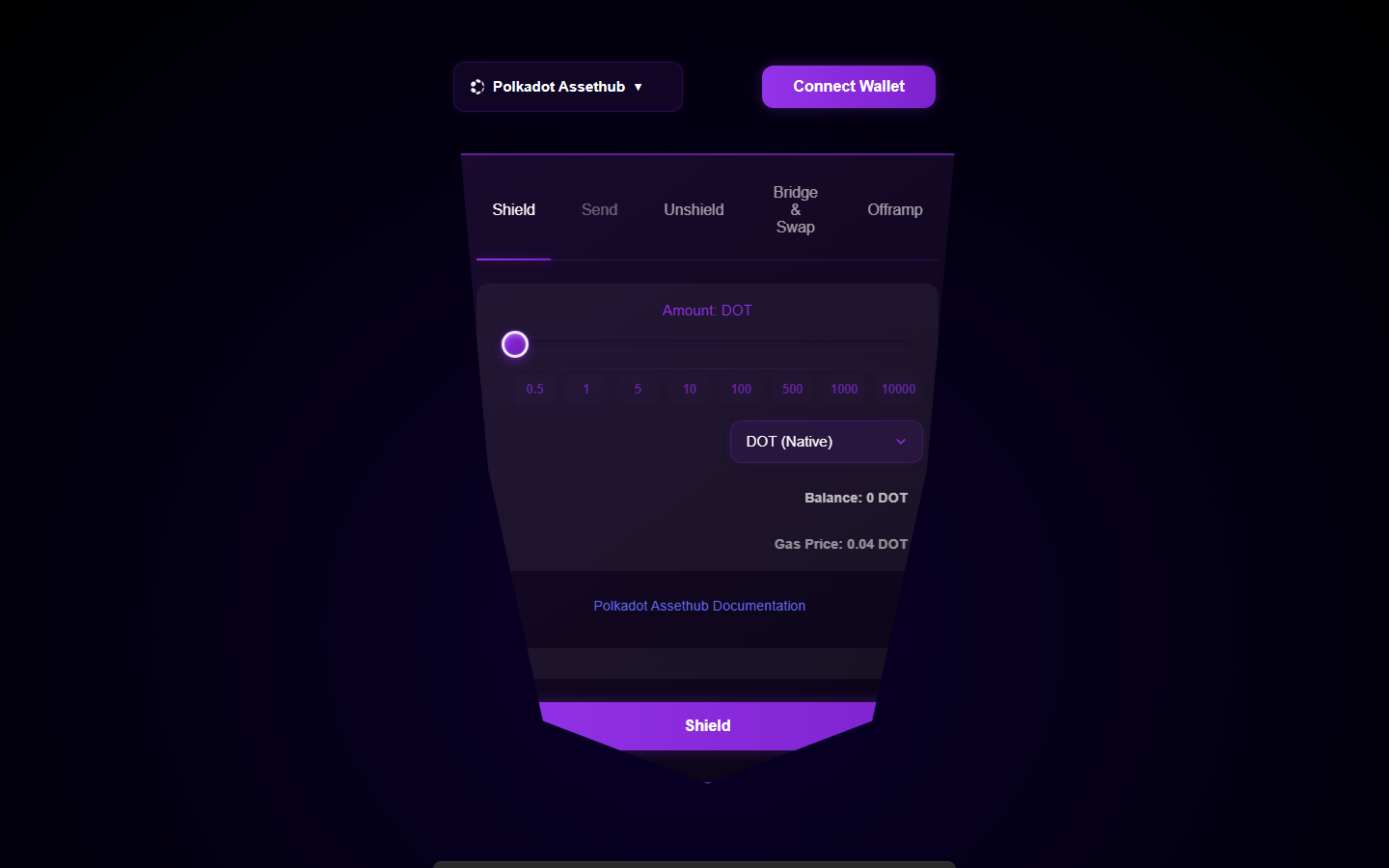
Kusama Shield operates at the extreme end of the privacy spectrum: a zero-registration tool that lets users move between Bitcoin and Monero through a shielded liquidity pool. Hosted at kusamashield.laissez-faire.trade, the service functions as both a privacy utility and a lightweight cross-chain exchange, but without the usual trappings of centralized platforms. There are no dashboards to log into, no email confirmations, and no withdrawal whitelists. The entire workflow is designed to minimize data leakage at every step, which is why it earns one of the highest privacy scores in our directory.
What distinguishes Kusama Shield from conventional no-KYC exchanges is its architectural emphasis on trust minimization. Rather than acting as a counterparty that temporarily holds funds, the protocol routes transactions through a shielded pool, breaking deterministic links between sender and recipient addresses. For users who treat privacy as a security layer rather than a convenience feature, this design philosophy is the main draw.
Privacy & KYC
Kusama Shield sits at KYC Tier L0 — the absolute baseline of identity exposure. No account is required, no email address is collected, and no IP logging is performed. This places it in the same regulatory grey zone as on-chain mixers and atomic swaps, but with a crucial difference: the interface is accessible through a standard web browser rather than requiring command-line proficiency.
- No signup workflow: Users arrive at the site, specify output addresses, and receive a deposit invoice. No passwords, no 2FA backups, no recovery phrases tied to a hosted account.
- IP-agnostic design: The service does not log connecting IP addresses, though users running Tor or a VPN can add an additional network-layer buffer without breaking functionality.
- Shielded pool architecture: Transactions are commingled in a liquidity pool rather than routed through a transparent hot wallet, making external chain analysis significantly harder.
The privacy score of 100/100 reflects this uncompromising stance. However, the trade-off is a trust score of 75/100 — respectable for a young, unaudited protocol, but indicating that users must still verify open-source code and understand the cryptographic assumptions underlying the shielded pool.
Supported assets & payments
Kusama Shield keeps its asset list deliberately narrow: Monero (XMR) and Bitcoin (BTC) only. This is a feature, not a limitation. By focusing on the two most widely used privacy and pseudonymous cryptocurrencies, the protocol avoids the complexity of supporting ERC-20 tokens or stablecoins that would introduce contract risk and regulatory attention.
There is no fiat on-ramp or off-ramp. Users must already hold XMR or BTC to interact with the service. The implied use case is privacy enhancement — converting transparent Bitcoin into opaque Monero, or vice versa, without leaving a paper trail at a regulated exchange. For 2026, this two-asset approach aligns with the reality that most serious privacy workflows still revolve around these base-layer coins.
Security & custody
Kusama Shield is non-custodial by design. Funds are never deposited into a company-controlled wallet for longer than the atomic settlement window requires. The open-source codebase allows technically inclined users to inspect the contract logic or run a local frontend, reducing reliance on the hosted domain.
That said, the trust score caveat matters here. Without a formal security audit published on the site, users are trusting the mathematics of the shielded pool and the integrity of the deployment. The open-source nature mitigates this, but only for those willing to review the code or wait for community validation. As with any L0 service, there is no customer support to appeal to if a transaction stalls; recovery depends entirely on the protocol's built-in refund or timeout mechanisms.
Who it's for — verdict
Kusama Shield is built for a specific profile: the privacy-literate crypto user who needs to move value between Bitcoin and Monero without touching a KYC exchange, and who accepts the responsibility of self-verifying a trustless protocol. It is not for beginners seeking hand-holding, nor for traders chasing altcoin breadth or leveraged positions.
The 9/10 overall score rewards Kusama Shield for executing its narrow mission with exceptional discipline. In a 2026 landscape where even "no-KYC" services increasingly demand phone numbers or geofence jurisdictions, a truly accountless, open-source privacy tool stands out. The deduction from a perfect score comes solely from the unaudited trust assumptions — a gap that community scrutiny or a future audit could close. For now, it remains one of the most anonymous bridges between Bitcoin and Monero available without command-line expertise.
Community summary
Kusama Shield is a trustless, open-source privacy layer that lets users swap and shield Bitcoin and Monero without creating an account or submitting identity documents.
Pros
- + True L0 — no account, email, or identity data required
- + Open-source code enables independent verification
- + Non-custodial architecture eliminates exchange hack risk
- + Shielded pool breaks on-chain linkability between inputs and outputs
- + Clean browser-based interface removes technical barriers
Cons
- − No fiat on- or off-ramps; requires existing crypto holdings
- − Only Bitcoin and Monero supported, limiting flexibility
- − No published security audit as of 2026
- − No customer support channel for transaction troubleshooting
Attributes
15 signalsStrengths
Guaranteed no KYC
P+25
Personal info is not verified
P+9
Refunds do not require KYC
P+5 T+5
Strict no-log policy
P+5 T+3
Accepts Monero
P+5
No registration needed
P+5
Non-custodial wallet
P+3 T+5
Open source code
T+7
Decentralized network
T+5
Source available code
T+4
Cautions
Unclear refund policy
T-4
Community contributed
Informational
Currently in beta
T-1
Basic Customer Support
T+1
JavaScript needed
Related
4 services
eigenwallet
Exchange · DEX
 Bisq
Exchange · P2P
Bisq
Exchange · P2P
 BasicSwap
Exchange · P2P
BasicSwap
Exchange · P2P
 RoboSats
Exchange · P2P
RoboSats
Exchange · P2P