 Kusama Shield
Tool · Exchange
Kusama Shield
Tool · Exchange

LeakCheck
Communityleakcheck.io
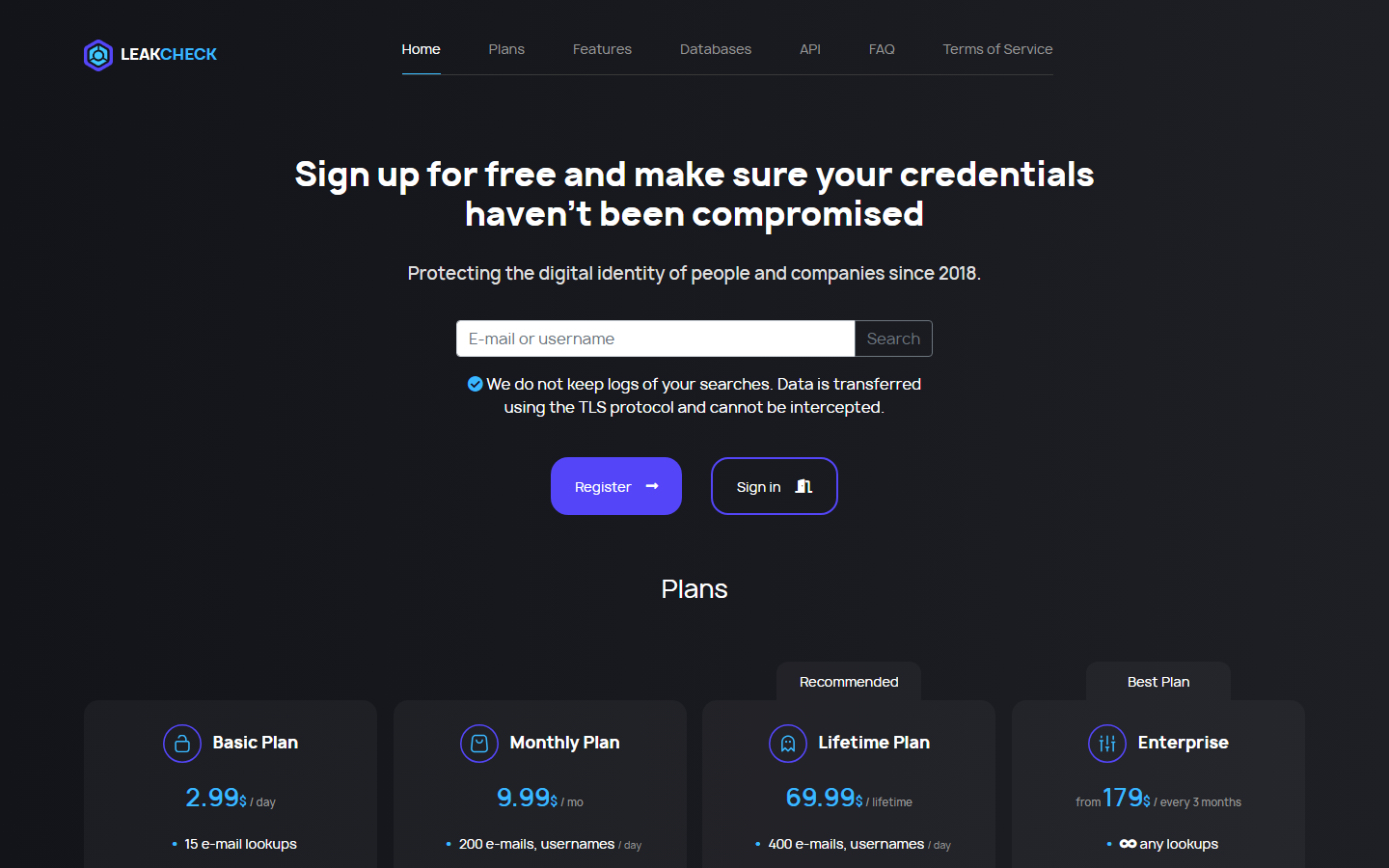
LeakCheck is a service that enables users and companies to ascertain whether their credentials have been compromised. The user can view detailed information, analyse the security risk and perform a number of other functions.
Live preview
leakcheck.io
▶
https://leakcheck.io
Review
EditorialOverview
LeakCheck positions itself as a practical entry point into the world of breach intelligence without demanding extensive personal information. Founded in 2018, the service has spent six years building a searchable database of compromised credentials drawn exclusively from public sources. Users can query by email, username, keyword, corporate domain, or even password to determine whether their data has surfaced in known leaks. The platform targets both individual privacy seekers and enterprise security teams, offering tiered access that ranges from casual daily lookups to bulk processing of 100,000-line datasets. What distinguishes LeakCheck in the no-KYC landscape is its deliberate minimalism: you can register with little more than an email and start searching within seconds.
The service emphasizes speed and scale. Queries return results in roughly a second, and the database covers a broad spectrum of indexed breaches. For developers and businesses, LeakCheck provides API access bundled with every subscription tier, plus a Telegram bot for mobile convenience. Enterprise customers gain additional capabilities like reverse password search, domain monitoring, and dedicated integration support. While it does not promise exhaustive coverage—some sources appear as "unknown" when leak files are unavailable—the platform compensates with usability and rapid iteration.
Privacy & KYC
LeakCheck operates at KYC Tier L2 — Discreet, requiring only an email address for account creation. This places it among the more privacy-respecting options in the cybersecurity tool space, though it stops short of full anonymity. Users can authenticate via Telegram or social networks, but the base requirement remains minimal. The platform does not demand government ID, phone verification, or proof of address, making it accessible to pseudonymous operators and privacy advocates alike.
- Email-only registration: No mandatory identity documents.
- Telegram integration: Offers an alternative login path that reduces direct data sharing.
- IP logging status unconfirmed: The authoritative data does not specify whether LeakCheck retains IP addresses; privacy-conscious users should assume standard server logging may apply.
- Data removal option: The site provides a removal email ([email protected]) for individuals seeking to delist their information—an unusual transparency gesture for this category.
That said, the privacy score of 65/100 suggests room for improvement. The absence of clear no-logs assurances, combined with unverified IP retention practices, keeps LeakCheck from joining the top tier of anonymity-first services. Users seeking maximum separation between identity and activity should pair LeakCheck with VPN or Tor usage and consider the Monero payment route to minimize financial traceability.
Supported assets & payments
LeakCheck accepts Monero (XMR) and Bitcoin (BTC), aligning its payment infrastructure with the preferences of privacy-focused users. Monero in particular stands out: its ring-signature architecture obscures transaction origins and amounts, making it the superior choice for subscribers who want to sever the link between their financial footprint and their breach-monitoring activity. Bitcoin remains viable but offers weaker on-chain privacy without additional layering techniques.
The pricing structure spans four tiers. The Basic Plan at $2.99 per day grants 15 email lookups—suitable for one-off investigations. The Monthly Plan at $9.99 per month raises daily limits to 200 emails or usernames plus 15 keywords. The Lifetime Plan at $69.99 offers 400 daily lookups and 30 keywords with no recurring billing, presenting strong long-term value for persistent users. Finally, the Enterprise Plan starts at $179 per quarter and unlocks unlimited queries, bulk checks, reverse password search, domain monitoring, and white-glove integration support. All paid tiers include API access, removing the typical paywall between casual and developer use cases.
Security & custody
As a non-custodial intelligence tool, LeakCheck does not hold user funds or cryptocurrency wallets. Subscribers pay for access, not asset storage, which eliminates the custody risks associated with exchanges or mixing services. The platform's security model centers on data handling rather than fund protection: it aggregates breach information from public sources, indexes it for searchability, and serves it through encrypted web and API channels.
Trust remains the central tension. The trust score of 45/100 indicates significant community skepticism or limited verifiable operational history. LeakCheck has operated since 2018 and claims thousands of users including global companies, yet independent third-party audits or security certifications are not mentioned in available sources. Users should treat the service as a reconnaissance layer rather than a definitive authority—cross-reference critical findings with Have I Been Pwned or similar databases where possible. The Telegram bot and API expand attack surface for account compromise, so enabling any available two-factor protections and using unique, high-entropy passwords is essential.
Who it's for — verdict
LeakCheck fills a specific niche: individuals and organizations that need rapid, low-friction breach intelligence without navigating invasive identity verification. Journalists investigating credential leaks, system administrators monitoring corporate domains, and privacy-conscious users auditing their own exposure will find the email-only signup and Monero payment options genuinely useful. The lifetime plan particularly rewards long-term commitment at a reasonable flat cost.
However, the modest trust score and unverified logging policies mean LeakCheck works best as a component in a broader operational security stack rather than a standalone solution. It excels for quick checks, bulk preliminary scans, and API-driven automation, but users with high-stakes threat models should supplement it with vetted alternatives and independent verification. For those prioritizing no-KYC access to breach data in 2026, LeakCheck delivers functional value with acceptable trade-offs—provided expectations align with its limitations.
Community summary
LeakCheck is a low-KYC breach intelligence platform that lets individuals and companies audit compromised credentials with just an email address, accepting Monero and Bitcoin for privacy-conscious users.
Pros
- + Minimal KYC—only email required for registration
- + Monero and Bitcoin accepted for privacy-preserving payments
- + Lifetime plan offers strong long-term value at $69.99
- + API access included with every subscription tier
- + Fast search results and broad breach database coverage
- + Telegram bot enables mobile and pseudonymous usage
Cons
- − Trust score of 45/100 raises operational reliability questions
- − IP logging policy remains unspecified in available sources
- − Some breach sources appear as "unknown," limiting completeness
Attributes
11 signalsStrengths
Identity-Free registration
P+10
Strict no-log policy
P+5 T+3
Accepts Monero
P+5
Cautions
May suspend your account
T-4
No-refund policy
T-3
Community contributed
Rare KYC
P-5
Informational
Source code is private
T-1
API available
JavaScript needed
Telegram bot available
Related
4 services
Kusama Shield
Tool · Exchange
 Crawlbase
Tool · Proxy store
Crawlbase
Tool · Proxy store
 Kuno
Tool
Kuno
Tool
 SimpleLogin
Tool · Email alias
SimpleLogin
Tool · Email alias