 Kusama Shield
Tool · Exchange
Kusama Shield
Tool · Exchange

litport
Communitylitport.net
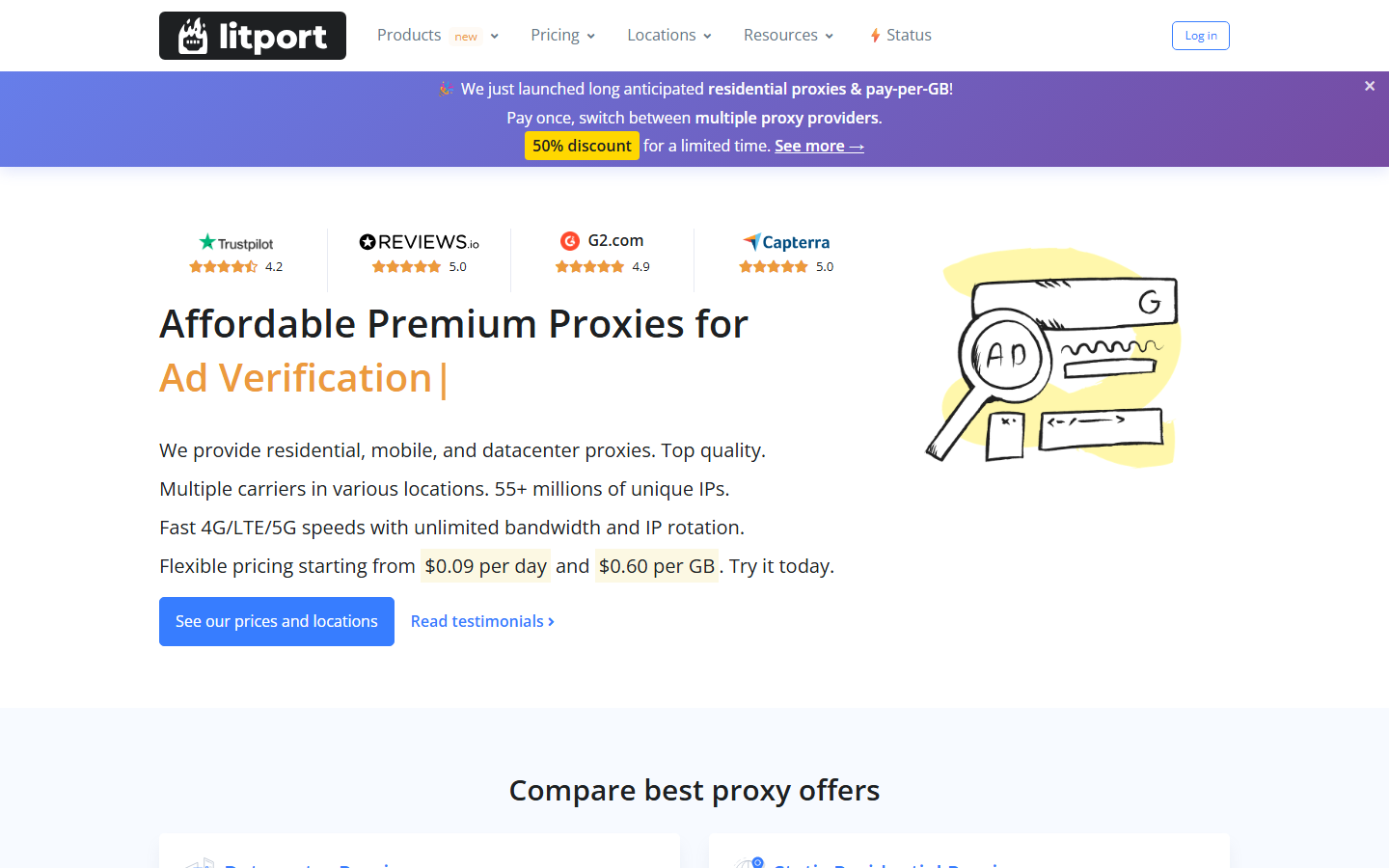
We provide residential, mobile, and datacenter proxies. Top quality. Multiple carriers in various locations. 55+ millions of unique IPs. Fast 4G/LTE/5G speeds with unlimited bandwidth and IP rotation. Flexible pricing starting from $0.09 per day. Try it today.
Live preview
litport.net
▶
https://litport.net
Review
EditorialOverview
Litport operates as a proxy infrastructure provider catering to users who prioritize operational privacy over identity verification. The service maintains a substantial pool of more than 55 million unique IP addresses spanning residential ISP, mobile carrier, and datacenter sources across multiple global locations. With flexible pricing starting at roughly $0.09 per day for entry-level datacenter plans, Litport targets scrapers, automation specialists, and crypto-native users who need reliable IP rotation without surrendering personal documentation.
The platform emphasizes speed and flexibility, advertising 4G, LTE, and 5G connectivity for mobile proxies alongside unlimited bandwidth configurations. Users can select between unlimited traffic or pay-per-GB models depending on workload intensity. Plan durations range from single-day tests to annual commitments with tiered discounts, making the service approachable for both experimental and production-scale deployments.
Privacy & KYC
Litport sits at KYC Tier L1 — Anonymous, meaning users access the service pseudonymously without submitting government identification, proof of address, or other personal documentation. This places it among the more permissive proxy providers for privacy-conscious operators who refuse identity-linked accounts.
- No mandatory identity verification for account creation or proxy activation
- Email requirement status unclear from current documentation
- IP logging policy not explicitly detailed in available materials
- Privacy score of 60/100 suggests room for improvement in transparency around data retention and logging practices
The pseudonymous access model aligns well with crypto-native workflows, though users seeking maximum operational security should independently verify current logging disclosures before routing sensitive traffic through the infrastructure.
Supported assets & payments
Litport accepts Bitcoin alongside fiat payment methods, enabling cryptocurrency users to fund proxy access without touching traditional financial rails. This dual-track payment structure supports the service's no-KYC positioning, as Bitcoin transactions can be conducted with minimal identity exposure when proper wallet hygiene is observed.
The pricing architecture offers meaningful flexibility. Datacenter proxies begin at $0.09 daily for shared static plans, while private static options start at $0.19 per day. Rotating configurations command modest premiums, with private rotating datacenter proxies at $0.49 daily. Residential and mobile proxy tiers follow similar unlimited or pay-per-GB structures, with per-GB rates appearing around $0.60 based on current listings. Volume discounts activate at 25-plus proxy orders, rewarding larger deployments.
Security & custody
As a non-custodial tool in the traditional sense, Litport does not hold user funds beyond immediate payment processing. The security model centers on proxy reliability and IP diversity rather than asset custody. Infrastructure spans 50-plus subnets for datacenter offerings alone, reducing single-point-of-failure risks for automation pipelines.
Proxy activation occurs within approximately 60 seconds of payment confirmation, suggesting automated provisioning rather than manual review. Speed caps vary by tier: shared plans throttle at 5 Mbps with 100-thread limits, while private plans unlock up to 100 Mbps with unrestricted threading. Free weekly proxy replacement on datacenter plans provides basic recourse against IP blocking or degradation.
The trust score of 50/100 indicates moderate community confidence, likely reflecting limited public auditing of infrastructure claims and absence of third-party security certifications. Users should validate performance independently through short-duration purchases before committing to extended contracts.
Who it's for — verdict
Litport suits privacy-focused developers, crypto traders managing multiple exchange accounts, researchers conducting large-scale data collection, and anyone requiring anonymous proxy infrastructure without bureaucratic onboarding friction. The Bitcoin payment pathway and pseudonymous access remove typical identity barriers that competing services enforce.
However, the middling trust and privacy scores signal caution. The lack of granular logging disclosures and unverified email requirements create uncertainty for threat-modeled users. Those needing bulletproof anonymity should layer additional operational security regardless of Litport's no-KYC marketing.
For users prioritizing convenience and cost over absolute assurance, Litport's 55 million IP pool, flexible durations, and crypto-friendly checkout deliver functional value. The overall score of 6/10 reflects competent execution of a narrow use case rather than market-leading transparency or security architecture.
Community summary
Litport delivers residential, mobile, and datacenter proxy infrastructure with pseudonymous signup and Bitcoin payment options, positioning itself as a no-KYC tool for privacy-focused automation and scraping workflows.
Pros
- + True pseudonymous access with no identity verification required
- + Bitcoin payments accepted alongside fiat options
- + Massive 55 million-plus IP pool across residential, mobile, and datacenter categories
- + Flexible pricing from $0.09/day with no long-term contracts
- + Rapid proxy activation within 60 seconds of payment
- + Unlimited bandwidth options available on multiple tiers
Cons
- − Privacy and trust scores remain mediocre at 60/100 and 50/100
- − Logging policy lacks detailed public documentation
- − IPv6 support still pending as of 2026
- − Shared proxy tiers have restrictive 5 Mbps speed caps
Attributes
2 signalsStrengths
No KYC mention
P+15
Cautions
Community contributed
Related
4 services
Kusama Shield
Tool · Exchange
 Crawlbase
Tool · Proxy store
Crawlbase
Tool · Proxy store
 Kuno
Tool
Kuno
Tool
 SimpleLogin
Tool · Email alias
SimpleLogin
Tool · Email alias
User reports
★ 5/5 · 1 ratings
Swapuz ✅ (Support at Swapuz)
5/5
litport is proxy infrastructure for sovereign ops — 55M+ IPs, 4G/5G speed, unlimited bandwidth, crypto checkout. Residential, mobile, datacenter — pick your ghost layer. 🕵️♂️📡