 eigenwallet
Exchange · DEX
eigenwallet
Exchange · DEX

LMEX
Communitylmex.io
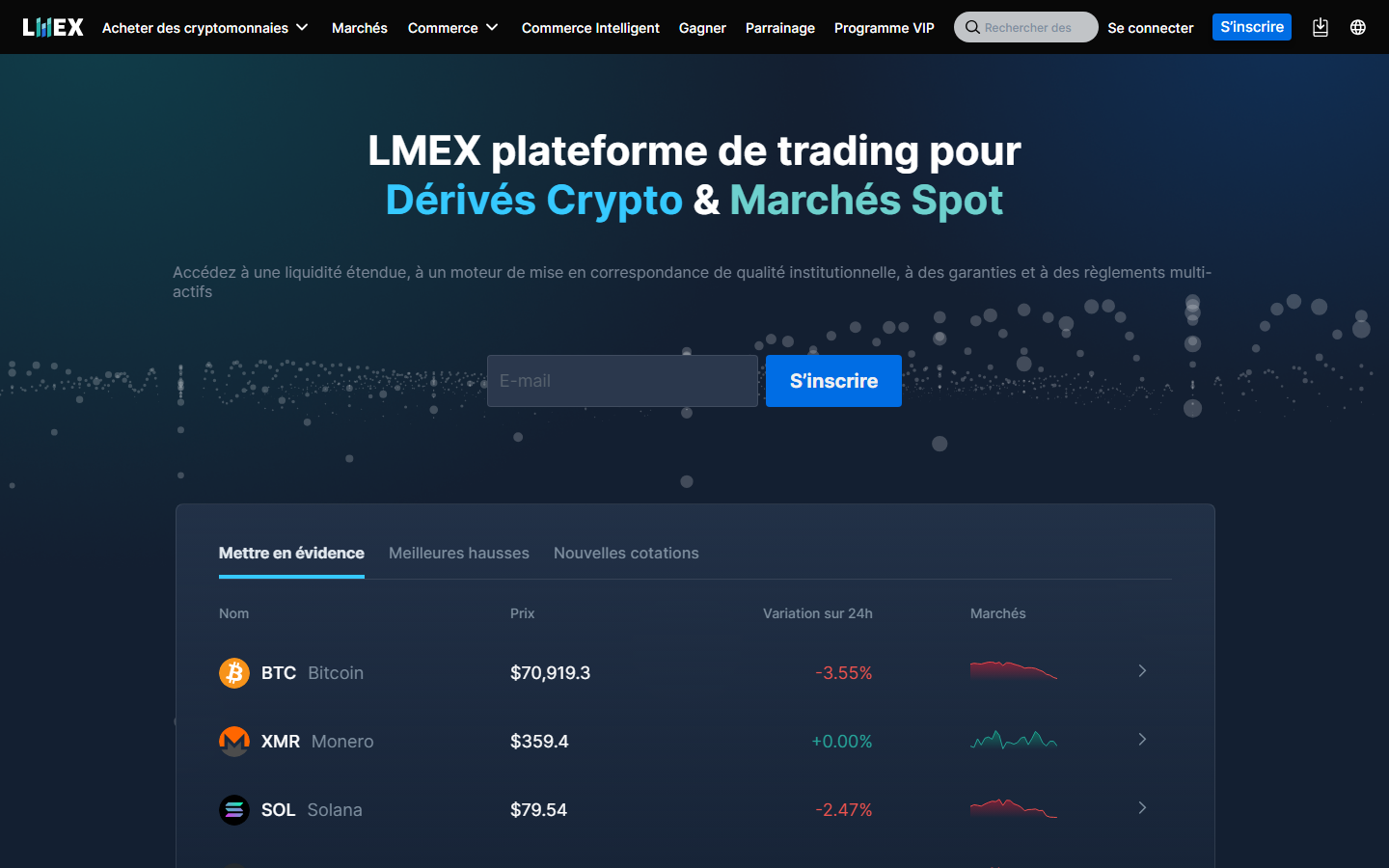
LMEX offers a cryptocurrency derivatives and spot exchange with deep liquidity, aggregated order books, multi-asset collateral and settlements, and advanced trading tools like Grid and DCA Bots. Whether you're trading spot or leveraged futures, LMEX provides a seamless, KYC-friendly experience with no daily withdrawal limits designed for active traders. BTC, XMR spot markets available.
Live preview
lmex.io
▶
https://www.lmex.io
Review
EditorialOverview
LMEX positions itself as a multi-functional cryptocurrency platform combining exchange and aggregator capabilities. The service targets active traders with leveraged futures, spot markets, and automated strategies including Grid and DCA bots. Multi-asset collateral and aggregated order books are central to its pitch, promising deep liquidity across trading pairs. For users seeking no-KYC or anonymous crypto exchange options, LMEX presents a mixed picture: basic access requires only email verification, but the platform's architecture and policies create meaningful privacy limitations that fall short of true anonymity.
Launched with a focus on derivatives and spot trading, LMEX emphasizes tools for sophisticated market participants rather than casual swappers. The platform's aggregated order-book model suggests it may pull liquidity from external sources, though users trade within LMEX's own environment. BTC and XMR spot markets are available, catering to traders who prioritize Bitcoin and Monero specifically.
Privacy & KYC
LMEX operates under a tiered KYC framework classified as L3: verification requirements escalate with trading volume or withdrawal thresholds, but the platform collects baseline data from every user. Email verification is mandatory for account creation, immediately eliminating fully anonymous onboarding. The platform also logs IP addresses, creating a persistent connection between trading activity and network location.
- KYC tier: L3 — tiered verification triggered above unspecified thresholds
- Email required: Yes, mandatory for all accounts
- IP logging: Confirmed active
- Privacy score: 42/100, reflecting significant data collection
For privacy-conscious traders, these policies represent substantial compromise. The combination of email linkage, IP tracking, and escalating identity demands places LMEX closer to mainstream regulated exchanges than to no-KYC alternatives. Users seeking to trade without identity exposure will hit friction points quickly, particularly as activity increases.
Supported assets & payments
LMEX's asset selection is deliberately narrow, focusing on two cryptocurrencies with strong privacy and store-of-value credentials. Bitcoin (BTC) and Monero (XMR) are the confirmed supported assets for spot trading. This concentration may appeal to users who prioritize these specific coins over broad altcoin exposure.
The platform's derivatives infrastructure suggests leveraged positions may extend beyond spot-available assets, though concrete details on futures underlying instruments are not specified in available data. Multi-asset collateral functionality implies users can post various cryptocurrencies as margin, potentially expanding effective trading exposure without direct spot support for every collateral type.
No fiat on-ramp details are confirmed; users should expect crypto-only funding. The absence of daily withdrawal limits, where advertised, benefits active traders moving significant volume, though this feature's practical availability likely depends on verification tier.
Security & custody
LMEX operates as a custodial exchange, meaning the platform controls private keys for user funds. This model introduces counterparty risk inherent to centralized services: deposits reside on LMEX infrastructure, subject to its security practices, solvency, and regulatory exposure. The trust score of 44/100 signals below-average confidence in these protections relative to competitors.
Custodial architecture conflicts with the self-custody ethos common among privacy-focused cryptocurrency users. Traders must accept that LMEX, not themselves, ultimately controls deposited Bitcoin and Monero. While this enables features like multi-asset collateral and instant internal transfers, it also creates honeypot potential and seizure vulnerability.
No specific security certifications, insurance funds, or proof-of-reserves mechanisms are documented in available research. Users should treat deposits as actively traded capital rather than long-term storage, moving excess holdings to personal wallets between trading sessions.
Who it's for — verdict
LMEX serves a specific niche: active traders who accept moderate identity verification in exchange for advanced derivatives tools, aggregated liquidity, and automation features. The platform suits users comfortable with email-linked accounts and IP logging, who primarily trade Bitcoin and Monero, and who value grid bots and DCA strategies over absolute privacy.
It is not recommended for users seeking genuinely anonymous crypto exchange services, those requiring strict operational security, or holders prioritizing self-custody. The 4/10 overall score reflects these structural limitations: functional trading infrastructure undermined by privacy deficits and custodial risk.
For 2026, LMEX occupies an awkward middle ground — too surveillance-leaning for privacy purists, yet lacking the regulatory clarity and trust indicators that mainstream users increasingly demand. Traders who fit its narrow profile may find utility; others should explore non-custodial or zero-KYC alternatives.
Community summary
LMEX operates as a cryptocurrency exchange and aggregator with tiered KYC requirements, offering spot and derivatives markets for Bitcoin and Monero while requiring email verification from all users.
Pros
- + Aggregated order books with claimed deep liquidity
- + Advanced trading tools including Grid and DCA bots
- + No daily withdrawal limits for verified tiers
- + Multi-asset collateral support
- + Bitcoin and Monero spot markets available
Cons
- − Mandatory email verification prevents anonymous signup
- − IP logging compromises operational privacy
- − Custodial model creates counterparty and seizure risk
- − Tiered KYC escalates identity demands with volume
- − Below-average trust and privacy scores (44/100 and 42/100)
Attributes
11 signalsStrengths
Identity-Free registration
P+10
Accepts Monero
P+5
Red flags
May require KYC/SOF by policy/law
P-6 T-4
Cautions
May suspend your account
T-4
Community contributed
Transaction monitoring
P-1
Shotgun KYC
P-15
Informational
Legally registered
T+2
API available
Mobile app available
Account required
P-1
Related
4 services
eigenwallet
Exchange · DEX
 Bisq
Exchange · P2P
Bisq
Exchange · P2P
 BasicSwap
Exchange · P2P
BasicSwap
Exchange · P2P
 RoboSats
Exchange · P2P
RoboSats
Exchange · P2P