 GoyMail
Email · Email alias
GoyMail
Email · Email alias

Mailum
Communitymailum.com
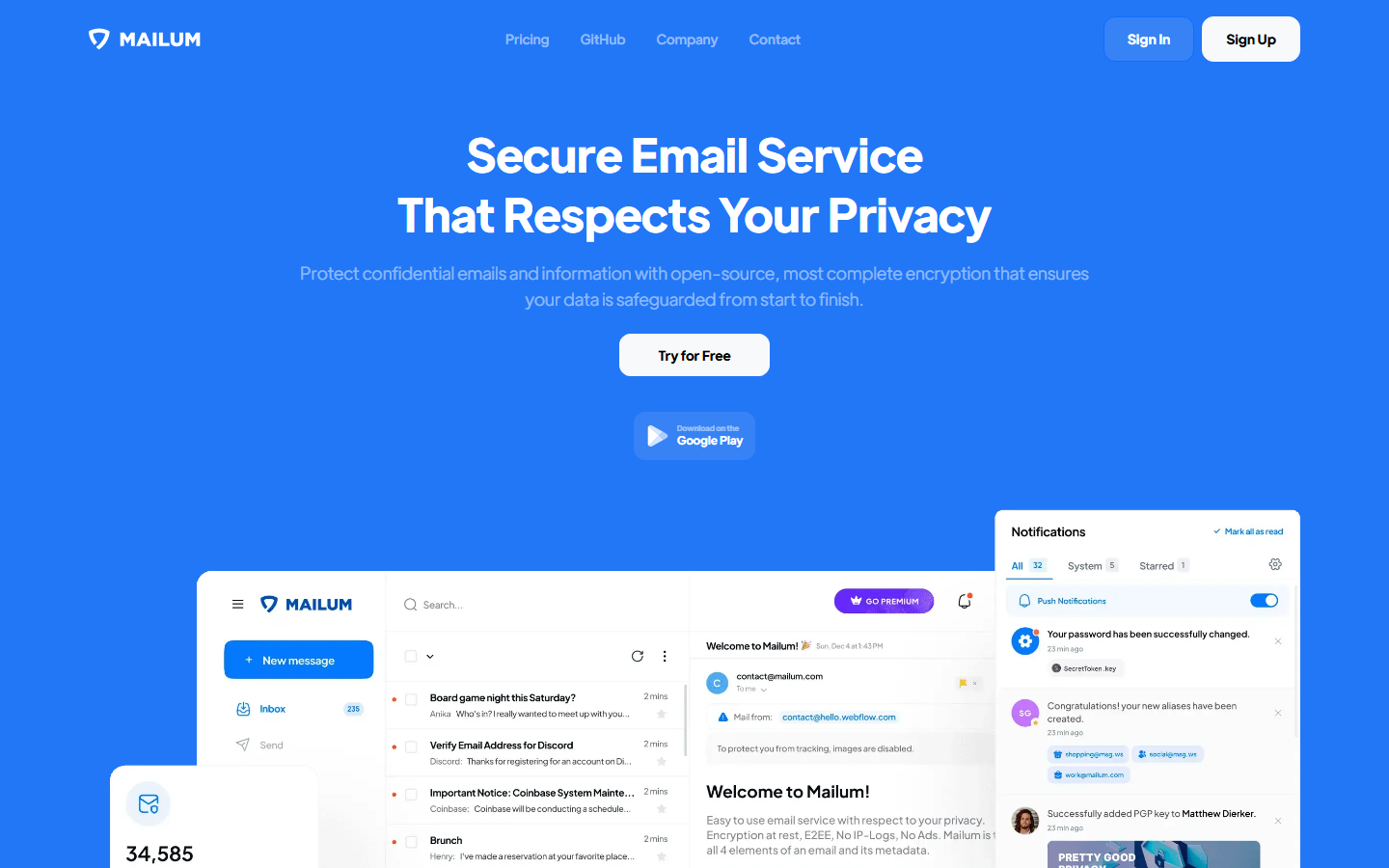
Privacy-focused Email Service with End-to-End Encryption. Protect confidential emails and information with open-source, most complete encryption that ensures your data is safeguarded from start to finish. At Mailum, we encrypt the entire email—body, subject, sender, recipient, and metadata—to ensure your messages remain completely secure and private.
Live preview
mailum.com
▶
https://mailum.com
Review
EditorialOverview
Mailum positions itself as a no-KYC email service built for users who refuse to trade identity for convenience. Launched with an open-source ethos, the platform encrypts not just message bodies but subjects, sender and recipient addresses, and metadata—what it calls "full-stack" protection. The service operates on a pseudonymous model: no government ID, no phone verification, no real-name policy. Users can pay for premium tiers with Monero, Bitcoin, and Lightning, with fiat also accepted for those less concerned with on-rail privacy. A Tor onion mirror is available, reinforcing its pitch to the anonymity-minded. However, a 6/10 overall score and a modest 42/100 trust rating signal that execution does not fully match ambition.
Privacy & KYC
Mailum sits at KYC Tier L1 — Anonymous, the least intrusive classification. Signing up demands no personal data, no backup email, and no phone number. This is genuine pseudonymous access, rare among email providers that typically demand at least one identity anchor. The platform’s encryption architecture is open-source and claims to lock down every packet of message metadata, not merely the body text.
- No identity verification required at any tier
- IP logging status unclear from disclosed policies; users relying on Tor should verify current practice independently
- Tor gateway offered for location-obscured access
- Community reports of VPN blocking raise concerns: some users state Mailum prevents site access over commercial VPNs, complicating anonymous registration and contradicting the no-KYC promise in practice
These VPN-friction reports are significant. A service marketing itself as anonymous yet blocking common privacy tools creates a tension that prospective users should weigh carefully.
Supported assets & payments
Mailum’s payment flexibility aligns with its crypto-native audience. Accepted methods include Monero (XMR)—the gold standard for private transactions—alongside Bitcoin and Lightning Network payments for faster, lower-fee settlements. Traditional fiat channels are also available, though they obviously sacrifice the anonymity chain that cryptocurrency payments preserve. The inclusion of Monero specifically signals intent to serve users who demand untraceable financial footprints, not merely pseudonymous ones.
Security & custody
Mailum’s security model centers on end-to-end encryption with an open-source codebase that allows independent audit. The provider encrypts the entire envelope—body, subject line, sender, recipient, and metadata—rather than the body-only approach common to legacy "secure" email. No third-party custody of decryption keys is described; users appear to retain control, though the exact key-escrow architecture is not detailed in available materials. The Tor availability adds a network-layer shield against traffic analysis. However, the 70/100 privacy score and 42/100 trust score suggest that either operational transparency, incident history, or third-party validation remains insufficient for full confidence. The trust gap may stem from the relative youth of the service, limited public security audits, or the aforementioned access friction reported by VPN users.
Who it's for — verdict
Mailum is best suited for privacy-conscious individuals needing a secondary, encrypted mailbox for sensitive correspondence, particularly where sender anonymity matters. Journalists, whistleblowers, cryptocurrency traders, and anyone operating under pseudonymity will find the L1 KYC tier and Monero payments compelling. The service is less practical as a primary daily driver: community feedback consistently flags that free-tier accounts cannot send emails to external addresses or reply to non-Mailum senders, limiting real-world utility until a paid plan is activated. Users who rely on VPNs for location privacy may encounter access hurdles that undermine the very anonymity they seek. In 2026, Mailum earns a conditional recommendation: a strong conceptual offering in no-KYC email, held back by trust-score concerns, free-tier restrictions, and reported VPN compatibility issues that the operator should address to match its privacy marketing with privacy practice.
Community summary
Mailum is a privacy-first, no-KYC email provider offering full-stack encryption and Tor-native access, though free-tier sending restrictions and IP-based blocking frustrate some anonymity seekers.
Pros
- + True L1 anonymous signup with no ID, phone, or email required
- + Full-stack encryption covering body, subject, sender, recipient, and metadata
- + Monero, Bitcoin, and Lightning payment options preserve financial privacy
- + Tor onion service available for network-layer anonymity
- + Open-source encryption architecture enables community audit
Cons
- − Free tier restricts outbound email to Mailum-to-Mailum only, crippling daily use
- − Reported VPN blocking contradicts anonymous-access marketing
- − Low 42/100 trust score indicates limited operational track record or transparency
- − IP logging policy not clearly disclosed
Attributes
6 signalsStrengths
No KYC mention
P+15
Accepts Monero
P+5
Has Onion or I2P URLs
P+5
Red flags
Service Termination Policy
T-4
Cautions
May suspend your account
T-4
Community contributed
Related
4 services


User reports
hysterical_pool_6096
1/5
they are blocking visiting their site with a vpn, so anonymous login is not possible and they don't allow sending e-mails
Swapuz ✅ (Support at Swapuz)
Mailum is full-stack encrypted email — body, subject, sender, recipient, metadata, all locked down. No KYC, open-source, Tor-native. Privacy isn’t a feature, it’s the foundation. 🔐📧
unified_listing_4404
3/5
As the other commenter said they still don't support sending emails in the free version, so it's unusable for regular email stuff, but can come handy for anonymous logins.
upper-class_humour_1558
Great email for privacy but the free version only allows you to send emails to other mailum users. With the free version you also cannot reply to emails from non mailum users