 Mixtum Bitcoin mixer
Other services
Mixtum Bitcoin mixer
Other services

MaraFile
Communitymarafile.cc
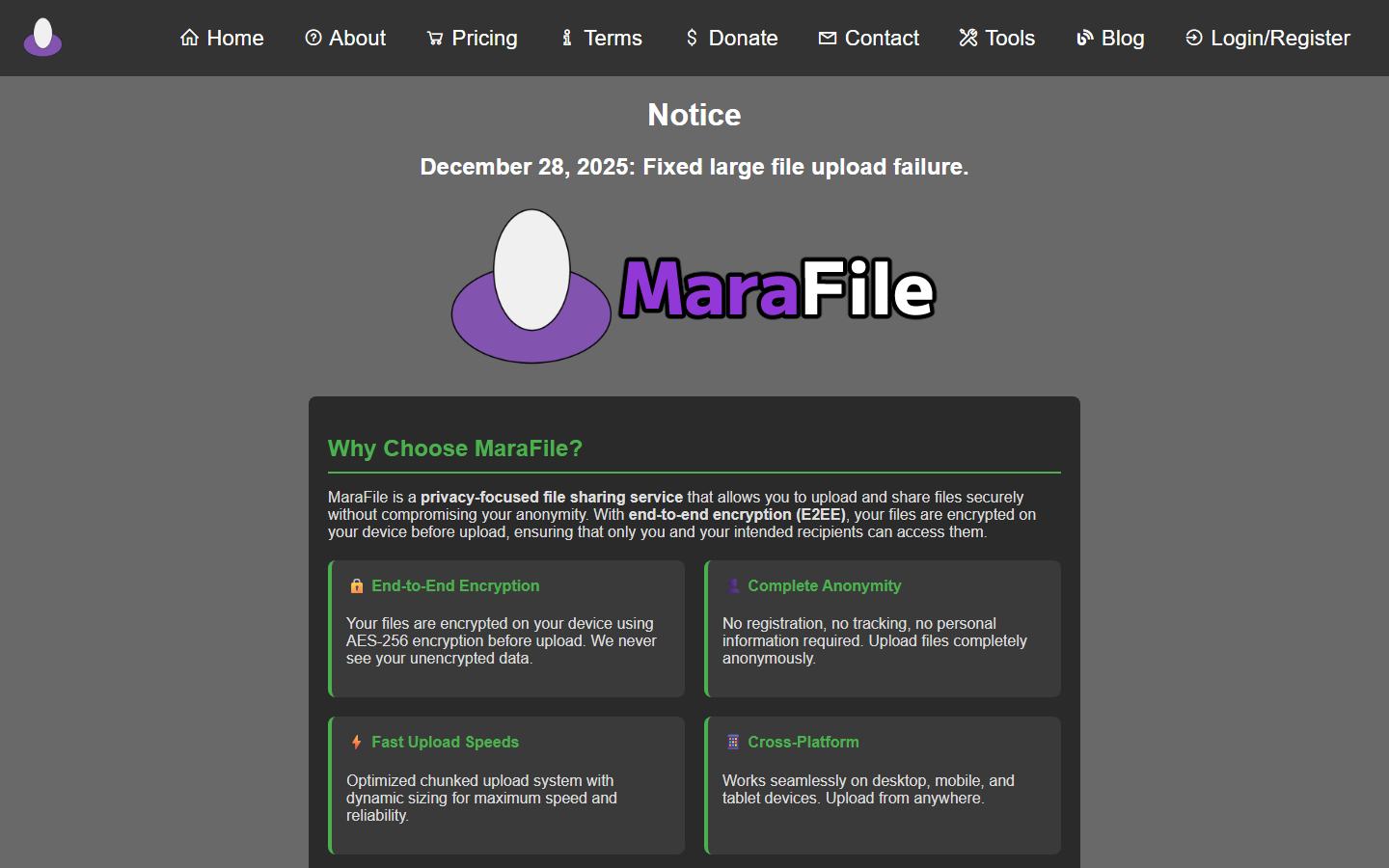
Privacy-focused file sharing service with end-to-end encryption (E2EE)
Live preview
marafile.cc
▶
https://marafile.cc
Review
EditorialOverview
MaraFile operates in the increasingly crowded anonymous file-hosting niche, distinguishing itself through a strict no-registration model and optional end-to-end encryption. Launched as a privacy-first alternative to mainstream cloud storage, the service lets visitors upload files immediately—no email, no username, no phone verification. The platform caps individual files at 1GB and permits batch uploads of up to 20 files simultaneously, with retention windows stretching from 24 hours to three months for anonymous users. Registered accounts unlock permanent storage, though this introduces a mild identity trade-off that privacy purists may weigh carefully.
The interface is deliberately sparse: a drag-and-drop zone, an encryption toggle, and a retention selector. Cross-platform compatibility is advertised for desktop, mobile, and tablet, and the chunked-upload architecture claims automatic resume on interrupted transfers. For a service billing itself as "completely free," the revenue model appears to rely on donations and possibly future premium tiers, though no paid plans were visible in the crawled pages as of 2026.
Privacy & KYC
MaraFile sits at KYC Tier L1 — Anonymous, the most permissive classification on our scale. No personal data is solicited at upload; the service functions pseudonymously by default. This makes it one of the few file hosts where journalists, activists, or ordinary users can exchange documents without creating an account trail.
- No email required for core uploads
- No IP logging disclosed in public policy documents
- Optional registration available only for users wanting permanent storage
- Non-custodial data handling when E2EE is enabled: encryption occurs client-side, and the key never transits MaraFile's servers
That said, the privacy score of 70/100 suggests room for improvement. The absence of a Tor onion service, lack of published warrant canary, and opaque server jurisdiction all temper enthusiasm. Users seeking maximum anonymity should pair MaraFile with a VPN or Tor browser, treating the service as one layer in a broader operational-security stack rather than a standalone shield.
Supported assets & payments
MaraFile accepts Monero (XMR) for donations, aligning with its privacy-centric ethos. Monero's ring signatures and stealth addresses make it the logical choice for a platform that refuses to collect billing names or addresses. No other cryptocurrencies or fiat payment rails were mentioned in the crawled pages. The donation model appears voluntary rather than paywalled—upload functionality remains free regardless of whether users contribute XMR. This is notable in an ecosystem where "free" services often monetize through data extraction or freemium upsells.
Security & custody
Security hinges on MaraFile's optional end-to-end encryption, implemented via AES-256-GCM in the browser. When activated, files are encrypted locally before any bytes reach the network. The decryption key is appended to the URL as a fragment identifier (#), which browsers do not transmit to the server—a clever design that prevents MaraFile from decrypting hosted content even under coercion. Without E2EE, files reside on company servers in plaintext-equivalent form, so enabling the toggle is non-negotiable for sensitive material.
The trust score of 46/100 reflects structural concerns common to young, unaffiliated privacy projects: no published audit reports, unknown operator identities, and no insurance or SLA guarantees. Chunked uploads and automatic retry logic improve reliability, but users should treat MaraFile as ephemeral infrastructure rather than archival storage. For critical backups, maintain offline copies or distribute across multiple providers.
Who it's for — verdict
MaraFile suits users who need fast, disposable file transfers without identity friction—think whistleblowers sharing documents with reporters, developers swapping binaries, or travelers moving files between devices. The 1GB cap and temporary retention make it ill-suited for media libraries or long-term backups. The overall score of 6/10 acknowledges solid cryptographic architecture and genuine anonymity while flagging opacity around infrastructure and operator accountability.
Privacy-conscious crypto users will appreciate the Monero donation path and the philosophical alignment with censorship-resistant tools. However, those requiring audited security, legal jurisdiction clarity, or enterprise-grade uptime should look elsewhere. MaraFile is a capable specialist tool, not a universal replacement for encrypted sync services like Cryptomator-backed clouds or peer-to-peer alternatives.
Community summary
MaraFile offers zero-registration file hosting with client-side AES-256-GCM encryption, letting users share up to 1GB files without surrendering identity or payment details.
Pros
- + True zero-signup uploads with no email or phone gate
- + Client-side AES-256-GCM encryption keeps keys off servers
- + Monero donations accepted, reinforcing privacy alignment
- + Clean cross-platform interface with chunked resume support
- + Batch uploads of 20 files streamline multi-document sharing
Cons
- − Trust score of 46/100 signals unverified operator credentials
- − 1GB per-file limit restricts large media or dataset sharing
- − No Tor onion mirror or published warrant canary for threat-model extremes
- − Permanent storage requires account registration, breaking pure anonymity
Attributes
5 signalsStrengths
No KYC mention
P+15
Accepts Monero
P+5
No registration needed
P+5
Cautions
New service
T-4
Community contributed
Related
4 services
Mixtum Bitcoin mixer
Other services
 AnonUsers
Other services
AnonUsers
Other services
 Crawlbase
Tool · Proxy store
Crawlbase
Tool · Proxy store
 Herman Shine
Other services
Herman Shine
Other services