 Mullvad
VPN
Mullvad
VPN

Meile dVPN
Communitymeile.app
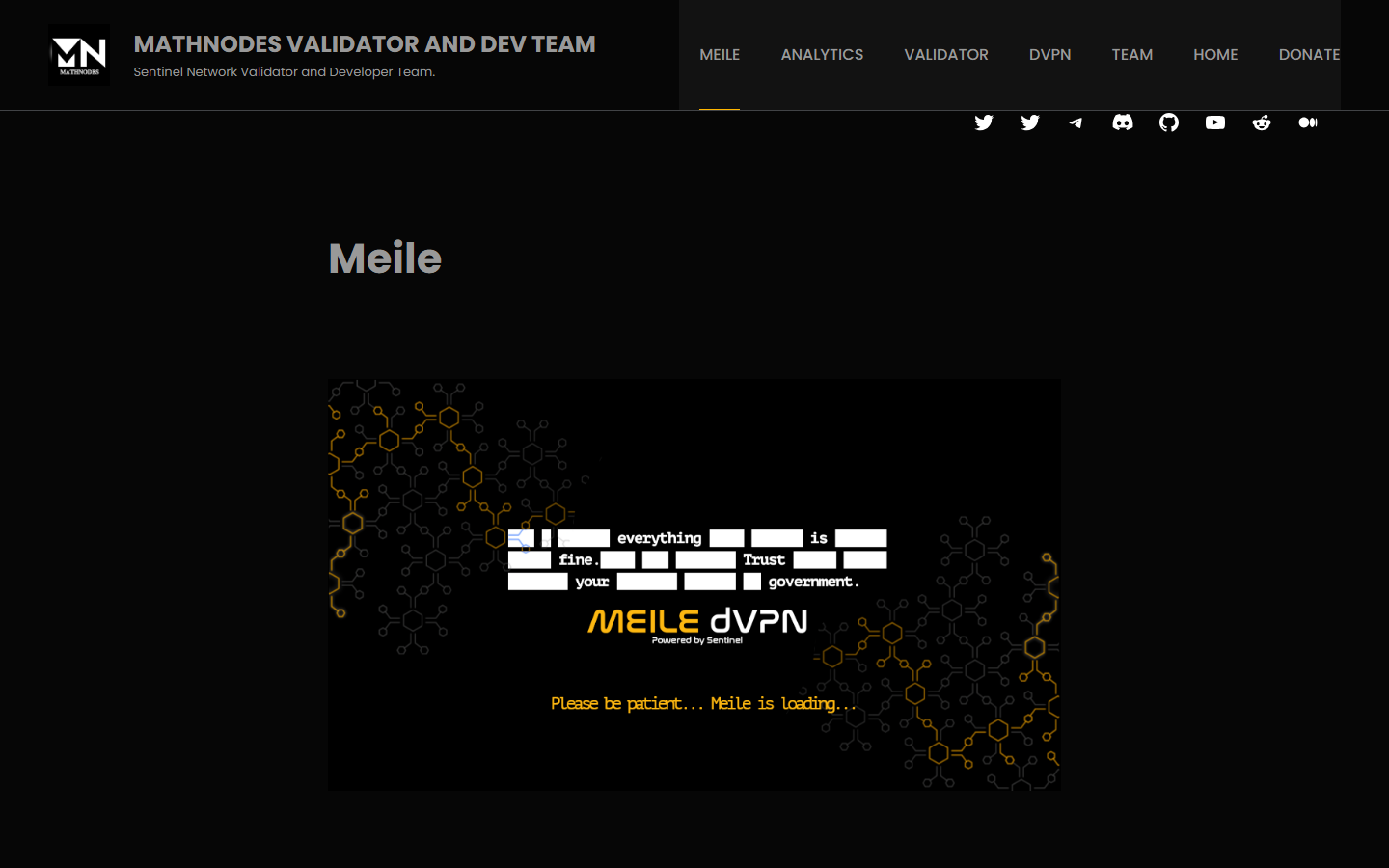
Meile is a decentralized VPN powered by the Sentinel blockchain. No KYC. Payment for monthly plans in Monero and other privacy coins within the app. GB and hourly subscriptions payable in DVPN & ATOM.
Live preview
meile.app
▶
https://meile.app
Review
EditorialOverview
Meile dVPN positions itself as an unstoppable privacy network built atop the Sentinel blockchain, a Cosmos SDK Layer-1 that has been in development since 2017. Unlike conventional VPN providers that operate centralized server farms, Meile routes traffic through a distributed mesh of community-operated nodes running from datacenters, universities, and residential connections. This architecture eliminates single points of failure and makes the network resistant to takedown requests. The service is developed by MathNodes, a validator and development team active within the Sentinel ecosystem, with desktop clients available for Windows, macOS, and multiple Linux distributions including Ubuntu, Debian, Fedora, and Arch.
The client reached version 2.6.0 in 2026, introducing refreshed UX/UI elements and animations alongside its existing WireGuard and V2Ray protocol support. Meile offers both subscription plans and pay-as-you-go sessions, with the latter priced per gigabyte or per hour and settled directly through the app's integrated wallet.
Privacy & KYC
Meile operates at KYC Tier L1 — Anonymous, meaning users access the service pseudonymously without submitting personal data. No email address is required for registration, and the service does not perform identity verification. This makes it genuinely no-KYC in an era where even privacy-focused competitors increasingly demand phone numbers or email confirmation.
The Sentinel infrastructure underpinning Meile is explicitly designed to resist the age verification and identity verification mandates being rolled out across Western jurisdictions. The project's documentation frames decentralized VPNs as tools to circumvent surveillance-state apparatuses and preserve an unsegregated internet. However, prospective users should note the privacy score of 65/100, which suggests room for improvement in areas the directory evaluates, potentially including traffic correlation risks inherent to smaller decentralized networks or metadata leakage at the client level.
- No personal data required at signup
- No email verification gate
- Built to bypass state-level identity verification requirements
- Privacy score reflects moderate, not exceptional, protections
Supported assets & payments
Meile's payment system is aggressively crypto-native and privacy-oriented. The Basic subscription plan costs $3.14 monthly and accepts multiple cryptocurrencies, though fiat is explicitly not accepted for this tier. The Premium plan at $6 per month unlocks access to 150+ nodes across 30+ countries and accepts over 300 cryptocurrencies. Both plans include unlimited bandwidth with WireGuard and V2Ray support.
For users seeking maximum anonymity, Monero (XMR) payments are supported directly in-app, alongside Bitcoin, Lightning Network, and shielded Zcash (ZEC) via BTCPay. The integrated wallet also handles Sentinel's native DVPN token, ATOM, OSMO, SCRT, NAM, and stablecoin alternatives including Zano, fUSD, and ZEPH/ZSD. A noteworthy friction point: plans paid outside Sentinel's native P2P token incur a 10% surcharge, incentivizing use of the ecosystem's native asset.
Pay-as-you-go bandwidth and hourly sessions are settled in DVPN or ATOM, with a 4.2069% session fee that funds development, token burns, and delegator rewards. A portion of non-P2P plan revenue is directed toward open-market buybacks of the native token, creating circular economic pressure within the Sentinel ecosystem.
Security & custody
Meile's security model differs fundamentally from traditional VPNs. Because it is non-custodial in infrastructure terms—users connect to independent node operators rather than a single corporate entity—there is no central server fleet to seize or subpoena. However, this decentralization introduces trust dispersion: individual node operators could theoretically log traffic, and the network's overall security depends on node diversity and honest participation.
The 2026 v2.5.0 release introduced Ring Sessions, which generate decoy session transactions by default to obscure real usage patterns on-chain. This directly addresses linkability, the blockchain analysis technique that can correlate payment activity with VPN sessions. QR-connection sharing enables mobile-to-desktop handoff without account linkage.
The trust score of 50/100 indicates significant reservations. While the open-source ethos and transparent tokenomics inspire confidence, the project's reliance on a relatively small development team, beta software status, and the inherent challenges of decentralized node vetting keep it from scoring higher. Users comfortable with experimental privacy tools will find this acceptable; those needing battle-tested reliability may hesitate.
Who it's for — verdict
Meile dVPN serves a specific niche: privacy-conscious users who refuse identity verification and prefer to transact in censorship-resistant cryptocurrencies. It is ideal for Monero enthusiasts, Cosmos ecosystem participants, and individuals in jurisdictions imposing mandatory age or identity verification for internet access. The no-KYC, no-email onboarding is genuinely rare and valuable.
However, the overall score of 6/10 reflects real trade-offs. The interface, while polished, sits atop beta software. The node network's size and consistency lag behind established centralized competitors. And the 10% non-native token surcharge, while economically rational for the ecosystem, adds friction for users holding diversified crypto portfolios.
We recommend Meile for technically adept users prioritizing anonymity over convenience, particularly those already integrated into the Sentinel or broader Cosmos ecosystem. For casual users seeking plug-and-play privacy with minimal configuration, more mature no-KYC alternatives may prove less demanding despite potentially weaker crypto payment integration.
Community summary
Meile dVPN is a Sentinel-powered decentralized VPN offering pseudonymous access with no identity verification, native crypto payments including Monero, and a community-run node network designed to resist censorship.
Pros
- + True no-KYC, no-email anonymous access
- + Native Monero and 300+ crypto payment options
- + Decentralized node network resists single points of failure
- + Ring Sessions decoy transactions combat blockchain linkability
- + Integrated wallet with IBC token support
- + Active 2026 development with transparent tokenomics
Cons
- − Beta software status with moderate trust score
- − 10% surcharge for non-native token payments
- − Smaller node network than established centralized VPNs
- − Privacy score of 65/100 suggests metadata or correlation risks
Attributes
3 signalsStrengths
No KYC mention
P+15
Accepts Monero
P+5
Cautions
Community contributed
Related
4 services

User reports
★ 5/5 · 1 ratings
Swapuz ✅ (Support at Swapuz)
5/5
Meile dVPN is decentralized privacy on autopilot — Sentinel-powered, no KYC, and crypto-native. Pay in XMR, DVPN, or ATOM for bandwidth or time. Sovereign routing for cypherpunks on the move. 🌐🛡️