 XmrBazaar
Marketplace · Shopping
XmrBazaar
Marketplace · Shopping
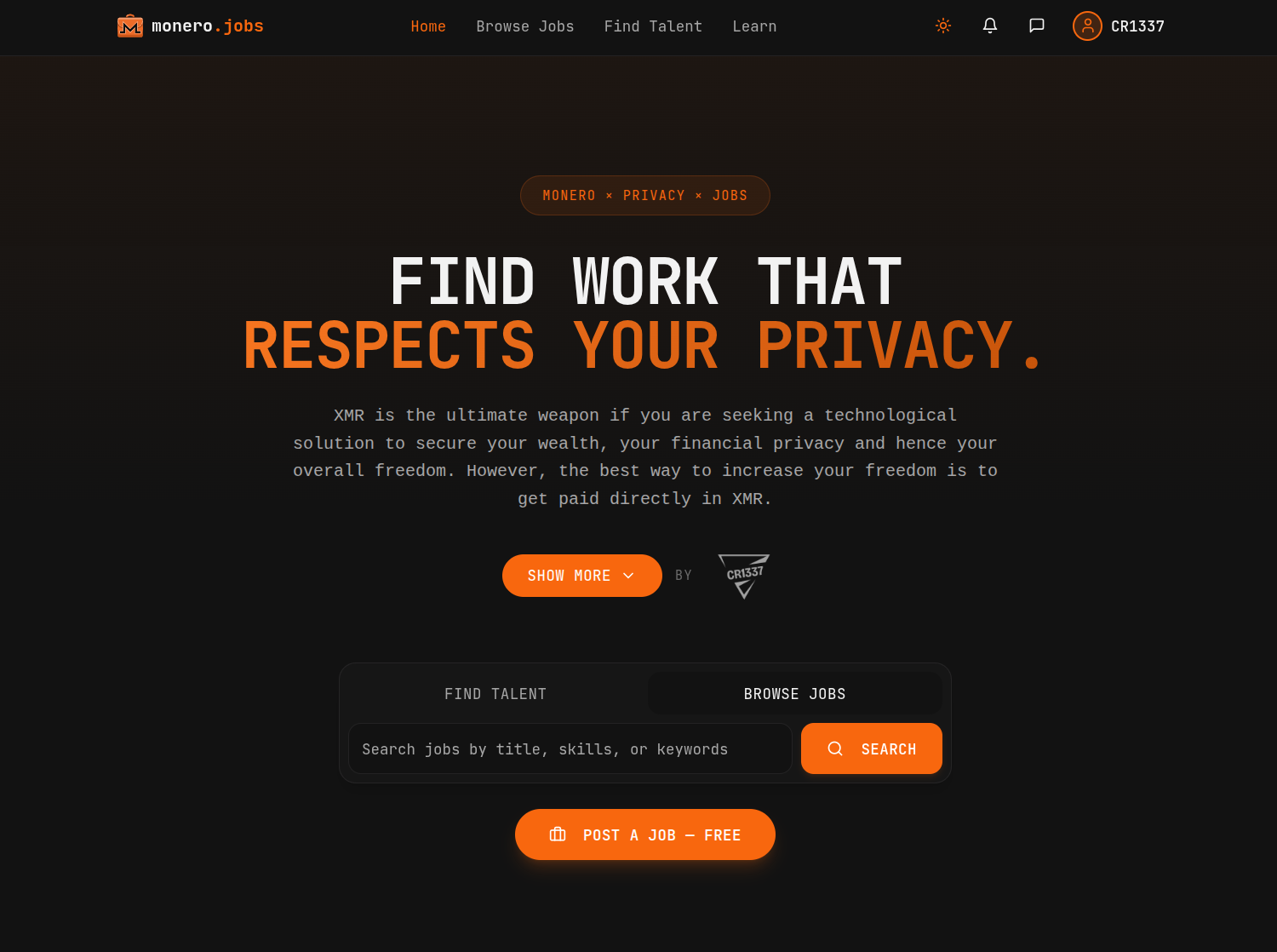
Monero.Jobs
Communitymonero.jobs
Privacy-first job board without any KYC and XMR-only payments.
Live preview
monero.jobs
▶
https://monero.jobs

Review
EditorialOverview
Monero.Jobs operates as a trustless, no-account marketplace connecting freelancers with employers who pay exclusively in Monero (XMR). The platform strips away every conventional friction point in online hiring: no registration forms, no email verification, no identity documents, and no payment intermediaries. Listings appear directly on the crawled homepage, suggesting a bare-bones, censorship-resistant design aligned with the Monero ecosystem's privacy ethos. For privacy-conscious gig workers and employers in 2026, it represents one of the few venues where labor can be exchanged for cryptocurrency without leaving a paper trail.
However, that radical minimalism comes with trade-offs. The site's trust score of 46/100 signals substantial caution flags, likely stemming from the absence of escrow protections, dispute resolution mechanisms, or verified reputation systems. The overall score of 7/10 reflects this tension: exceptional privacy architecture undermined by operational fragility.
Privacy & KYC
Monero.Jobs achieves a perfect L0 KYC tier — the gold standard for anonymity. No account creation is required whatsoever. Users browse listings, contact employers, and arrange payments without submitting names, emails, phone numbers, or government IDs. The platform itself appears to collect nothing.
- Zero identity verification: No tiered KYC, no optional verification, no geofencing.
- No email gate: Communication presumably occurs through external channels chosen by the parties.
- IP logging status unknown: The authoritative data does not confirm IP collection practices, though the privacy score of 80/100 suggests minimal or no logging.
- Monero's privacy layer: XMR's ring signatures and stealth addresses obfuscate transaction trails, compounding the platform's anonymity.
This architecture makes Monero.Jobs functionally invisible to financial surveillance regimes. For workers in jurisdictions with restrictive capital controls or for employers funding sensitive projects, that opacity is the core value proposition. The 80/100 privacy score leaves room for improvement — likely reflecting uncertainty about server hosting, potential CDN logging, or the lack of a Tor onion service.
Supported assets & payments
The marketplace is monogamously committed to Monero. No Bitcoin, no stablecoins, no fiat on-ramps appear anywhere in the available data. This XMR-only policy is ideologically consistent but practically limiting. Freelancers must already hold or know how to acquire Monero; employers must fund wallets independently. There are no built-in payment processors, no automatic invoicing tools, and no escrow smart contracts mentioned in crawled materials. Payments occur directly wallet-to-wallet, placing full responsibility for timing, verification, and dispute handling on the transacting parties. For seasoned Monero users, this is liberation. For newcomers, it is a barrier requiring self-education in wallet security, transaction confirmation times, and price volatility management.
Security & custody
Monero.Jobs is non-custodial by design. The platform never holds user funds, never manages private keys, and never intermediates transactions. This eliminates exchange-style hacking risks but transfers every security burden to individual users. There is no evidence of escrow functionality, bonded reputation staking, or multisig payment arrangements in the crawled homepage data. Employers and workers must negotiate trust independently — typically through upfront payments, milestone releases, or personal references. The 46/100 trust score reflects this vulnerability. Without verified reviews, dispute arbitration, or insurance pools, the marketplace resembles Craigslist more than Upwork. Users should treat every engagement as a high-trust, high-risk interaction and verify counterparties through out-of-band channels before committing significant labor or capital.
Who it's for — verdict
Monero.Jobs serves a narrow but dedicated demographic: privacy absolutists, unbanked freelancers, grey-market specialists, and ideologically committed Monero users who prioritize anonymity over consumer protections. It is poorly suited to risk-averse employers, compliance-dependent enterprises, or gig workers needing predictable fiat conversion. The platform's 2026 positioning is clear — it sacrifices usability, trust infrastructure, and asset variety to deliver something no mainstream competitor offers: completely anonymous labor markets. Use it if you understand Monero cold wallets, can vet counterparties independently, and accept that no central authority will rescue a bad deal. Avoid it if you need escrow, customer support, or payment flexibility. For the right user, Monero.Jobs is irreplaceable. For everyone else, it is a cautionary object lesson in the costs of radical decentralization.
Community summary
A zero-KYC, XMR-only freelance marketplace that lets workers and employers trade labor for Monero without accounts, emails, or identity checks.
Pros
- + True zero-KYC — no account, email, or identity required ever
- + XMR-only payments leverage Monero's industry-leading transaction privacy
- + Non-custodial architecture eliminates platform hacking risk
- + Direct P2P engagement without surveillance intermediaries
- + Ideologically consistent with cypherpunk principles
Cons
- − No escrow, dispute resolution, or trust verification mechanisms
- − Very low trust score (46/100) reflects high counterparty risk
- − XMR-only policy excludes users preferring stablecoins or Bitcoin
- − Minimal feature set — no ratings, portfolios, or automated invoicing
- − No apparent moderation against fraudulent listings
Attributes
4 signalsStrengths
Guaranteed no KYC
P+25
Accepts Monero
P+5
Cautions
New service
T-4
Community contributed
Related
4 services
XmrBazaar
Marketplace · Shopping
 Monero United
Marketplace
Monero United
Marketplace
 Shopstr
Marketplace
Shopstr
Marketplace
 Rigly
Tool · Marketplace
Rigly
Tool · Marketplace