
 Crypton.sh
SMS · e-SIM
Crypton.sh
SMS · e-SIM
Live preview
mrsms.io
▶
https://mrsms.io
Review
EditorialOverview
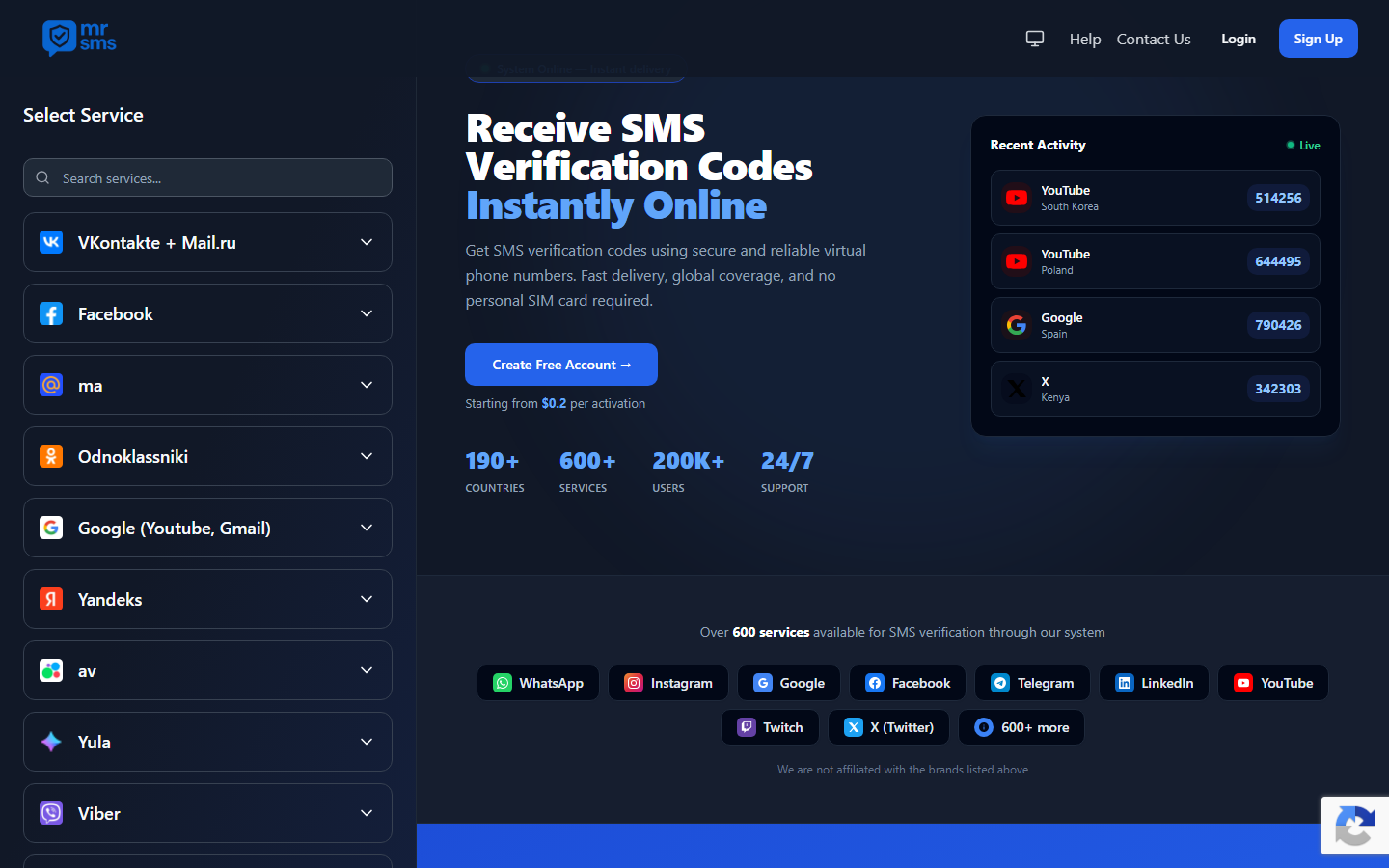
MrSMS is a virtual phone number marketplace built for users who need SMS verification codes without surrendering personal identity. The platform operates on a simple premise: rent a temporary number, receive one or more text messages, and discard it. With coverage spanning 190+ countries and compatibility with 600+ online services—including Telegram, WhatsApp, Facebook, Google, and Instagram—the service targets privacy-conscious individuals, digital marketers, and anyone managing multiple online identities. The company claims 200,000+ users and advertises average activation times under five minutes.
What distinguishes MrSMS from conventional VoIP providers is its explicit orientation toward cryptocurrency payments and minimal data collection. Users can fund accounts and pay per activation without linking bank accounts, credit cards, or government-issued identification. Pricing starts at roughly $0.20 per activation, with a pay-only-if-you-receive guarantee that refunds failed attempts automatically.
Privacy & KYC
MrSMS operates at KYC Tier L1 — Anonymous, meaning pseudonymous access with no mandatory personal data submission. The platform requires only an email address for account creation; no government ID, no proof of address, no selfie verification. For privacy-focused users, this represents a meaningful barrier reduction compared to telecom providers or even many competing virtual number services that demand phone verification of their own.
- Email required: Yes
- Identity documents: None
- Phone verification for signup: None (ironic, given the service's purpose, but accurate)
- IP logging: Unspecified in public policy
The privacy score of 72/100 reflects solid pseudonymous architecture tempered by uncertainty around logging practices. The absence of published transparency reports, warrant canary, or detailed data retention policy leaves gaps that cautious users should note. The service is headquartered in a jurisdiction that does not appear to mandate telecom-grade KYC for virtual number resellers, but users seeking maximum anonymity should pair MrSMS with Tor or a reputable VPN and a dedicated email alias.
Supported assets & payments
MrSMS accepts Bitcoin and Monero as payment methods, aligning squarely with the privacy-focused demographic. Monero support is particularly noteworthy—its ring signature architecture provides stronger transactional privacy than Bitcoin's transparent ledger, making it the preferable option for users who wish to sever financial tracing entirely. The platform also advertises "digital wallets" as an alternative, though specifics remain vague in public-facing documentation.
The pay-per-use model eliminates subscription lock-in. Users deposit funds, select a country and service, and pay only upon successful SMS receipt. This micro-transaction structure suits occasional users better than heavy-volume operators, though the lack of disclosed volume discounts or API pricing for bulk registration may limit enterprise adoption.
Security & custody
MrSMS functions as a non-custodial adjacent service in the sense that virtual numbers are temporary rentals rather than stored assets. Users do not deposit cryptocurrency into a long-term custodial wallet; balances fund immediate or near-term activations. The platform presumably holds user deposits in pooled accounts, though no cold storage details, security audits, or insurance disclosures are published.
The trust score of 47/100 signals significant reservations. No verifiable company registration, no named leadership team, and no third-party security assessments appear in public records. The 200,000+ user claim and on-site testimonials cannot be independently verified. While the pay-only-on-success model reduces upfront financial risk, users should treat deposited balances as expendable and avoid maintaining large unused balances.
Operational security depends heavily on user behavior. The numbers themselves are shared infrastructure—other users may have utilized the same pool before—so recycling numbers for sensitive long-term accounts introduces intersection attack risks. For high-security applications, dedicated (non-shared) virtual numbers or physical SIM alternatives remain superior.
Who it's for — verdict
MrSMS occupies a practical niche: disposable verification for users who refuse identity-linked telecom services. It suits journalists operating under pseudonyms, cryptocurrency traders avoiding exchange phone linking, digital marketers managing client accounts, and ordinary citizens reducing surveillance surface area. The Monero payment option and true no-KYC onboarding distinguish it from mainstream competitors like Google Voice or most Twilio-integrated alternatives.
However, the 6/10 overall score reflects trade-offs. The trust deficit is real—anonymous operators demand anonymous verification, creating inherent tension. Coverage breadth exceeds depth; some countries may offer limited operator selection or number freshness. And the shared-number model, while cost-efficient, carries reuse risks that privacy purists must mitigate through account segregation.
For 2026, MrSMS is a conditional recommendation: appropriate for low-to-medium sensitivity verifications where cost and speed matter more than absolute security, provided users fund minimally, pay with Monero, and layer additional operational security. For banking, primary email, or cryptocurrency exchange accounts holding significant value, invest in higher-assurance alternatives.
Community summary
MrSMS provides pseudonymous virtual phone numbers across 190+ countries for receiving SMS verification codes, accepting Bitcoin and Monero without identity verification.
Pros
- + True pseudonymous signup with no ID verification required
- + Monero and Bitcoin payment options protect financial privacy
- + Pay-only-if-successful pricing eliminates wasted spend
- + 190+ country coverage with 600+ supported platforms
- + Fast activation times under five minutes claimed
Cons
- − Low trust score with unverified company background and no public audits
- − Shared virtual numbers create potential reuse and linkage risks
- − No published transparency on IP logging or data retention
- − Requires email address despite anonymous tier claim
- − Unclear bulk pricing or API access for professional users
Attributes
8 signalsStrengths
No KYC mention
P+15
Identity-Free registration
P+10
Accepts Monero
P+5
Cautions
New service
T-4
Community contributed
Third-Party payment processor
P-2 T+1
Informational
Email required
Account required
P-1
Related
4 services
Crypton.sh
SMS · e-SIM
 Narayana
SMS · e-SIM
Narayana
SMS · e-SIM
 Skytelecom
SMS · e-SIM
Skytelecom
SMS · e-SIM
 nadanada
VPN · SMS
nadanada
VPN · SMS