 eigenwallet
Exchange · DEX
eigenwallet
Exchange · DEX

Mt Pelerin
Communitymtpelerin.com
Centralized Crypto onramp/offramp without KYC
Live preview
mtpelerin.com
▶
https://www.mtpelerin.com
Review
EditorialOverview
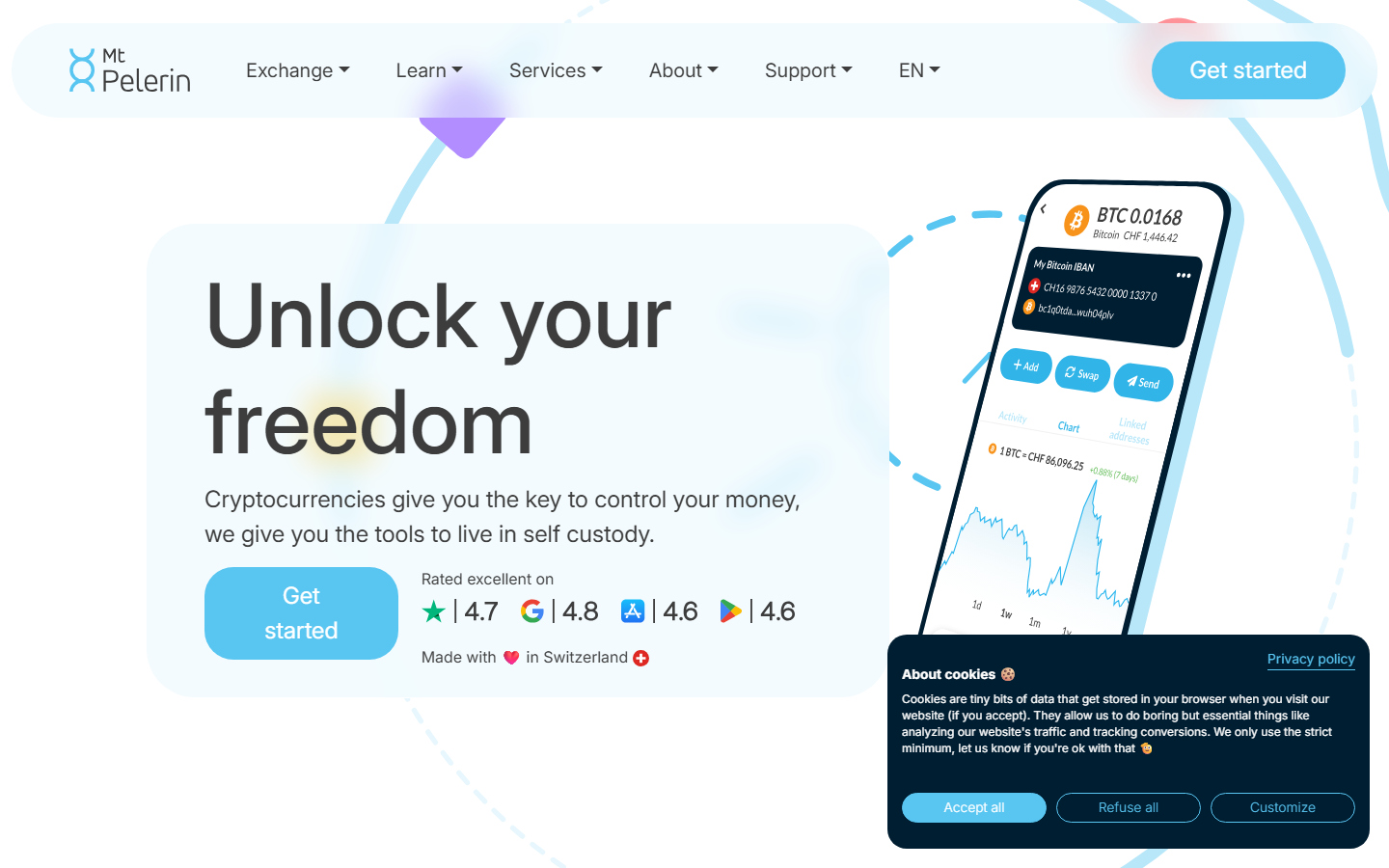
Mt Pelerin markets itself as a Switzerland-based gateway between traditional finance and self-custodied crypto. The platform lets users buy, sell, swap, and bridge cryptocurrencies without creating a conventional exchange account, instead delivering assets directly to wallets you control. It supports Bitcoin, Ethereum, stablecoins, and a range of altcoins across 15 blockchains, with fiat integration through personal IBANs and bank transfers in 18 currencies. For privacy-focused users, the pitch is compelling: skip the exchange custody model, keep your keys, and convert fiat to crypto with minimal friction. Yet the reality is more nuanced than the marketing suggests.
The service operates as a centralized onramp rather than a decentralized protocol, meaning Mt Pelerin handles the compliance, banking relationships, and transaction execution. Users can access it through a web interface or mobile app, with features including multi-wallet management, an address book, and quest-based Bitcoin rewards. Customer support receives consistently positive mentions across public feedback, with availability in six languages and responsiveness that stands out in an industry notorious for ghosting users.
Privacy & KYC
This is where Mt Pelerin diverges sharply from genuine no-KYC services. The platform advertises "no signup," but operates under a tiered verification structure that escalates identity demands based on transaction volume and behavior. Small purchases may pass with minimal information, yet the threshold for triggering full identity verification sits low enough that most regular users will eventually face document requests, proof-of-address, and source-of-funds scrutiny. The platform requires email verification from the outset and logs IP addresses as standard practice.
- KYC tier: L3 — Tiered verification with full identity checks above certain thresholds
- Email required: Yes, mandatory for all transactions
- IP logging: Confirmed active
- Privacy score: 26/100 — among the weaker performers in the no-KYC directory
The gap between "no signup" and "no KYC" matters critically here. Competitors in the L1-L2 range allow wallet-only interaction with no persistent identifiers. Mt Pelerin's model instead front-loads convenience while back-loading compliance, catching users who assumed their initial frictionless experience would continue indefinitely. The platform's Swiss jurisdiction offers some data protection advantages over laxer regimes, but does not override the fundamental reality: this is a regulated financial service that cooperates with identity verification requirements.
Supported assets & payments
Mt Pelerin's asset coverage is genuinely broad for a fiat-integrated service. Users can trade Bitcoin (including Lightning Network satoshis), Ethereum, USDC, EURC, Tether, and a substantial altcoin selection including BNB, Avalanche, Polygon, Pax Gold, Tether Gold, Sonic, Tezos, and multiple wrapped or bridged Bitcoin variants. The platform also supports the Frankencoin (ZCHF) stablecoin with 1:1 Swiss franc conversion, alongside DAI, LUSD, crvUSD, and other decentralized stablecoins.
Payment rails include card purchases, SEPA bank transfers, and the distinctive personal IBAN feature that lets users receive fiat salaries directly converted to crypto. The 18 fiat currency support for cash-outs exceeds many competitors, making this particularly viable for European users needing regular off-ramping. Bridge functionality across 15 chains adds utility for multi-network users, though execution relies on Mt Pelerin's centralized infrastructure rather than trustless cross-chain protocols.
Security & custody
The custody model represents Mt Pelerin's strongest privacy-adjacent feature. Assets move directly to user-controlled wallets — MetaMask, hardware wallets, or any self-custody solution — rather than sitting on platform balances. This eliminates exchange counterparty risk and prevents the asset freezes common to custodial platforms. Users maintain full signing authority; Mt Pelerin cannot block or seize funds post-delivery.
However, the non-custodial label applies only to the crypto delivery mechanism, not the overall trust model. The platform still controls transaction execution, pricing, and fiat settlement. Users must trust Mt Pelerin's solvency for the brief but critical window between payment and on-chain delivery. The service lacks the transparency of fully open-source or smart-contract-based alternatives where execution logic is auditable on-chain. For users prioritizing both self-custody and minimized counterparty trust, this creates an uncomfortable middle ground.
Who it's for — verdict
Mt Pelerin suits European users who value self-custody convenience over strict anonymity, particularly those needing reliable fiat off-ramps with IBAN integration. The competitive exchange rates, zero spread claims, and responsive support create a polished experience for users comfortable with tiered verification. Bitcoiners using Lightning, salary receivers wanting automatic crypto conversion, and traders bridging across EVM chains will find specific utility here.
For the core NoKYC Directory audience seeking genuinely anonymous acquisition, however, this service disappoints. The 26/100 privacy score and L3 KYC tier place it well outside the threshold for recommendation to users avoiding identity linkage. The "no signup" framing proves misleading — email, IP, and escalating verification create a substantial identity trail. Users who outgrow the minimal tier face the same documentation burdens as conventional exchanges, without the depth of liquidity or advanced trading features those platforms offer. Mt Pelerin is a competent onramp for the privacy-tolerant, not a solution for the privacy-determined.
Community summary
A Swiss-made onramp and off-ramp that delivers crypto straight to your own wallet, but its tiered identity checks and data collection fall short of true no-KYC standards.
Pros
- + Non-custodial delivery to user-controlled wallets
- + Broad fiat support with 18 currencies and personal IBANs
- + Lightning Network Bitcoin support
- + Responsive multilingual customer support
- + Zero spread and no price impact on swaps
- + 15-chain bridge functionality
Cons
- − Tiered KYC escalates to full identity verification
- − Mandatory email and IP logging from first use
- − Misleading "no signup" marketing vs actual privacy
- − Centralized execution model despite self-custody delivery
Attributes
16 signalsStrengths
No registration needed
P+5
Non-custodial wallet
P+3 T+5
Red flags
Service Termination Policy
T-4
May require KYC/SOF by policy/law
P-6 T-4
Cautions
May Freeze or Seize Funds
T-3
Community contributed
Transaction monitoring
P-1
Soft KYC
P-3 T-1
Data Sharing
P-3
Phone number is required
P-4
Shotgun KYC
P-15
Informational
Source code is private
T-1
Legally registered
T+2
Email required
JavaScript needed
Some countries are restricted
Related
4 services
eigenwallet
Exchange · DEX
 Bisq
Exchange · P2P
Bisq
Exchange · P2P
 BasicSwap
Exchange · P2P
BasicSwap
Exchange · P2P
 RoboSats
Exchange · P2P
RoboSats
Exchange · P2P
User reports
intoxicating_samovar_4245
3/5
I used it once, it's what I called light KYC. A bit more convenient and quick than a centralized exchange if you want to acquire crypto with your credit card. Of course they can shotgun KYC you. Interface is simple and clear. There are better similar services tho, I think about dfx.swiss