 PinToPay
Cards
PinToPay
Cards
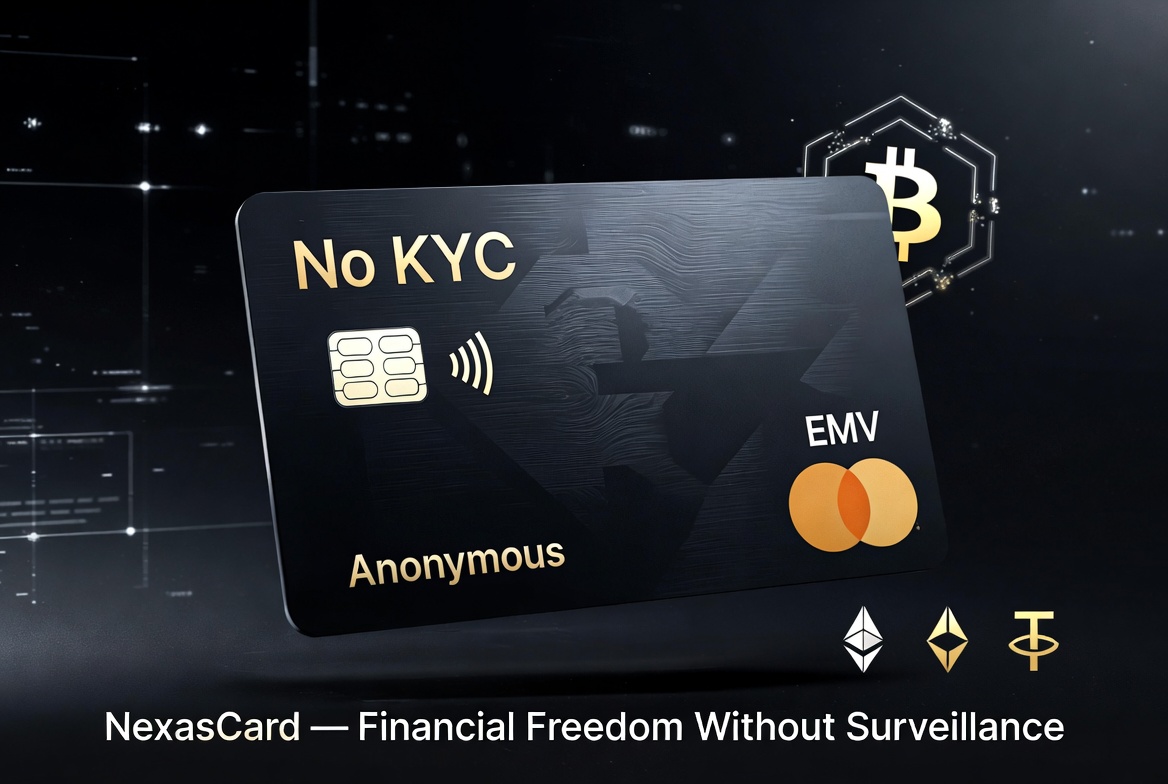
NexasCard
Communitynexascard.com
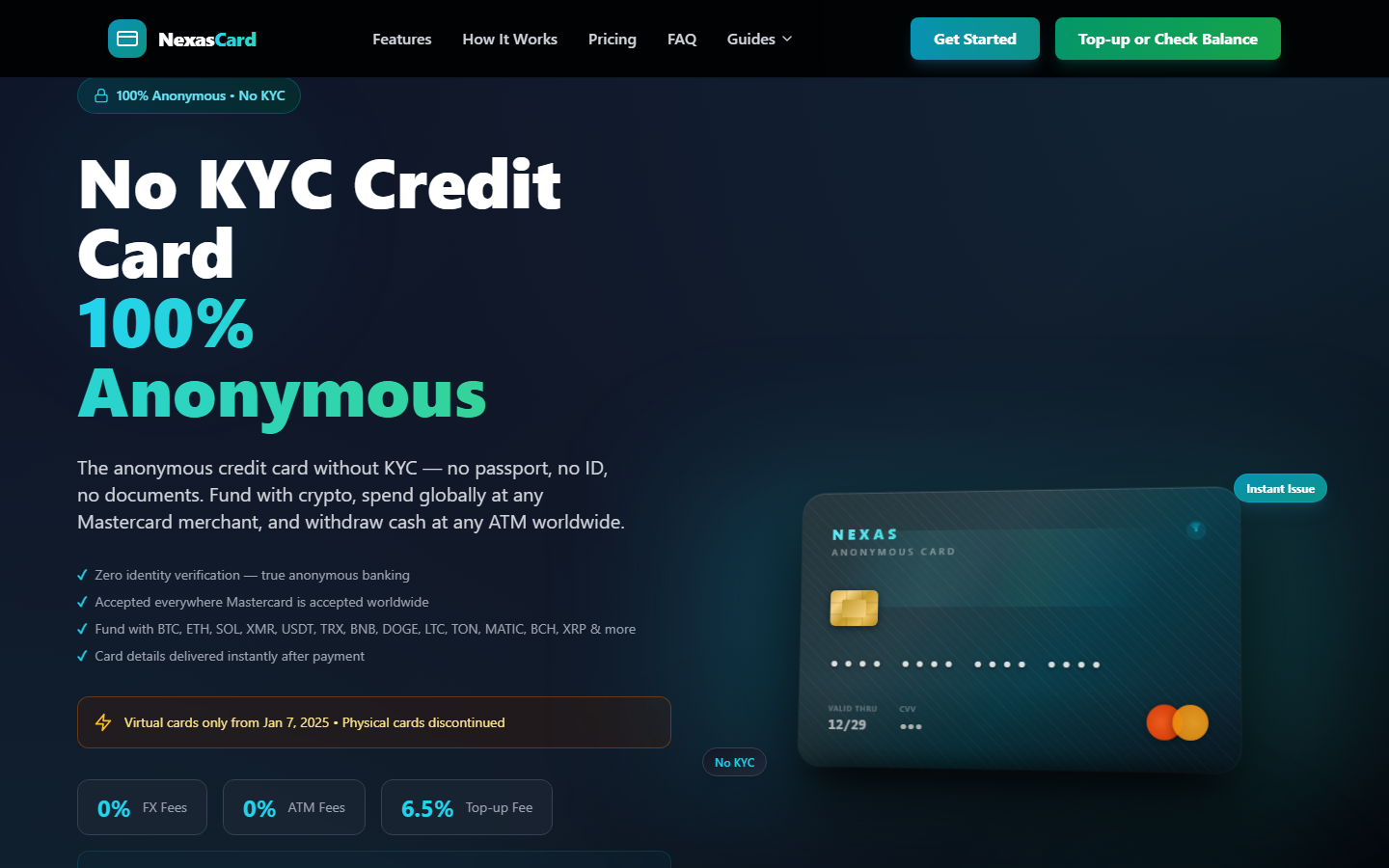
Anonymous virtual Mastercard with zero identity verification, funded from a 14-crypto list (BTC, ETH, SOL, XMR, USDT, TRX, BNB, DOGE, LTC, TON, MATIC, BCH, XRP, DGB). 0% FX, 0% ATM, Apple / Google / Samsung Pay supported, $5K daily and $25K monthly spend limits, $70 minimum balance. The fee compromise sits on the top-up side: 6.5% per load, the highest in the no-KYC card peer set. Physical cards were discontinued in January 2025; the product is virtual-only.
Live preview
nexascard.com
▶
https://www.nexascard.com
Review
EditorialOverview
NexasCard is an anonymous virtual Mastercard with no KYC at any point in the funnel and the broadest supported deposit-crypto list in the no-KYC card peer set: fourteen assets including Bitcoin, Ethereum, Solana, Monero, USDT, Tron, BNB, Dogecoin, Litecoin, Toncoin, Polygon, Bitcoin Cash, XRP and DigiByte. On the spend side the economics are aggressive — 0 % FX, 0 % ATM withdrawal fee, no monthly fee — and the card provisions cleanly into Apple Pay, Google Pay and Samsung Pay, so the virtual-only product still behaves like a tap-to-pay card at the point of sale.
The compromise sits on a single line: the top-up fee is 6.5 %, the highest in the segment. NexasCard wagers that the no-FX, no-ATM, broad-crypto, multi-wallet feature stack is worth paying a premium at the load step. Whether that is a good bet depends on how you spend.
Privacy & KYC
NexasCard sits at KYC Tier L0 — Trustless. The homepage states explicitly that there is “zero identity verification” — no passport, no driver’s licence, no selfie, and the platform stores no identity at any point. The signup flow uses an email address and a deposit; from there the card details are delivered the moment the first crypto deposit confirms. There is no published threshold above which KYC kicks in, and no AML-escalation clause in the public-facing copy.
This is exactly the privacy posture a no-KYC directory exists to catalogue. The privacy score of 85 / 100 reflects it: broad crypto including Monero, true identity-free issuance, Apple / Google / Samsung Pay provisioning without phone-number coupling. The ceiling is held below 90 because the service is custodial (the balance lives with NexasCard until it is loaded onto the card), the support channel is a normal email address rather than a privacy-preserving messenger like SimpleX, and the platform runs on clearnet only.
Supported assets & payments
The accepted-deposit list is the differentiator:
- BTC — Bitcoin
- ETH — Ethereum
- SOL — Solana
- XMR — Monero (the standout — almost no virtual Mastercard programme accepts XMR)
- USDT — Tether (chain not specified per page)
- TRX — Tron
- BNB — BNB Chain
- DOGE — Dogecoin
- LTC — Litecoin
- TON — Toncoin
- MATIC — Polygon
- BCH — Bitcoin Cash
- XRP — XRP Ledger
- DGB — DigiByte
Spend currencies are USD, EUR, MXN and more, with conversion at no markup. The virtual card provisions into Apple Pay, Google Pay and Samsung Pay — meaning even though there is no plastic, the card behaves like a tap-to-pay card in store via the phone, which closes the only meaningful gap between virtual-only and physical-card products for most users.
Fees, limits, and the 6.5 % question
- Card cost: $0 — no card-issuance fee documented
- Minimum balance: $70 (your spendable balance, not a fee)
- Top-up fee: 6.5 % per load
- FX markup: 0 %
- ATM withdrawal fee (Nexas side): 0 % — operator surcharges from the ATM itself still apply
- Monthly / subscription fee: $0
- Daily card spend limit: $5,000
- Monthly card spend limit: $25,000
- Daily ATM withdrawal limit: $500
The 6.5 % top-up is roughly twice what Goblin Cards charges (3.5 %), two-and-a-half times PinToPay (2.5 %), and infinitely worse than FotonCard (free). It is the single biggest economic gate on the product. The break-even calculus is specific: if you top up in $500–$1,000 chunks (not micro-loads), and your spend pattern is mostly cross-border and / or ATM-heavy, the 0 % FX and 0 % ATM savings claw back the top-up premium and put NexasCard ahead. If you top up frequently in small amounts and spend domestically, the 6.5 % is dead weight you would not pay elsewhere.
The trust unknowns — read this section
NexasCard’s operational signal beyond its own site is unusually thin for a service this prominently marketed:
- No Trustpilot profile. Most card programmes — even tiny ones — accumulate at least a handful of reviews within months of launch. NexasCard has not.
- No Reddit threads on r/CryptoCurrency, r/Monero or adjacent communities about real spending experience.
- No bitcointalk discussion thread documenting either successful use or operational problems — the absence is notable because bitcointalk reliably catches both.
- The only ranked comparison piece (GISuser, April 2026) rates NexasCard 9.8 / 10 against four other no-KYC cards. The framing reads as paid-placement structure rather than independent review — there is no published rating methodology and no flagged concerns in the article body, which is rare for genuine independent assessment of a young card programme.
- The physical card was discontinued on 2025-01-07. That is a real operational pivot — it implies the unit economics of physical issuance did not work, which is also why Goblin Cards can only sustain the equivalent product at a $350 upfront fee.
- Issuer / sponsor BIN / jurisdiction are not publicly disclosed. If the BIN sponsor cancels the program, the escalation path is undocumented.
None of these are conclusive on their own. Taken together they describe a service whose privacy claims are credible but whose operational reliability has not yet been stress-tested by a documented community. The trust score of 40 / 100 reflects exactly that — not an accusation of misbehaviour, an honest signal of absent evidence.
Who it’s for — verdict
NexasCard is a sensible candidate if you tick all three of these boxes simultaneously:
- You want a virtual Mastercard usable in Apple / Google / Samsung Pay without surrendering any identity
- You can tolerate a 6.5 % cost at the top-up step, typically by loading in larger, less frequent chunks
- You can treat the loaded balance as imminent spend, not savings, until the platform has accumulated a public operational track record
For Monero-holders specifically — given how few virtual Mastercards accept XMR directly and how few of those provision into Apple Pay — NexasCard is one of the most useful options in mid-2026 even with the 6.5 % top-up tax.
If the answer to any of those three is no, browse the rest of this category: FotonCard wins on top-up cost (free), PinToPay wins on operational reliability and Apple Pay maturity at the cost of L3 minimal verification, Goblin Cards wins on the physical-card property. The directory’s recommendation is to choose by trade-off, not by score alone — and to load only what you are willing to put at risk while NexasCard’s external track record catches up to its marketing.
Community summary
NexasCard is an anonymous virtual Mastercard with the broadest crypto top-up list in its peer group (14 assets including Monero), 0% FX and 0% ATM fees, and Apple / Google / Samsung Pay support. The trade-off is a 6.5% top-up fee — the highest in the no-KYC card market — and an unusually thin operational signal: no Trustpilot presence, no independent Reddit / bitcointalk threads, and the only promotional placement (GISuser 9.8/10) reads as paid-style. The privacy posture is the score driver; the trust unknowns hold the overall rating to 6.5 / 10.
Pros
- + True no-KYC at signup — no documents, no selfie, no identity stored
- + Broadest crypto top-up list in the peer set: BTC, ETH, SOL, XMR, USDT, TRX, BNB, DOGE, LTC, TON, MATIC, BCH, XRP, DGB (14 assets)
- + Genuine Monero (XMR) support — rare among virtual Mastercards
- + 0 % FX markup on cross-border spend
- + 0 % ATM withdrawal fee on the Nexas side (ATM operator surcharges still apply)
- + Apple Pay, Google Pay and Samsung Pay supported — usable for tap-to-pay even though the card is virtual
- + Instant card details delivered after the first deposit confirms
- + No monthly fee, no subscription, no inactivity charge documented
- + Low entry — $70 minimum balance, not a fee
Cons
- − 6.5 % top-up fee — the highest in the no-KYC card peer set (Goblin 3.5 %, PinToPay 2.5 %, FotonCard free)
- − No independent operational signal — no Trustpilot profile, no Reddit threads, no bitcointalk discussion as of audit date
- − The only ranked comparison (GISuser, 9.8 / 10) reads as promotional placement, not independent review
- − Physical cards were discontinued on 2025-01-07 — virtual-only product now
- − Issuer / sponsor BIN / jurisdiction not publicly disclosed
- − Support is email-only ([email protected]) — no Telegram, no SimpleX, no documented escalation path
- − Custodial — loaded balance sits with NexasCard, not in user wallet
- − Spend limits are tight at the high end ($25K / month) for ad-spend or high-ticket workflows
- − Clearnet only — no Tor / onion endpoint