 SHOPINBIT
Shopping
SHOPINBIT
Shopping

Novacard
Communitynovacard.co
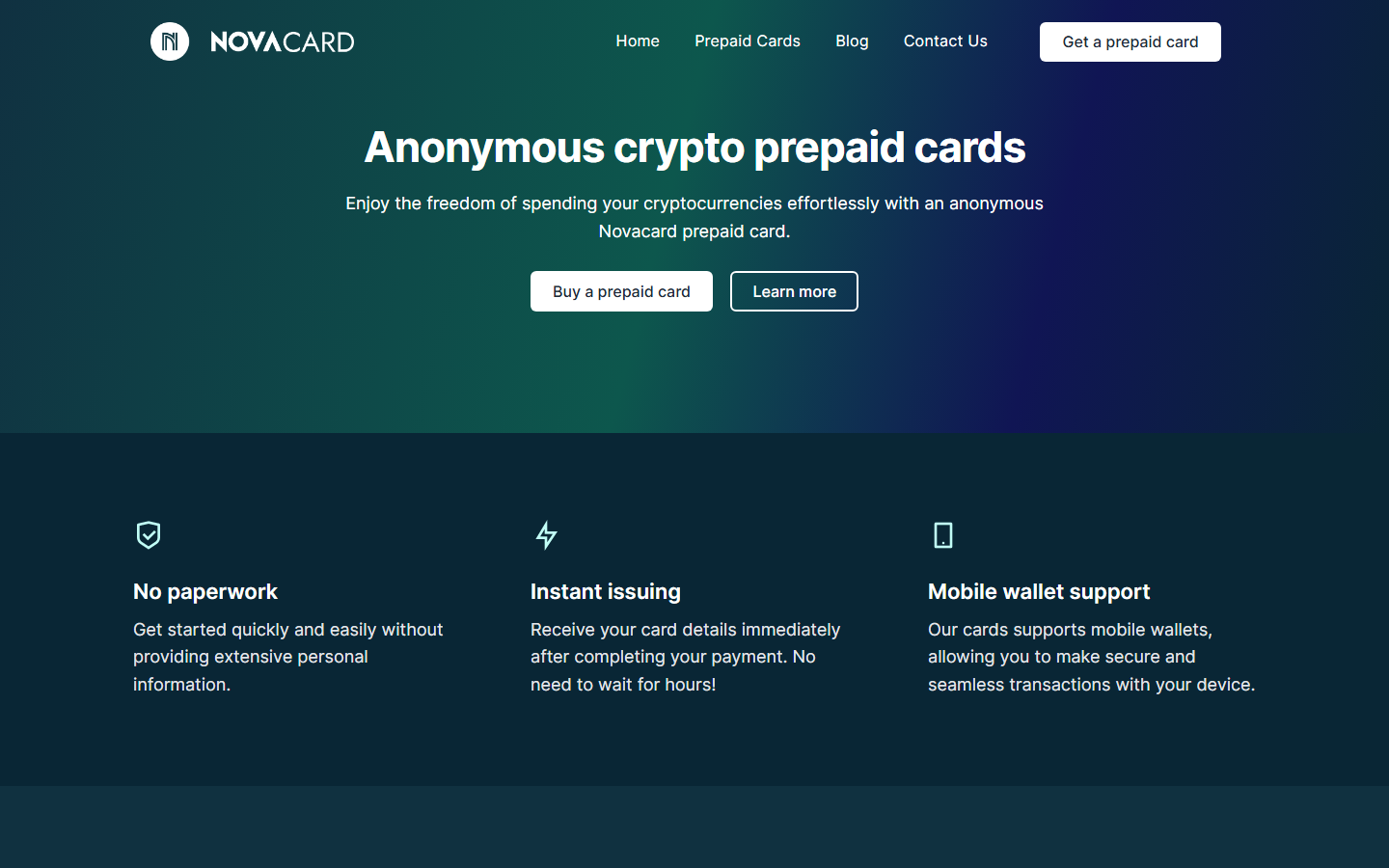
Novacard's anonymous crypto prepaid cards are designed to protect your identity while making online payments. Get a Visa prepaid card and seamlessly spend your cryptocurrencies on everyday purchases.
Live preview
novacard.co
▶
https://novacard.co
Review
EditorialOverview
Novacard operates as a reseller of virtual prepaid cards, positioning itself as a privacy-oriented off-ramp for cryptocurrency holders who want to make everyday purchases without traditional banking friction. Users can buy Visa-branded prepaid cards using Bitcoin or Lightning Network payments, receiving card details instantly after crypto settlement. The service emphasizes speed and minimal onboarding, targeting shoppers who prioritize convenience over long-term card utility. However, the platform's actual privacy protections, refund policies, and operational transparency reveal significant limitations that potential users should weigh carefully.
Founded in 2024, Novacard is a relatively young player in the crypto-to-fiat spending space. It does not issue cards directly; instead, it partners with licensed money services businesses that handle the actual card issuance under Visa and Mastercard agreements. This intermediary model has important implications for accountability, dispute resolution, and data handling that the marketing materials tend to obscure.
Privacy & KYC
Novacard advertises its service with language like "no paperwork" and "anonymous," but the reality is more nuanced and considerably less private than first impressions suggest. The official KYC classification is L3 — Tiered, meaning identity verification is triggered only above specific transaction thresholds. For low-value purchases, users may indeed complete transactions with minimal personal data, but the platform reserves the right to demand full verification as volumes increase.
- Email required: Yes, an email address is necessary for account creation and card delivery.
- IP logging: Active; the terms note that mobile wallet providers may check "risk scores" including IP addresses, and Novacard's own infrastructure captures this data.
- AML screening: All crypto payments route through third-party processors that conduct mandatory Anti-Money Laundering checks, creating a financial trail.
- No reload capability: Cards are single-load instruments, which limits exposure but also reduces practical anonymity through repeated use.
The privacy score of 35/100 reflects these layered compromises. While Novacard avoids the upfront documentation demands of full KYC exchanges, the combination of email requirements, IP tracking, third-party AML screening, and non-reloadable cards produces a service that is pseudonymous at best rather than genuinely anonymous. Users seeking strong financial privacy will find the "incognito mode" marketing overstated.
Supported assets & payments
Novacard keeps its cryptocurrency acceptance narrow but practical for privacy-focused users. The platform currently accepts Bitcoin and Lightning Network payments, with the latter offering notably faster settlement and lower fees for smaller card purchases. This dual-option approach accommodates both conservative Bitcoin holders and users who prefer the efficiency of second-layer transactions.
Payment processing is handled entirely by external providers, not by Novacard itself. These partners convert crypto to fiat for card funding and perform the aforementioned compliance checks. The Lightning option is particularly relevant for a no-KYC audience, as it can reduce on-chain traceability, though the third-party processor's involvement reintroduces observation points. No altcoins, stablecoins, or privacy coins are supported, which limits flexibility compared to broader crypto spending platforms.
Security & custody
The custody model is straightforward and user-controlled in a limited sense: once purchased, the prepaid card balance sits with the licensed issuer, not with Novacard or the user's own wallet. Novacard never holds user funds in a traditional custodial arrangement, but this is cold comfort given the structural risks involved.
Cards are non-reloadable and non-refundable after delivery, a critical restriction buried in the terms of service. If a merchant rejects the card, the user bears the loss unless another accepting merchant can be found. There is no withdrawal mechanism for remaining balances. The isolated card balance feature, while marketed as a privacy advantage, also means users must estimate spending precisely or forfeit residual funds. Card security is entirely the user's responsibility; lost or compromised details cannot be recovered or reissued.
Mobile wallet compatibility with Apple Pay and Google Pay exists in theory, but with substantial caveats. Wallet providers apply their own risk scoring that may reject cards based on geolocation, IP reputation, or other factors beyond Novacard's control. Country-specific restrictions apply to certain cards, and merchants lacking 3D Secure support may decline transactions. The trust score of 50/100 reflects this operational fragility and the absence of meaningful recourse when things go wrong.
Who it's for — verdict
Novacard fills a narrow niche: users who need a quick, low-hassle way to convert small amounts of Bitcoin into spendable fiat for online purchases, and who accept the trade-offs of non-reloadable instruments and limited recourse. The Lightning payment option is a genuine convenience for this use case. However, the service is not suitable for users seeking robust financial privacy, significant spending capacity, or reliable customer protection.
The gap between marketing language and operational reality is the central concern. "Anonymous" and "no paperwork" are relative terms here; the AML-screened payment flow, email requirements, and IP logging create a profile that determined adversaries could reconstruct. Combined with no refunds, no reloads, and unpredictable merchant acceptance, Novacard earns its 4/10 overall score as a risky convenience tool rather than a dependable privacy solution. For occasional small purchases by users who understand and accept these limitations, it may suffice. For anyone else, established alternatives with clearer policies and stronger protections deserve priority consideration.
Community summary
Novacard resells virtual prepaid cards purchasable with Bitcoin and Lightning, marketing them as a paperwork-light way to spend crypto online without linking to a bank account.
Pros
- + Instant card delivery after Lightning or Bitcoin payment
- + No extensive upfront documentation for low-value purchases
- + Isolated card balance protects against overcharge risks
- + Apple Pay and Google Pay compatibility for mobile spending
- + Lightning Network support enables fast, low-fee settlements
Cons
- − Non-reloadable cards with no refund or withdrawal option
- − Third-party AML screening undermines anonymity claims
- − Unpredictable merchant acceptance due to 3D Secure gaps
- − No meaningful recourse for failed or rejected transactions
Attributes
2 signalsCautions
Community contributed
Shotgun KYC
P-15
Related
4 services


User reports
★ 5/5 · 1 ratings
Swapuz ✅ (Support at Swapuz)
5/5
Novacard is like incognito mode for your crypto spending. Anonymous Visa, no KYC, no trace. Bought coffee, stayed a ghost. Works smooth, just right.