 eigenwallet
Exchange · DEX
eigenwallet
Exchange · DEX

OpenPeer
Communityopenpeer.xyz
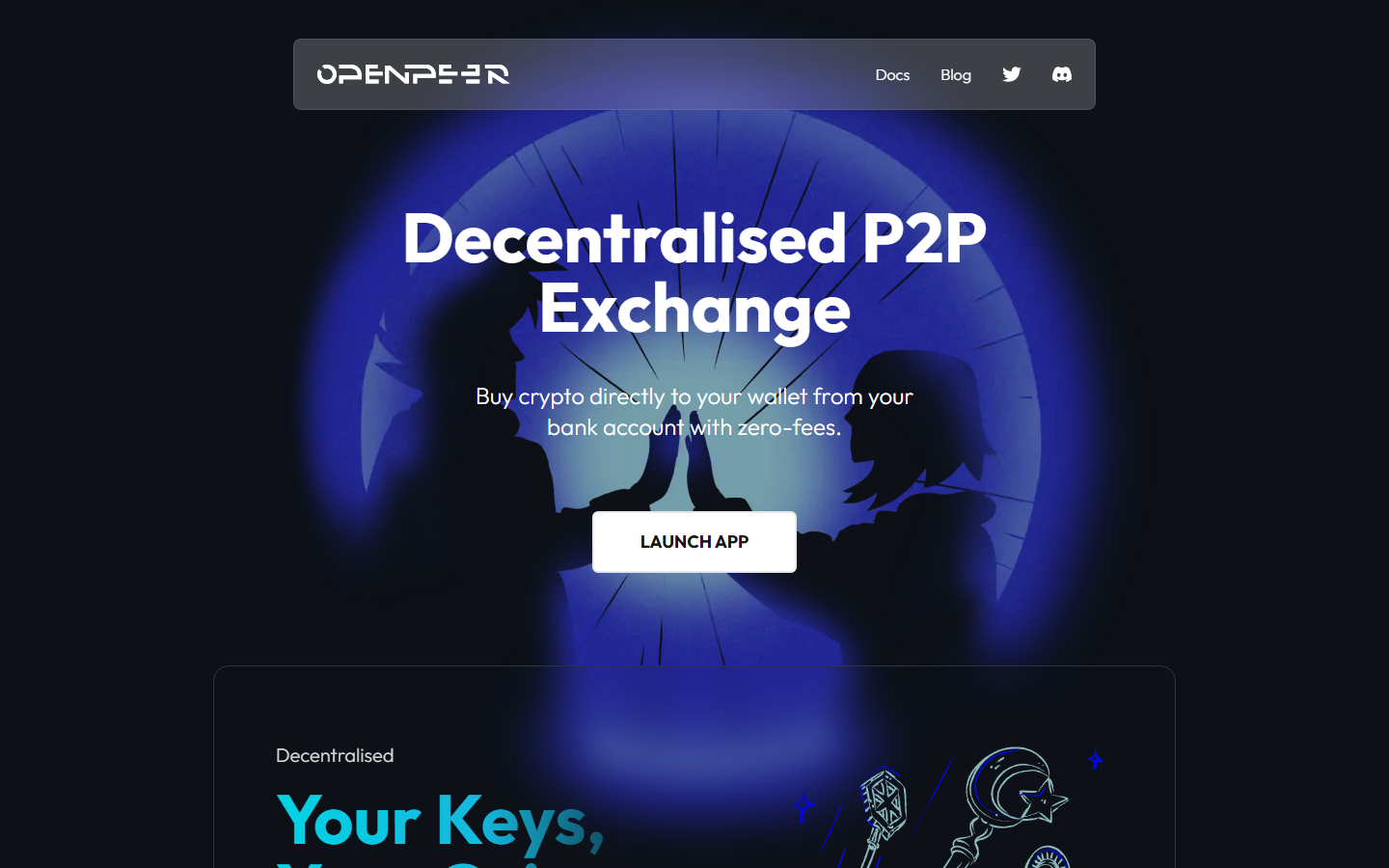
Decentralized and self-custodial P2P exchange supporting Ethereum and other EVM-compatible chains like Polygon, Arbitrum and BNB Chain. Trade directly from your wallet like Metamask, Coinbase Wallet or Trust Wallet.
Live preview
openpeer.xyz
▶
https://openpeer.xyz
Review
EditorialOverview
OpenPeer operates as a decentralized P2P exchange protocol built for privacy-minded traders who want to convert fiat currency into cryptocurrency without surrendering custody of their funds. Launched as an open protocol on Ethereum and expanding across the EVM ecosystem, the platform connects buyers and sellers directly through smart contracts while users retain control of their private keys. Unlike conventional centralized exchanges that require extensive identity verification and hold user deposits, OpenPeer facilitates wallet-to-wallet trades using self-custody solutions like MetaMask, Coinbase Wallet, and Trust Wallet. The service emphasizes global accessibility, supporting traders in over 100 fiat currencies across more than a dozen countries including Argentina, Colombia, Indonesia, Nigeria, Turkey, and Venezuela. With a 0.3% seller fee and gas-free transactions subsidized by the protocol, OpenPeer positions itself as a cost-effective alternative to legacy P2P platforms like LocalBitcoins and LocalCryptos.
Privacy & KYC
OpenPeer falls into our L2 — Discreet KYC tier, meaning it demands minimal personal data—typically just an email address to get started. This places it firmly in the no-KYC exchange category for practical purposes, though the protocol's privacy architecture deserves closer scrutiny. The platform does not appear to mandate government ID verification for basic trading, which preserves anonymity for users seeking anonymous crypto trading options. However, our privacy score of 45/100 reflects meaningful concerns: the protocol likely logs IP addresses and email identifiers, creating potential correlation points for blockchain analysis. The partially truncated official copy mentioning "KYC requi..." suggests evolving compliance obligations that users should monitor. P2P trading inherently exposes some counterparty information, and dispute resolution mechanisms may require additional verification in practice.
- Minimal signup: email-only access for most jurisdictions
- No mandatory government ID for standard trades
- IP logging likely active
- P2P counterparty exposure unavoidable
- Dispute resolution may trigger supplemental verification
Supported assets & payments
OpenPeer supports trading across multiple EVM-compatible chains including Ethereum, Polygon, Arbitrum, BNB Chain (Binance Smart Chain), and Optimism. The protocol focuses on high-liquidity stablecoins and major assets: USDT, USDC, ETH, and DAI feature prominently in dedicated onboarding flows. Settlement occurs directly on the user's chain of choice, eliminating bridge risks and reducing complexity. Payment methods remain flexible by design—users negotiate fiat transfers through any banking rail, mobile money, or cash arrangement their counterparty accepts. The platform explicitly targets emerging markets with currency support for the Argentine peso, Colombian peso, Indonesian rupiah, Mexican peso, Nigerian naira, South African rand, Turkish lira, and others. This multichain, multi-currency architecture makes OpenPeer particularly valuable for users in regions with limited access to conventional crypto on-ramps or restrictive capital controls.
Security & custody
OpenPeer's core security proposition is complete self-custody—funds never touch an exchange-controlled wallet. Traders connect existing non-custodial wallets and execute swaps through audited smart contracts, retaining sole control of their private keys. The protocol subsidizes all on-chain gas fees, removing a common friction point that exposes user wallets to dusting attacks or balance depletion. This non-custodial exchange model eliminates catastrophic exchange hacks and exit scams, though it shifts operational responsibility squarely to users. Smart contract risk persists: while the protocol emphasizes security, any DeFi interaction carries potential vulnerability to exploits or upgrade mechanisms. The trust score of 50/100 suggests moderate confidence in the protocol's current maturity—reasonable for an emerging platform but below established competitors with longer track records. Users should verify contract addresses independently and start with small test transactions.
Who it's for — verdict
OpenPeer best serves privacy-conscious traders in emerging markets who need fiat on-ramps without surrendering custody or completing invasive KYC. The platform excels for users already comfortable with self-custody wallets and EVM chain navigation. Its zero-gas-fee structure particularly benefits small-volume traders who would otherwise see transaction costs consume significant portions of their purchases. However, the modest overall score of 5/10 and trust rating of 50/100 indicate OpenPeer remains a specialized tool rather than a primary trading venue. Users requiring deep liquidity, advanced order types, or ironclad privacy guarantees may find the experience limiting. The protocol's 2026 trajectory depends on expanding its merchant verification program, hardening privacy protections, and demonstrating sustained smart contract security. For now, OpenPeer represents a viable private crypto on-ramp—but one best used with measured expectations and conservative position sizing.
Community summary
OpenPeer is a decentralized, self-custodial P2P exchange protocol that lets users trade fiat for crypto directly from their wallets across multiple EVM chains, with minimal identity requirements and zero gas fees.
Pros
- + True self-custody—private keys remain entirely user-controlled
- + Zero gas fees subsidized by the protocol
- + Minimal KYC with email-only signup for most users
- + Multichain support across major EVM networks
- + Strong emerging-market coverage with 100+ fiat currencies
- + Low 0.3% fee for sellers
Cons
- − Limited to four major assets (USDT, USDC, ETH, DAI)
- − Trust score of 50/100 reflects nascent protocol maturity
- − Privacy score of 45/100 indicates meaningful logging concerns
- − P2P counterparty risk and potential dispute friction
- − No advanced trading features or order types
Attributes
2 signalsCautions
Community contributed
Rare KYC
P-5
Related
4 services
eigenwallet
Exchange · DEX
 Bisq
Exchange · P2P
Bisq
Exchange · P2P
 BasicSwap
Exchange · P2P
BasicSwap
Exchange · P2P
 RoboSats
Exchange · P2P
RoboSats
Exchange · P2P