
 eigenwallet
Exchange · DEX
eigenwallet
Exchange · DEX
Live preview
peer.xyz
▶
https://www.peer.xyz
Review
EditorialOverview
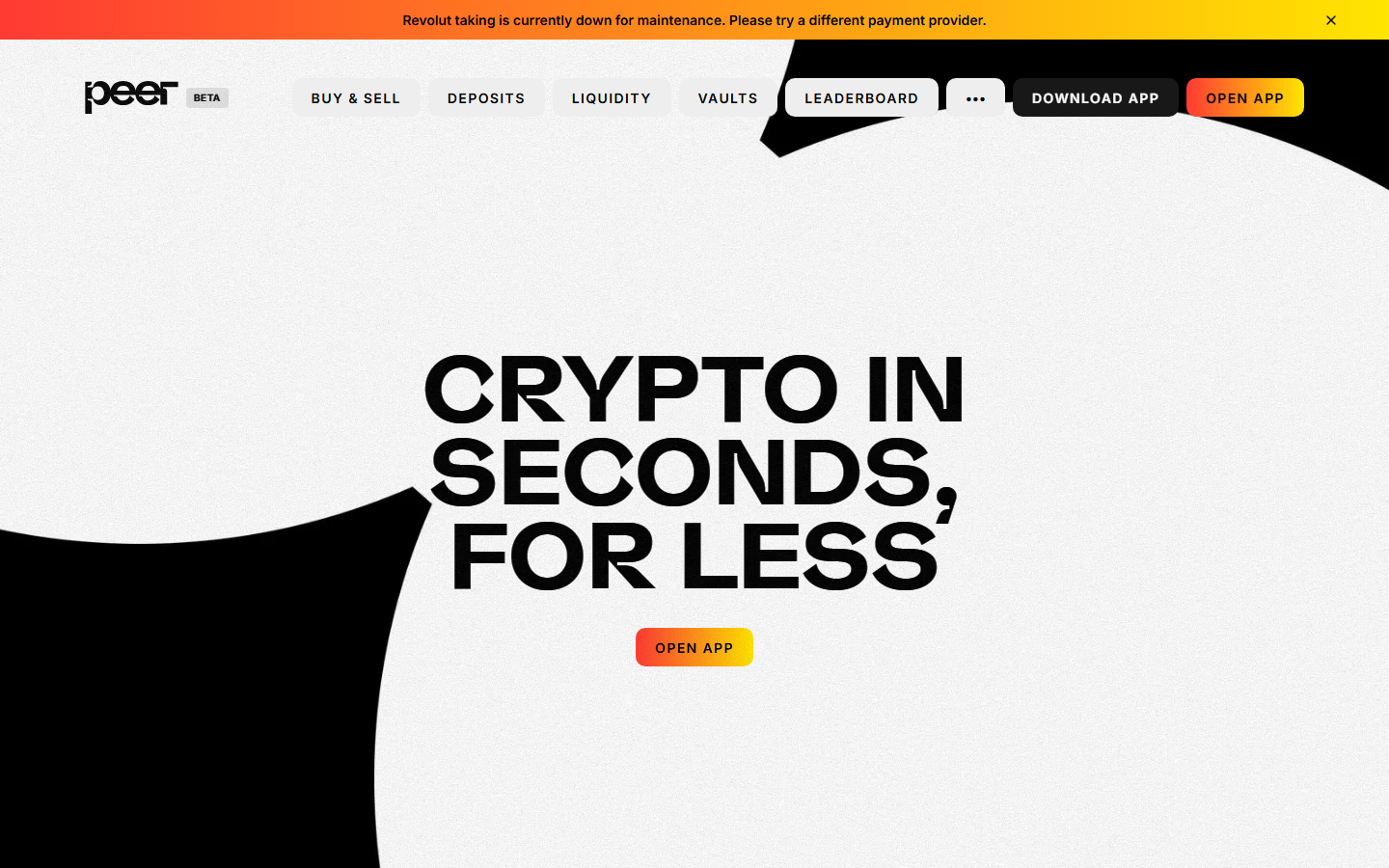
Peer is a privacy-first, peer-to-peer fiat-crypto marketplace that strips away the surveillance apparatus common to mainstream exchanges. Launched as an open-source project, it connects buyers and sellers directly, eliminating the centralized honeypot of user data that makes traditional platforms attractive targets for hackers and regulators alike. The platform's architecture leans heavily on zero-knowledge design principles, meaning the operator cannot see, store, or monetize trade details between counterparties.
Unlike custodial exchanges that hold funds and demand exhaustive identity verification, Peer facilitates trustless transactions where users retain control of their assets until settlement. This positions it squarely in the no-KYC exchange category alongside legacy P2P platforms, but with a modern emphasis on cryptographic privacy rather than mere regulatory arbitrage. For privacy-conscious users in 2026, Peer represents a functional middle ground between fully decentralized protocols with poor liquidity and centralized venues with intrusive onboarding.
Privacy & KYC
Peer earns its strongest marks in the privacy column. The service operates at KYC Tier L1 — Anonymous, which in practical terms means pseudonymous access with no personal data collection during registration or trading. Users are not required to submit government ID, proof of address, or biometric scans. Email is not mandatory, removing another common tracking vector. IP logging status remains unspecified in public documentation, so users seeking maximum anonymity should layer Tor or a no-logs VPN as a defensive precaution.
- KYC level: None — pseudonymous by default
- Email required: No
- Identity documents: None requested
- Zero-knowledge architecture: Platform cannot surveil trade specifics
The zero-knowledge claim is significant: if implemented correctly, even the marketplace operator cannot reconstruct who traded with whom, for how much, or at what price. This differs materially from "privacy-respecting" exchanges that simply promise not to misuse data they still possess. Peer scores 70/100 on privacy — a solid rating held back primarily by unverified IP practices and the inherent metadata exposure of P2P fiat transfers.
Supported assets & payments
Peer's asset selection is deliberately narrow: Bitcoin and fiat currencies only. There are no altcoins, stablecoins, or synthetic derivatives cluttering the interface. This minimalist approach reduces attack surface and simplifies compliance ambiguity, though it clearly limits appeal to traders seeking broader portfolio access.
Fiat payment methods depend on counterparty negotiation — typical P2P rails include bank transfers, cash deposits, mobile money, and in-person cash exchanges. The platform itself does not process payments, so availability varies by jurisdiction and seller preference. Bitcoin serves as the sole crypto settlement layer, leveraging its robust liquidity and established P2P infrastructure. Users should expect standard Bitcoin network fees plus any premium or discount negotiated with their trading partner.
Security & custody
Peer employs a non-custodial model, which is foundational to its security posture. Funds never sit on platform-controlled wallets; instead, trades use escrow or atomic swap mechanisms that release Bitcoin only when fiat payment confirmation is cryptographically verified. This eliminates the catastrophic exchange hack risk that has plagued custodial venues since Mt. Gox.
The open-source codebase allows public audit of smart contracts and escrow logic, though users must verify they are interacting with the canonical deployment. No insurance fund or corporate backing exists — if a trade dispute arises, resolution depends on the platform's arbitration system or multisig escrow release conditions. The trust score of 74/100 reflects this pragmatic reality: mathematically sound, but lacking the institutional assurances of regulated alternatives. Users should start with small trades to validate counterparty reliability in their local market.
Who it's for — verdict
Peer suits a specific profile: Bitcoin maximalists, privacy purists, and users in jurisdictions with restrictive capital controls who need anonymous Bitcoin acquisition without navigating complex DeFi protocols. The learning curve exceeds one-click custodial apps, and fiat P2P inherently carries counterparty friction that automated order books avoid.
The overall score of 7/10 acknowledges Peer as a competent, ideologically consistent tool rather than a mass-market product. It loses points for limited asset support, geographic dependency of fiat liquidity, and the operational burden of P2P negotiation. It gains them for genuine privacy architecture, open-source transparency, and principled rejection of surveillance capitalism. For readers of NoKYC Directory, Peer merits serious consideration — provided you need Bitcoin specifically, accept P2P trade mechanics, and verify your own operational security beyond the platform layer.
Community summary
Peer operates a trustless, open-source peer-to-peer marketplace that lets users swap fiat for Bitcoin without surrendering personal identity, built on zero-knowledge principles.
Pros
- + True pseudonymous access with no identity verification required
- + Open-source codebase enables public security audit
- + Zero-knowledge design prevents platform-level transaction surveillance
- + Non-custodial architecture eliminates exchange hack risk
- + Direct fiat-to-Bitcoin P2P trading without intermediary control
Cons
- − Bitcoin-only — no altcoins or stablecoins supported
- − Fiat liquidity and payment methods vary heavily by region
- − P2P trade negotiation requires more time and skill than automated exchanges
Attributes
15 signalsStrengths
No KYC mention
P+15
Identity-Free registration
P+10
Open source code
T+7
Escrow available
T+6
Mature service
T+5
Peer to peer market
T+4
Non-custodial protocol
T+3
Cautions
No-refund policy
T-3
Community contributed
Informational
Currently in beta
T-1
Legally registered
T+2
Basic Customer Support
T+1
API available
Mobile app available
Some countries are restricted
Related
4 services
eigenwallet
Exchange · DEX
 Bisq
Exchange · P2P
Bisq
Exchange · P2P
 BasicSwap
Exchange · P2P
BasicSwap
Exchange · P2P
 RoboSats
Exchange · P2P
RoboSats
Exchange · P2P