FotonCard
Cards
FotonCard
Cards

PinToPay
Verifiedpintopay.me
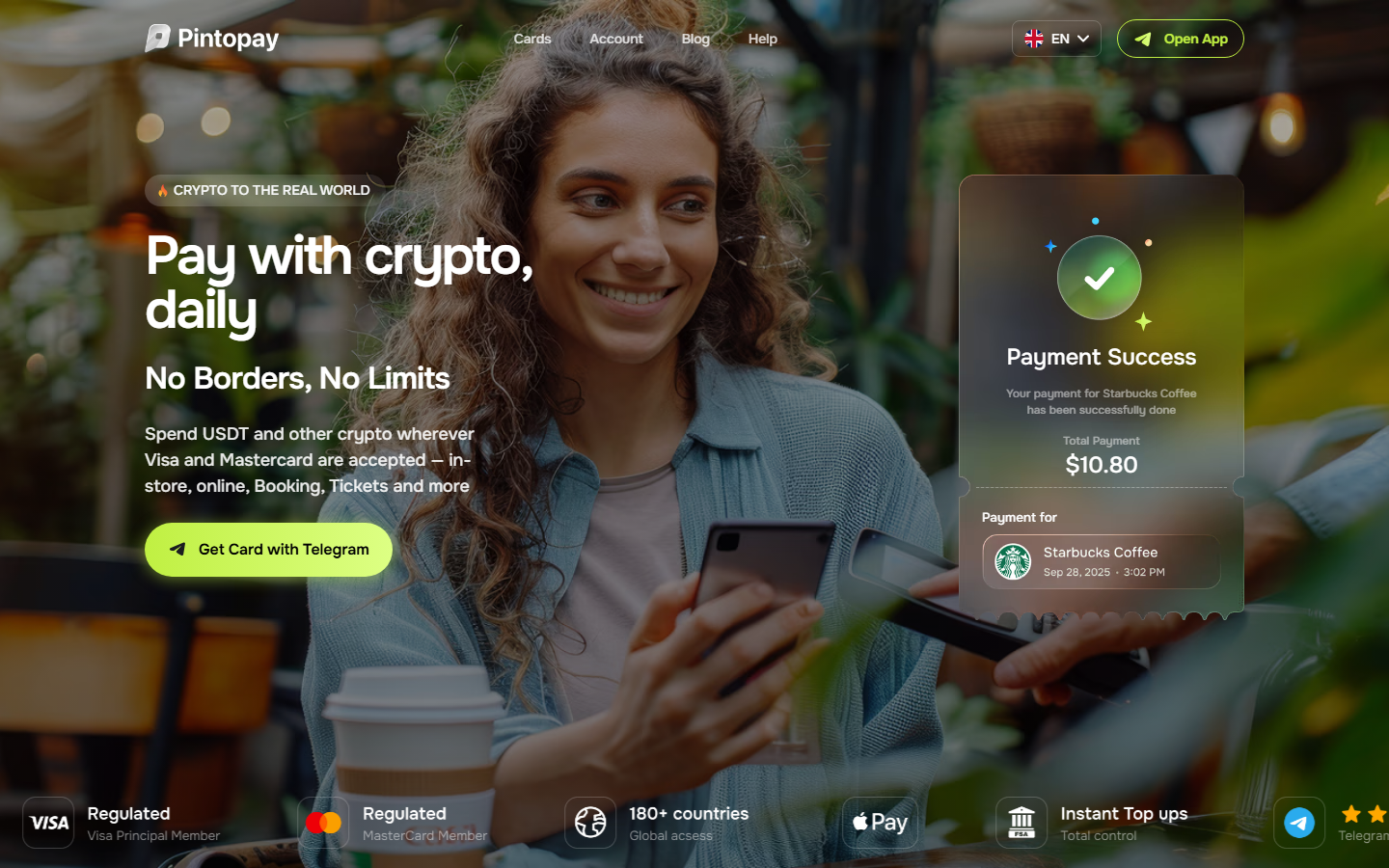
Mastercard-branded prepaid card funded directly with USDT (TRC-20 / ERC-20 / BEP-20), with Apple Pay, 180+ country coverage, $0.25 flat per purchase and 2.5% top-up fee. Minimal verification at signup; light AML checks reserved for high-value flows.
Live preview
pintopay.me
▶
https://pintopay.me
Review
EditorialOverview
PinToPay (Pintopay Inc., Hong Kong) is a crypto-funded Mastercard prepaid card that turns stablecoin balances into spendable fiat without a bank in the loop. The platform issues a virtual card in minutes through a quick onboarding form (email or Telegram bot), with a physical card programme rolling out progressively. Funding is stablecoin-first — top-ups settle in USDT across TRC-20, ERC-20 and BEP-20 — and the in-app wallet additionally accepts BTC, ETH and USDC for users who want to swap into USDT before loading. Once funded, the card behaves like any Mastercard: tap-to-pay through Apple Pay, online checkouts at any Mastercard merchant, and (with the physical card) ATM cash withdrawal. The issuer is Sunrate Solutions Limited, a Hong Kong Money Service Operator (MSO licence 16-11-02003), with custody handled through Cactus Custody / Matrix Trust Company.
Privacy & KYC
PinToPay sits at KYC Tier L3 — Tiered. Signup is deliberately frictionless: no government ID is requested, no proof of address, no selfie. A single contact channel (email or Telegram handle) is sufficient to receive the virtual card. In practice this means most day-to-day users — small monthly volumes, mobile-wallet usage, online subscriptions — will never trigger identity verification.
The trade-off, and it is a real one, is that PinToPay’s Terms of Service and Privacy Policy reserve the right to request KYC documents for AML / risk-management reasons: suspicious transaction patterns, sanctioned-jurisdiction proximity, or unusually large single-card loads. This is not a “no-KYC” service in the strictest Monero-cards sense — it is a minimal-KYC service that operates inside a regulated card-network framework, with verification held in reserve as a compliance backstop rather than applied by default. For users coming from a fully-KYC neobank background this is a sharp upgrade in privacy; for users used to truly trustless on-chain spending, it is a step back.
Supported assets & payments
Top-ups are processed exclusively in USDT across three chains:
- TRC-20 (Tron) — the cheapest path; recommended for most users
- ERC-20 (Ethereum) — works but pricier on gas
- BEP-20 (BNB Chain) — low-fee alternative to Tron
The hosted wallet additionally supports BTC, ETH and USDC balances which can be converted in-app to USDT for card loads. There is no Monero, no Lightning, and no native Bitcoin top-up directly to the card — privacy-coin holders will need to off-ramp into USDT first. Spending happens on the standard Mastercard network: Apple Pay contactless, online checkouts, and (with the physical card) ATM withdrawals.
Fees
- Top-up fee: 2.5% (minimum $2 below $100)
- Per-purchase fee: $0.25 flat — independent of ticket size
- ATM withdrawal: $0.25 flat (physical card)
- FX: no markup — the raw Mastercard network rate
- Monthly / annual fees: none
- Virtual card issuance: free; physical card programme priced separately at rollout
The flat-rate purchase model is unusually friendly for high-ticket spend: a $1,000 booking costs the same $0.25 as a $5 coffee. Smaller day-to-day purchases pay proportionally more, but the absence of an FX markup compensates for international travellers, who normally lose 1–3% to currency conversion on neobank cards.
Security & custody
PinToPay is custodial. Funds sit with the issuer (Sunrate Solutions) and the custody partner stack (Cactus Custody / Matrix Trust Company), not in a wallet the user controls. This is the standard structure for every regulated card programme in this space — the alternative would require the user to hold private keys for a fiat-denominated account, which Mastercard rules do not permit — but it is a meaningful distinction from a non-custodial card like 2Fiat, where funds settle on the card balance directly without an intervening account.
Operational signals are generally positive: the issuer is licensed and identifiable, the fee schedule is published, the top-up flow is auditable on-chain via the deposit address, and direct user experience confirms reliable settlement and Apple Pay provisioning. The trust score of 78/100 reflects the combination of regulated infrastructure plus real-world usage; the ceiling is held below the 90s by the custodial model and the high-value AML clause.
Geographic reach
Card-network coverage is broad — Mastercard at 35M+ merchants in 180+ countries — but PinToPay’s own service availability is narrower. Standard sanctioned-jurisdiction exclusions apply (Cuba, Iran, North Korea, Russia, Syria), and there are notable non-sanctioned gaps as well — Australia, Japan, South Korea, Singapore and Hong Kong itself are not currently supported, generally for issuer-side licensing reasons rather than user-side restrictions. Always verify availability from your jurisdiction at signup.
Who it’s for — verdict
PinToPay is the right fit for a specific user: someone who holds stablecoins (USDT primary), wants real-world spending at any Mastercard merchant, values minimal-friction onboarding over absolute non-custody, and is willing to accept the custodial / regulated-issuer trade-off in exchange for clean Apple Pay support, flat-fee economics and broad geographic reach. The $0.25 flat per purchase and the absence of an FX markup make it a particularly strong choice for international travellers and digital nomads with mid-to-high ticket spending.
It is not the right fit for users whose threat model demands self-custody or Monero-grade chain privacy, or for users in the listed unsupported jurisdictions. For the audience it serves, the service earns its 8.7 / 10 overall score as one of the most practical crypto-funded cards in 2026 — a step up from the unaudited no-name virtual-card services, and a step down from a true non-custodial design, landing in a usable middle ground that holds up in day-to-day use.
Community summary
PinToPay issues virtual Mastercards funded with stablecoins (USDT primary, plus BTC / ETH / USDC in-wallet), with $0.25-per-purchase pricing, Apple Pay, no markup on FX and 180+ country coverage. Minimal-friction signup via email or Telegram, with verification reserved for high-value AML cases.
Pros
- + Minimal-friction onboarding via email or Telegram (no ID at signup)
- + Instant virtual card — usable in Apple Pay within minutes
- + Mastercard rails — 35M+ merchants in 180+ countries
- + Transparent flat pricing: $0.25 per purchase, $0.25 per ATM withdrawal (physical)
- + No FX markup beyond the Mastercard network rate
- + High monthly spend ceiling (advertised up to $300k)
- + Stablecoin-first top-ups (USDT TRC-20 keeps fees negligible)
- + Card issuance free; no monthly maintenance fee
Cons
- − Custodial — funds sit with the issuer / partner trust company (Sunrate Solutions, HK)
- − No Monero, no Lightning — top-ups are stablecoin / large-cap only
- − AML clause reserves the right to request ID on suspicious / high-value flows
- − Physical card rollout still in progress in many regions
- − Restricted in sanctioned jurisdictions (Cuba, Iran, DPRK, Russia, Syria) and a few non-sanctioned ones (e.g. Australia, Japan, Korea, Singapore, Hong Kong)
- − No Tor / onion endpoint — clearnet only