 Mullvad
VPN
Mullvad
VPN

Rapidproxy
Communityrapidproxy.io
Over 70M+ premium IPs via Rapidproxy - Enjoy easy data extraction, avoiding CAPTCHAs, IP blocks with
Live preview
rapidproxy.io
▶
https://www.rapidproxy.io
Review
EditorialOverview
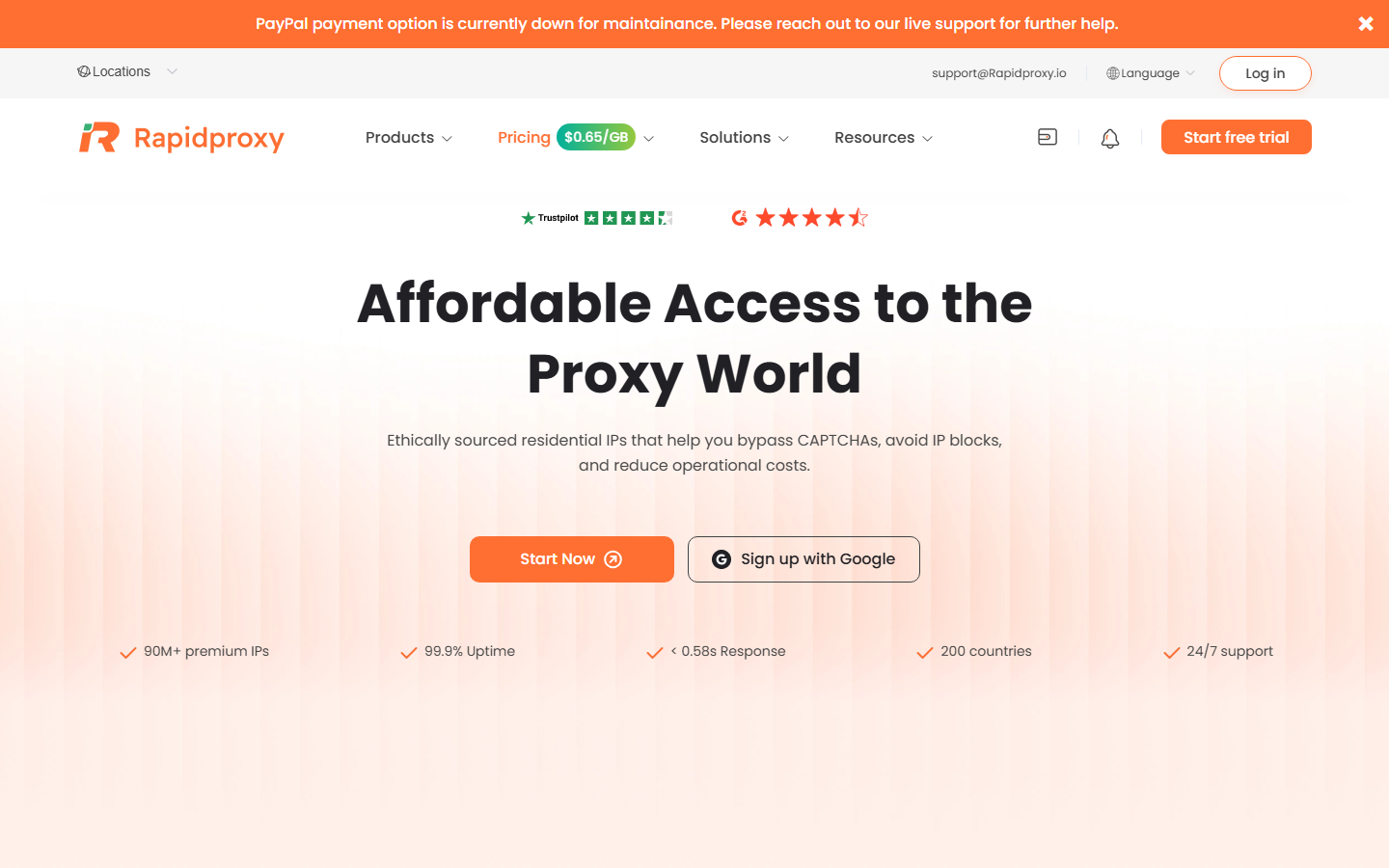
Rapidproxy operates a large-scale residential proxy network built around 90 million-plus real-user IPs spread across 200-plus countries. The service targets data extraction, ad verification, social media management, and similar automation tasks rather than traditional consumer VPN use. Two core products dominate the lineup: rotating residential proxies priced from $0.65 per GB with non-expiring traffic, and static residential proxies starting at $5 per IP per month with 30-day terms and unlimited bandwidth. The platform emphasizes city-level geo-targeting, HTTP(S) and SOCKS5 protocol support, and sticky sessions up to 180 minutes for rotating plans.
What distinguishes Rapidproxy in the privacy space is its L1 — Anonymous KYC tier. Users can create credentials with only an email address; no government ID, phone verification, or real-name policy blocks access. This pseudonymous onboarding, combined with cryptocurrency acceptance, positions Rapidproxy as a viable no-KYC proxy option for privacy-conscious operators who need residential IP diversity without identity exposure.
Privacy & KYC
Rapidproxy sits at the most permissive end of the KYC spectrum. The service collects no personal data beyond a functional email address, placing it firmly in the pseudonymous category. For users seeking minimal identity footprint, this is a meaningful advantage over competitors demanding phone numbers, payment-card names, or document uploads.
However, the privacy picture carries caveats. The directory assigns Rapidproxy a privacy score of 52/100 and a trust score of 43/100 — middling-to-weak marks that suggest room for improvement in transparency or operational security practices. The platform does not appear to operate a Tor onion mirror, and while residential proxies inherently route traffic through third-party IPs, Rapidproxy does not publish detailed logging policies for its own infrastructure. Users should assume standard connection metadata may be retained for abuse prevention and service stability.
- KYC tier: L1 — Anonymous (email-only signup, no identity documents)
- Email required: Yes
- IP logging: Unclear; no explicit no-logs claim found
- Cryptocurrency accepted: Bitcoin, Monero
Supported assets & payments
Rapidproxy keeps payment options narrow but privacy-aligned. The service accepts Bitcoin and Monero, giving users two established cryptocurrency rails that avoid traditional financial surveillance. Monero in particular offers strong transactional privacy, a natural fit for buyers prioritizing anonymity. At the time of review, PayPal was noted as down for maintenance on the official site, reinforcing that crypto may be the most reliable path for pseudonymous users.
Pricing follows a traffic-based or per-IP model depending on product choice. Rotating residential proxies start at $0.65/GB with the notable benefit that purchased traffic never expires — useful for intermittent scraping projects. Static residential proxies command $5/IP monthly with unlimited bandwidth, better suited for long-term account management or stable endpoint needs. New users can claim 500 MB of free trial traffic without expiration, a low-risk entry point for testing IP quality and geo-targeting accuracy.
Security & custody
As a proxy service rather than a custodial exchange or wallet, Rapidproxy does not hold user funds beyond prepaid traffic balances. This eliminates many custody risks associated with crypto platforms, though users should treat account credentials as sensitive given the stored traffic value. Authentication supports both username-password pairs and IP whitelisting via API extraction, with the former enabling use across devices without fixed-location restrictions.
The network claims 99.9% uptime and sub-0.58-second response times, but independent verification of these figures is limited. Residential proxies by nature depend on the stability of peer devices, so actual performance varies by target region and time. The service lacks published third-party security audits or transparency reports, contributing to the below-average trust score. Users handling sensitive data should layer additional operational security rather than relying solely on Rapidproxy's infrastructure.
Who it's for — verdict
Rapidproxy fills a specific niche: privacy-focused operators who need scalable residential IPs without surrendering identity. The no-KYC email signup and Monero payment path are genuine differentiators in a market increasingly hostile to anonymity. Data scrapers, ad verification teams, and social media automation users who prioritize pseudonymity over brand-name trust will find the offering compelling.
Yet the 5/10 overall score reflects real limitations. Trust and privacy metrics sit in the lower half of the directory's range, logging practices lack clarity, and the service shows no public audit history. For users whose threat model tolerates moderate operational opacity in exchange for functional anonymity, Rapidproxy works. Those requiring proven no-logs guarantees, Tor integration, or institutional-grade transparency should look elsewhere. Treat it as a tool for tasks, not a foundation for high-stakes privacy.
Community summary
Rapidproxy runs a 90-million-IP residential proxy network that lets users sign up pseudonymously and pay with Bitcoin or Monero, making it a rare no-KYC option in the proxy market.
Pros
- + True pseudonymous signup with no ID or phone verification required
- + Monero and Bitcoin payments preserve financial privacy
- + 90M+ residential IPs across 200+ countries with city-level targeting
- + Non-expiring traffic on rotating plans avoids waste
- + 500 MB free trial with no expiration for low-risk testing
Cons
- − Privacy and trust scores (52/100 and 43/100) indicate transparency gaps
- − No published logging policy or third-party security audit
- − PayPal maintenance downtime may limit fiat fallback options
- − No Tor onion mirror or advanced anonymity infrastructure
Attributes
14 signalsStrengths
No KYC mention
P+15
Accepts Monero
P+5
Red flags
Service Termination Policy
T-4
Cautions
May suspend your account
T-4
Can't analyse ToS
T-3
Community contributed
Third-Party payment processor
P-2 T+1
Data Sharing
P-3
Refunds may need personal information
P-3
Phone number is required
P-4
Informational
Legally registered
T+2
Basic Customer Support
T+1
Email required
Account required
P-1
Related
4 services


User reports
★ 4/5 · 1 ratings
economic_abdomen_1128
4/5
I've not yet tested the platform but I've visited the platform and found that they accept crypto as payment method. And, also I noticed that they provide per static IP for $5 per month.