Silent Node
VPS · Hosting
Silent Node
VPS · Hosting

RDP.sh
Communityrdp.sh
100% privacy focused hosting. Cloud provider backed by EU-legislation and high quality standards from The Netherlands 🇳🇱, Miami 🇺🇸 and Poland 🇵🇱. Provides Windows and Linux servers in different locations with an affordable price tag.
Live preview
rdp.sh
▶
https://rdp.sh
Review
EditorialOverview
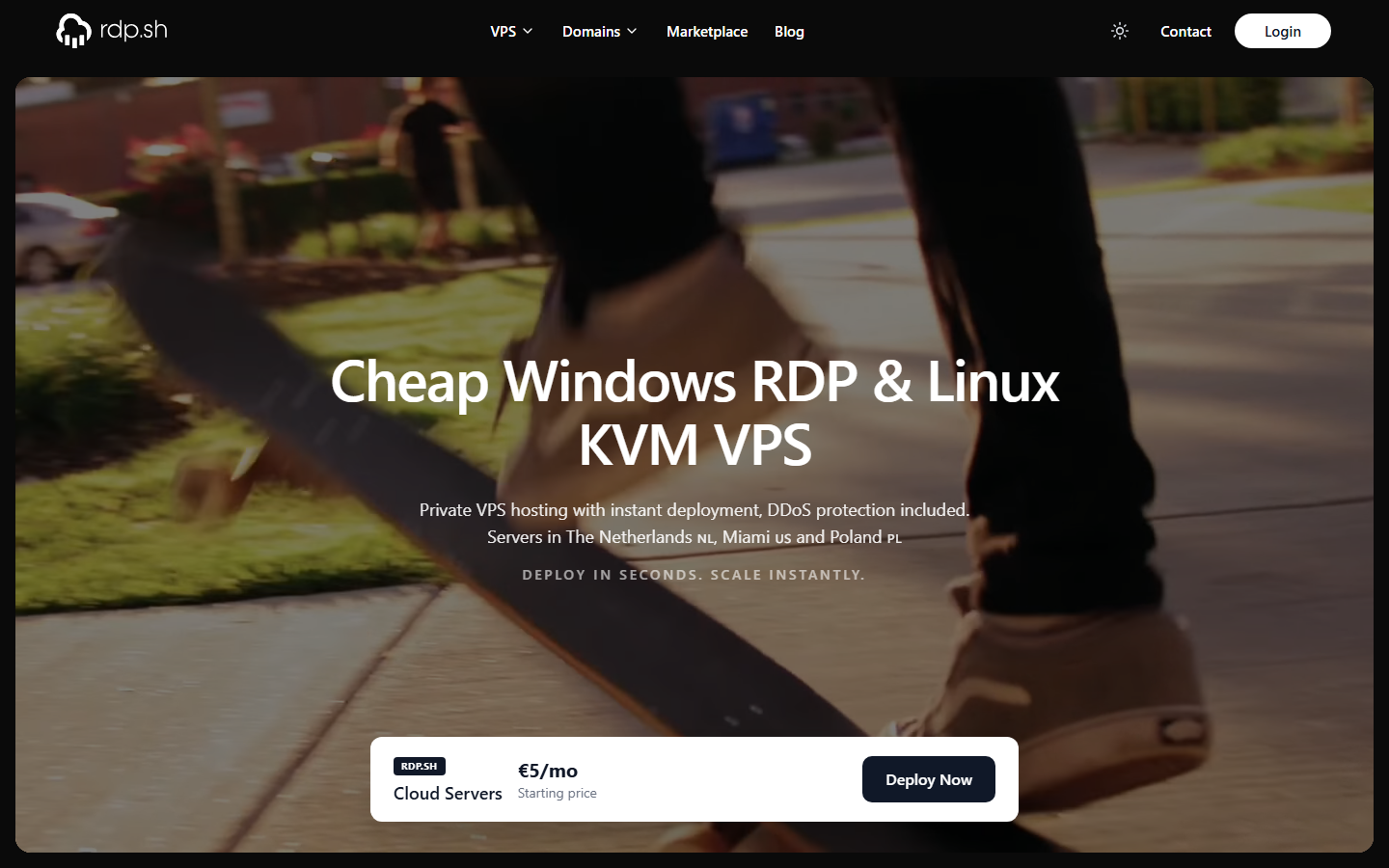
RDP.sh positions itself as a privacy-first cloud provider specializing in high-performance Windows RDP and Linux KVM virtual servers. Operating under EU legislation with infrastructure in Amsterdam, Warsaw, Miami, and Paris, the platform targets developers, automation engineers, and privacy-conscious users who need remote desktop or server resources without surrendering personal data. Plans start at €5 monthly for a 1 vCPU / 2 GB RAM Linux instance, scaling to €80 for a 10-core Windows configuration with 36 GB RAM. Every tier includes unlimited bandwidth, NVMe storage, DDoS protection, and API-driven instant provisioning that the company claims deploys in under five minutes.
What distinguishes RDP.sh from mainstream hosts is its deliberate rejection of conventional payment rails. By accepting only Monero and Bitcoin, the service eliminates the financial surveillance layer that typically accompanies VPS rentals. The control panel emphasizes simplicity—users can upgrade resources with minimal downtime, and Windows-certified technicians provide specialized support around the clock. For those running game servers, hosting panels like cPanel/WHM, or deploying containerized applications via Coolify or Dokploy, RDP.sh bundles one-click installation templates across CentOS, Rocky Linux, Ubuntu, Debian, Fedora, and AlmaLinux distributions.
Privacy & KYC
RDP.sh operates at KYC Tier L1 — Anonymous, meaning access is strictly pseudonymous. No email address is required during signup, and the provider does not collect personal identification documents. This makes it one of the more accessible no-KYC hosting options for users operating under pseudonyms or seeking to compartmentalize their infrastructure from their real-world identity.
- IP logging: The provider does not explicitly state a no-logging policy for IP addresses, so users should assume connection metadata may be retained for operational or abuse-prevention purposes.
- Email requirement: None — registration proceeds without a mailbox.
- Jurisdiction: EU-backed corporate structure with datacenters in the Netherlands, Poland, France, and the United States, creating a mixed jurisdictional footprint.
While the privacy score of 65/100 reflects solid anonymity at the onboarding stage, the gap between that and a higher rating likely stems from unspecified logging practices and the Miami location falling under US legal reach. Users with extreme threat models should layer additional operational security—Tor for account management, separate wallets per invoice, and never associating server content with personal identifiers.
Supported assets & payments
RDP.sh accepts exclusively Monero and Bitcoin for all services. This deliberate restriction reinforces its no-KYC positioning: neither cryptocurrency requires a bank account, name, or billing address to transact. Monero in particular offers transaction obfuscation that Bitcoin lacks, making it the preferable choice for users who want to sever the financial trail entirely. Invoices are presumably settled on-chain or via direct wallet transfer, though the site does not detail whether Lightning Network or subaddress rotation is supported. The absence of stablecoins, fiat on-ramps, or processor intermediaries like BitPay means users must already hold cryptocurrency to engage with the platform.
Security & custody
RDP.sh employs a non-custodial payment model for user funds—you send coins directly to settle invoices, with no wallet balance held by the provider. Server custody, however, is fully custodial in the traditional hosting sense: your data resides on their NVMe-backed KVM virtual machines, managed through their control panel and API. Every plan includes standard protections: enterprise-grade DDoS mitigation, dedicated IPv4 addresses, and root or administrator-level access to your instance. The 99.99% uptime SLA and 5 Tbps network backbone suggest redundant infrastructure, though users retain responsibility for hardening their own operating systems. Notably, the provider offers Windows Server 2019 through 2025 alongside current Linux distributions, appealing to users who require native Windows environments for proprietary software or remote desktop workflows that Linux cannot replicate.
Who it's for — verdict
RDP.sh fills a specific niche: affordable, anonymous compute for users who prioritize privacy over brand recognition. The 6/10 overall score reflects competent infrastructure at competitive prices, held back by a middling trust score (50/100) that likely stems from limited transparency around ownership, sparse community discourse, and unverified no-logs claims. It suits developers spinning up automation scripts, privacy advocates hosting censorship-resistant services, gamers running private servers, and small businesses needing Windows RDP without Microsoft Azure's identity requirements. The trust deficit means high-value or mission-critical workloads may warrant more established alternatives, but for pseudonymous experimentation and mid-risk hosting, RDP.sh delivers genuine no-KYC access with respectable hardware specs. Verify their abuse-policy boundaries before deploying anything sensitive—EU hosts vary widely in their tolerance for controversial content.
Community summary
RDP.sh delivers pseudonymous Windows and Linux VPS hosting from EU and US datacenters, accepting only Bitcoin and Monero for users who refuse identity verification.
Pros
- + True pseudonymous signup with no email required
- + Monero and Bitcoin payments only — no financial surveillance
- + Windows RDP plus extensive Linux distro selection
- + Instant deployment under five minutes with API access
- + EU legal base with geographically diverse locations
- + Competitive entry pricing at €5/month with unlimited bandwidth
Cons
- − Trust score of 50/100 indicates limited verifiable reputation
- − IP logging status unclear — not an explicit no-log provider
- − No community reviews or third-party audit evidence available
- − Mixed jurisdiction footprint includes US datacenter
Attributes
3 signalsStrengths
No KYC mention
P+15
Accepts Monero
P+5
Cautions
Community contributed