 Mullvad
VPN
Mullvad
VPN

RiseupVPN
Communityriseup.net
501(c)(4) non-profit, free to use VPN service, funded by donations
Live preview
riseup.net
▶
https://riseup.net/en/vpn
Review
EditorialOverview
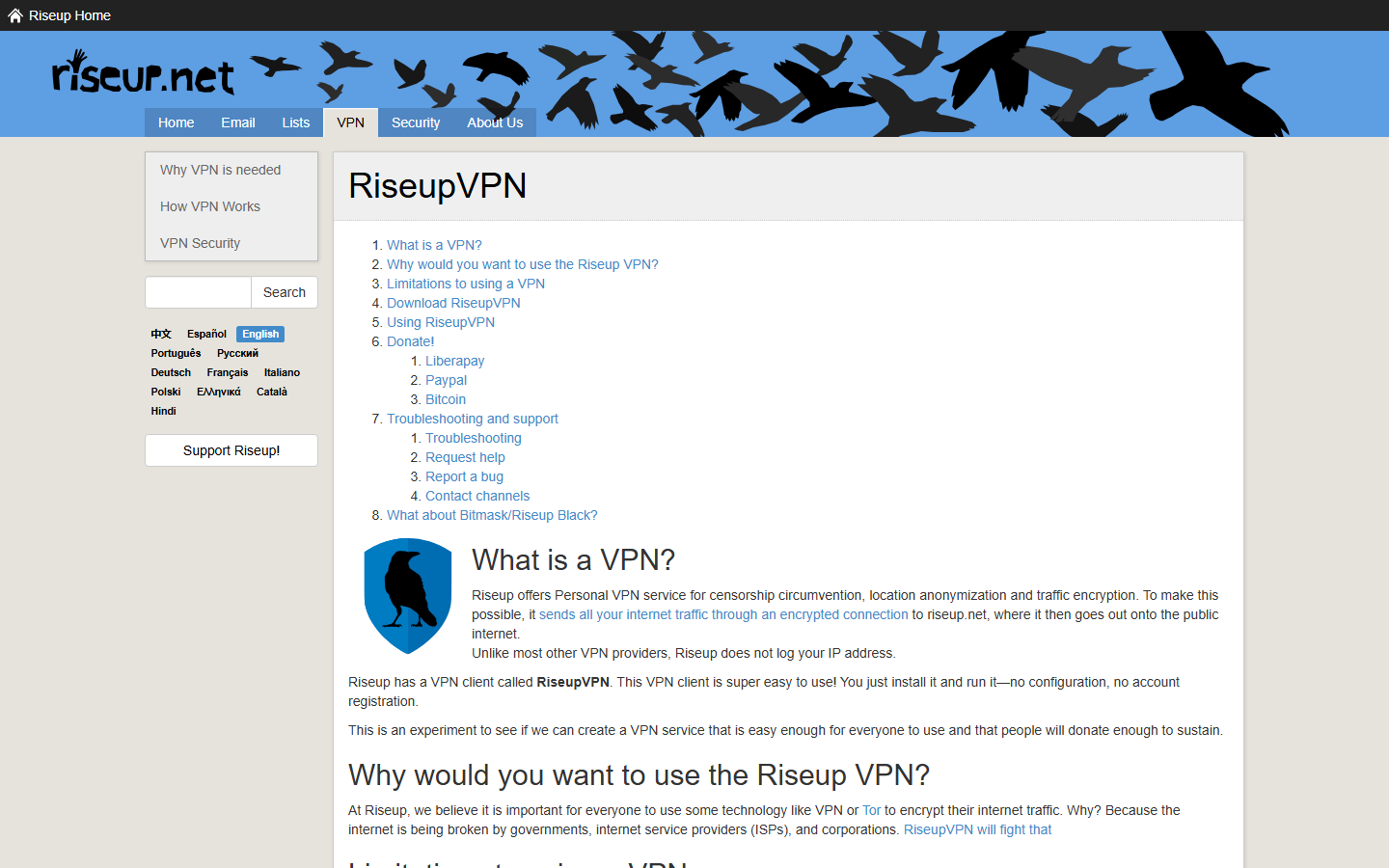
RiseupVPN is the VPN arm of Riseup, an autonomous tech collective that has operated since 1999. Unlike commercial VPN providers chasing subscription revenue, RiseupVPN runs as a 501(c)(4) non-profit experiment entirely sustained by user donations. The service strips away every friction point that typically exposes identity: there are no accounts, no passwords, no email requirements, and no payment gates blocking access. Users download the client, launch it, and route traffic through an encrypted tunnel to Riseup's infrastructure.
The project explicitly frames itself as a response to the broken modern internet—one where governments, ISPs, and corporations routinely surveil, throttle, or censor traffic. RiseupVPN's stated mission is making encryption accessible enough that non-technical users can adopt it without configuration headaches. It is available across GNU/Linux, macOS, Windows, and Android, with a system-tray interface that visually indicates connection status at a glance.
Privacy & KYC
RiseupVPN sits at KYC Tier L1 — Anonymous, the most permissive classification in our framework. Access is pseudonymous by design: the client generates credentials internally, so users never submit names, emails, phone numbers, or any identifying data to obtain service. This eliminates the account-compromise and data-breach risks that plague conventional VPNs.
- No IP logging: Riseup states outright that it does not log user IP addresses, a claim backed by its non-profit structure and activist ethos rather than marketing copy.
- No signup required: The absence of registration removes a major surveillance vector and makes the service immediately usable from burner devices.
- Funding transparency: Because the service is donation-funded rather than subscription-funded, there is no billing records trail linking real-world identity to VPN usage.
That said, RiseupVPN operates from US jurisdiction, which may give pause to threat models involving state-level adversaries. The collective's long history and radical transparency partially offset this, but users with extreme needs should layer Tor or evaluate jurisdiction more critically.
Supported assets & payments
While RiseupVPN is free to use, the collective requests donations to sustain operations—currently estimated at roughly $60 USD per person per year. Payment options include Bitcoin, PayPal, and credit/debit card via Liberapay, a non-profit subscription platform built on free software. Euro bank account direct debits are also accepted for Euro-denominated contributions.
Bitcoin donations route to a published on-chain address, enabling pseudonymous support without banking intermediaries. The collective emphasizes that VPN-specific donation links should be used; otherwise, funds cannot be earmarked for VPN infrastructure. This matters because sustainability data directly shapes whether the no-KYC experiment survives.
Security & custody
RiseupVPN's security model is built on open-source software and client-side simplicity. The application derives from the earlier Bitmask codebase—previously branded "Riseup Black"—but removes user credentials entirely in favor of automatic key generation. Under the hood, it encrypts all internet traffic and routes it through Riseup servers before exiting to the public internet, achieving standard VPN goals: censorship circumvention, location anonymization, and traffic encryption against local network adversaries.
The client includes a killswitch-like behavior where traffic is blocked during connection transitions, reducing accidental exposure. Platform coverage is broad, though iOS is notably absent. Users seeking additional obfuscation can access Riseup's services via Tor onion mirrors, adding a layer of metadata resistance for those already in the Tor ecosystem.
Because there is no user account infrastructure, there is effectively no custodial risk of credential databases being stolen. The trade-off is minimal customer support infrastructure and reliance on community channels—mailing lists and IRC—for troubleshooting.
Who it's for — verdict
RiseupVPN earns its strongest marks for ideological consistency and frictionless anonymity. It is ideal for journalists, activists, researchers, and everyday privacy-conscious users who need basic censorship circumvention and traffic encryption without leaving a paper trail. The no-signup, no-IP-logs architecture makes it one of the easiest on-ramps for users who have never used a VPN before.
However, the service is not a fit for users demanding large server networks, streaming unblocking, audited no-logs certifications, or 24/7 live support. Its non-profit, donation-dependent model introduces sustainability uncertainty, and US jurisdiction remains a structural limitation for certain threat models. We score it 7/10 overall—a niche but principled choice where anonymity and accessibility trump feature breadth.
Community summary
A donation-funded, open-source VPN from a long-running activist collective that requires zero personal information and keeps no IP logs.
Pros
- + Zero personal data required—true anonymous access
- + Open-source client with no configuration needed
- + No IP address logging stated explicitly
- + Bitcoin donations accepted for pseudonymous funding
- + Cross-platform support for Linux, macOS, Windows, Android
- + Long-standing activist collective with transparent mission
Cons
- − US jurisdiction may concern advanced threat models
- − No iOS client available
- − Sustainability depends entirely on voluntary donations
- − Limited server network compared to commercial rivals
- − No independent third-party audit published
Attributes
9 signalsStrengths
No KYC mention
P+15
Identity-Free registration
P+10
Strict no-log policy
P+5 T+3
No registration needed
P+5
Open source code
T+7
Audited
T+5
Red flags
Service Termination Policy
T-4
Cautions
Community contributed
Informational
Legally registered
T+2