 eigenwallet
Exchange · DEX
eigenwallet
Exchange · DEX
RubyCash
Communityrubycash.org
RubyCash – modern crypto exchange with competitive rates, fast, secure deals, and 24/7 support.
Live preview
rubycash.org
▶
https://rubycash.org
Review
EditorialOverview
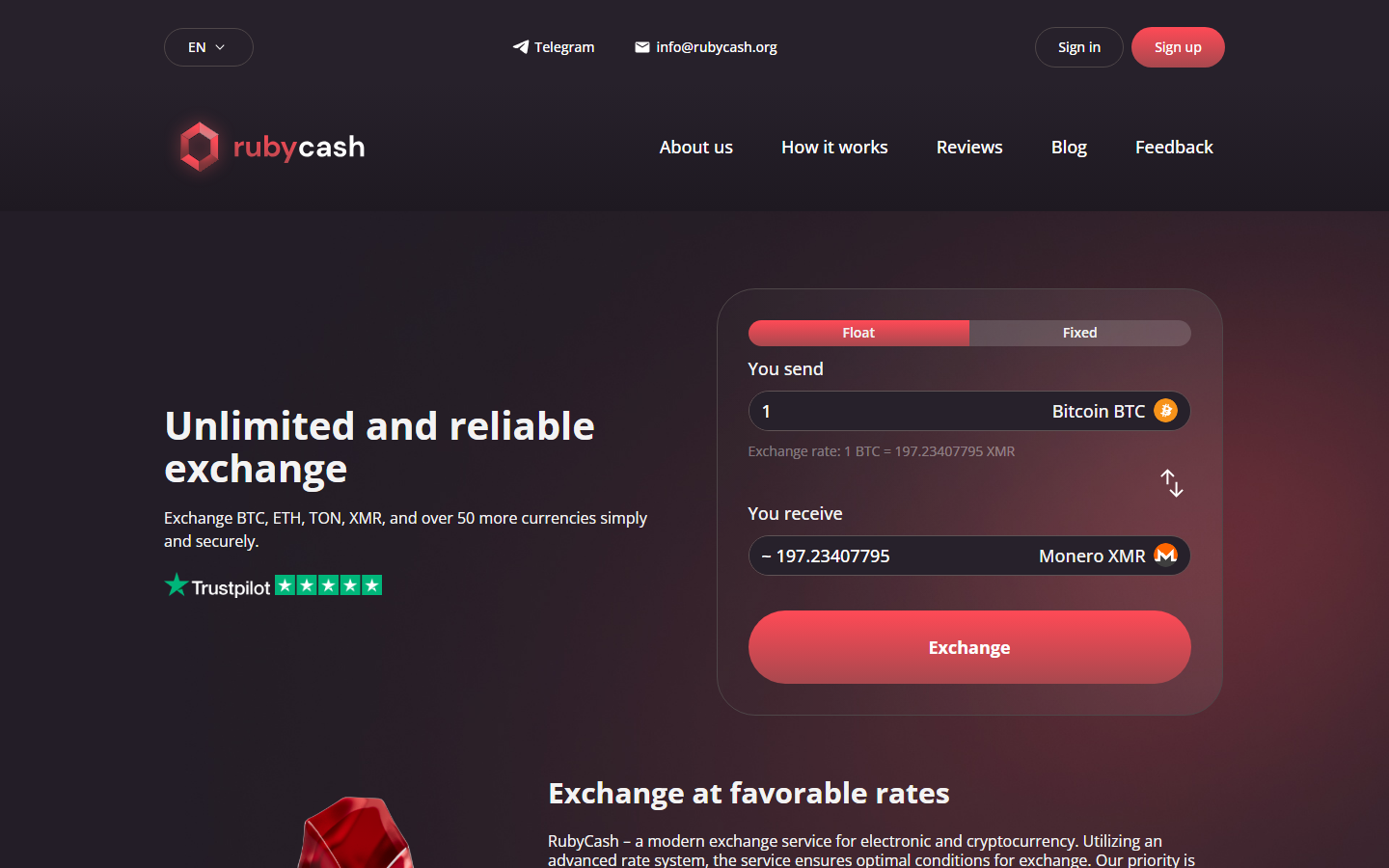
RubyCash presents itself as a modern instant exchange platform offering competitive rates across more than 50 cryptocurrencies and fiat payment methods. The service emphasizes speed and simplicity, promising secure transactions with round-the-clock support. Users can swap between major assets like Bitcoin, Ethereum, Monero, and various stablecoins without creating an account for basic operations—though the "no signup" label comes with significant caveats. The platform also supports fiat on-ramps and off-ramps through Visa, Mastercard, and multiple regional banking options including Ukrainian hryvnia corridors and Kazakhstani tenge.
Despite its polished marketing, RubyCash earns a middling overall score of 4/10 in our assessment. The gap between its privacy promises and actual data practices is substantial enough that privacy-conscious traders should examine the fine print carefully before committing funds.
Privacy & KYC
RubyCash operates under an L3 tiered KYC policy, meaning identity verification kicks in only above specific transaction thresholds rather than at first use. For small swaps, this creates genuine no-KYC entry points—an attractive feature for users seeking anonymous crypto exchange options. However, the model is fundamentally conditional anonymity rather than true privacy-by-design.
The platform's privacy score of 33/100 reflects several concerning practices:
- Mandatory email collection despite the "no signup" branding—users must provide an email address to proceed with exchanges
- Active IP logging, creating a persistent link between real-world identity and transaction history
- Tiered verification requirements that escalate with volume, potentially exposing user identities at higher thresholds
- No clear transparency about what specific limits trigger full KYC or how long data is retained
For a directory focused on minimal verification services, these practices place RubyCash firmly in the conditional privacy category rather than genuinely anonymous territory. Users seeking completely no-KYC Bitcoin exchanges will find stricter alternatives elsewhere.
Supported assets & payments
RubyCash supports a genuinely broad selection of assets spanning major cryptocurrencies, layer-2 tokens, and fiat payment rails. The platform handles Bitcoin, Ethereum, Monero, Litecoin, Solana, Cardano, Ripple, TRON, Dogecoin, and Cosmos alongside multiple Tether and USDC variants across ERC-20, TRC-20, BEP-20, Solana, Polygon, and Arbitrum networks. This multi-chain coverage simplifies swaps that would otherwise require bridging or multiple exchange accounts.
Fiat integration is particularly strong for Eastern European and Central Asian markets. Users can transact through Visa and Mastercard in USD, EUR, TRY, PLN, CNY, MDL, and GEL, plus Ukrainian banking rails including MonoBank, Privat24, Raiffeisen, OshadBank, and UkrsibBank. Kazakhstani options include ForteBank, HalykBank, Kaspi Bank, and Jusan Bank. The inclusion of WeChat Pay and Alipay broadens accessibility for Chinese users, while UZCARD and HUMO serve Uzbekistani traders.
Exchange modes include both float (market-rate with potential slippage) and fixed (locked-rate) options, giving users some control over price certainty versus potentially better execution.
Security & custody
RubyCash operates as a custodial exchange, meaning the platform controls funds during the swap process rather than facilitating non-custodial atomic trades. Users must trust RubyCash to honor its reserves and execute transactions promptly. The platform advertises a substantial XMR reserve of 90 million Monero—though this figure should be treated as a marketing claim rather than independently verified proof of solvency.
The trust score of 41/100 suggests meaningful concerns about operational transparency and reliability. No community sentiment samples were available for independent verification, leaving users dependent on curated testimonials displayed on the official site. The presence of a Telegram-based review incentive program—offering 1 USDT per verified review with up to 3 USDT per order—introduces potential bias into publicly visible feedback.
Security features mentioned include transaction encryption and 24/7 support availability, but specifics about cold storage ratios, insurance funds, or audit history remain undisclosed.
Who it's for — verdict
RubyCash suits traders who prioritize convenience and speed over absolute privacy, particularly those in under-served fiat corridors like Ukraine, Kazakhstan, and Uzbekistan. The platform's strength lies in its extensive payment method coverage and multi-chain stablecoin support rather than its privacy credentials.
For strict no-KYC advocates, RubyCash falls short. The mandatory email requirement, IP logging, and tiered verification architecture create multiple identity touchpoints. Users seeking anonymous Monero exchanges or completely ID-free Bitcoin swaps should consider alternatives with stronger privacy scores and non-custodial designs.
The 4/10 overall rating reflects this identity tension: RubyCash delivers functional utility for casual users but cannot be recommended as a privacy-first solution. Treat it as a low-KYC rather than no-KYC service, and assume your activity is linkable to your email and IP address regardless of transaction size.
Community summary
RubyCash markets itself as a streamlined instant exchange for crypto and fiat swaps, yet its L3 tiered KYC, mandatory email collection, and IP logging undermine its privacy claims.
Pros
- + Broad multi-chain stablecoin support (USDT/USDC across 7+ networks)
- + Extensive Eastern European and Central Asian fiat payment rails
- + No account required for basic swaps below KYC thresholds
- + Fixed and floating exchange rate options available
- + 24/7 customer support via Telegram
Cons
- − Mandatory email collection undermines "no signup" claims
- − Active IP logging with 33/100 privacy score
- − Tiered KYC escalates with volume—conditional anonymity only
- − Custodial model requires trust in platform reserves
- − No independent audit or proof of reserves disclosed
Attributes
17 signalsStrengths
Accepts Monero
P+5
No registration needed
P+5
Good Customer Support
T+5
Red flags
Service Termination Policy
T-4
May require KYC/SOF by policy/law
P-6 T-4
Cautions
Unclear refund policy
T-4
May Freeze or Seize Funds
T-3
Community contributed
Transaction monitoring
P-1
KYC depends on partners
P-5
Shotgun KYC
P-15
Informational
Source code is private
T-1
Legally registered
T+2
API available
Email required
Telegram bot available
Some countries are restricted
Related
4 services
eigenwallet
Exchange · DEX
 Bisq
Exchange · P2P
Bisq
Exchange · P2P
 BasicSwap
Exchange · P2P
BasicSwap
Exchange · P2P
 RoboSats
Exchange · P2P
RoboSats
Exchange · P2P