 Mullvad
VPN
Mullvad
VPN

Safing SPN
Verifiedsafing.io
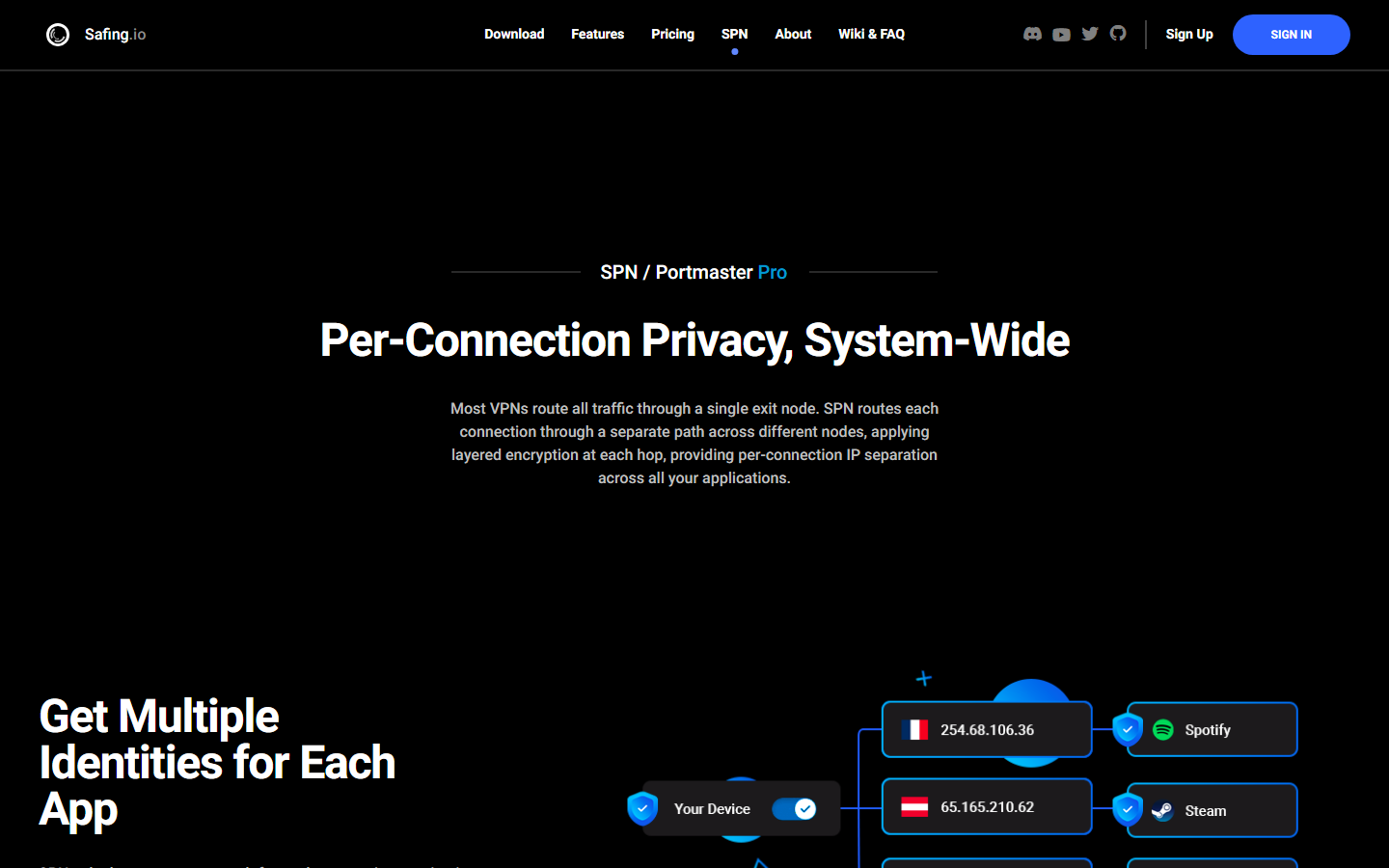
SPN can provide multiple identities based on the app you are using.
Live preview
safing.io
▶
https://safing.io/spn
Review
EditorialOverview
Safing SPN is a privacy network that abandons the single-tunnel VPN model in favor of per-connection onion routing. Built into the Portmaster firewall suite, it calculates a unique path for every connection your computer makes, assigning separate exit IPs to each application and even individual browser tabs. The service is now owned by IVPN following an acquisition announced in late 2024, though it continues to operate as a distinct product with its own infrastructure and development roadmap. Unlike conventional VPNs designed for remote office access, SPN treats identity fragmentation as its core mission, making it one of the more architecturally ambitious no-KYC privacy tools available in 2026.
The software remains fully open source, with clients for Windows, Debian/Ubuntu, and Fedora. A free tier covers basic Portmaster firewall functionality, while SPN routing requires a paid subscription.
Privacy & KYC
SPN sits at KYC Tier L1 — Anonymous. Signup is pseudonymous: no government ID, no name, no address. The service does require an email address for account management, but burner or alias addresses work fine. No IP logging is mentioned in the current policy, and the onion-routing architecture itself limits what any single node can observe.
The privacy architecture goes beyond standard VPNs in several ways:
- Per-connection pathing: Every TCP connection routes through independently calculated multi-hop circuits, not a single server
- App-level identity separation: Steam, Spotify, and your email client each exit from different IPs in different jurisdictions
- Layered encryption: Each hop decrypts only its own layer, inspired by Tor's design but applied system-wide
- Granular exclusion rules: Whitelist specific apps or domains to bypass SPN when compatibility issues arise
The privacy score of 80/100 reflects strong technical design tempered by the email requirement and the relative youth of the network compared to Tor's decade-plus of battle-testing.
Supported assets & payments
Safing SPN accepts Monero (XMR), Bitcoin (BTC), fiat via credit card and PayPal, and cash payments. The inclusion of Monero is particularly notable for no-KYC users seeking unlinkable transactions, while cash payments via mail add a physical-layer anonymity option rarely seen in VPN services. Crypto payments are processed without mandatory identity verification, preserving the pseudonymous account structure.
Pricing follows a standard monthly or annual subscription model. The free Portmaster tier provides firewall and connection monitoring tools indefinitely, but SPN routing itself requires upgrading to a paid plan.
Security & custody
SPN is non-custodial by design in the networking sense: you run the open-source Portmaster client locally, inspect its behavior, and retain control over which connections enter the encrypted tunnel. There is no browser-based proxy or third-party app store wrapper that could inject malicious code.
Security fundamentals are solid. HTTPS connections receive double protection — TLS encryption end-to-end, wrapped in SPN's onion layers for the transit path. The company emphasizes that SPN protects IP exposure but does not eliminate browser fingerprinting, login correlation, or malicious JavaScript tracking. This honest threat-model framing is refreshing in an industry prone to overpromising.
The trust score of 70/100 likely reflects the IVPN acquisition transition and the smaller node network compared to established competitors, rather than any specific security flaw.
Who it's for — verdict
Safing SPN suits privacy-conscious users whose threat model demands per-connection IP separation across all applications, not just browser traffic. Journalists, researchers, and crypto users who compartmentalize identities by app will find the multi-identity architecture genuinely useful. The no-KYC signup and Monero payment support align cleanly with the cypherpunk ethos.
However, the system-wide routing approach introduces complexity. Users report mixed experiences with compatibility — some find certain services blocked or degraded when every connection fragments across global exit nodes. The learning curve exceeds that of one-click VPN apps. If you simply need to change your Netflix region or hide your IP from public Wi-Fi, a conventional VPN is faster and cheaper. If you want every application to present a distinct network identity with no identity verification required, SPN remains one of the few specialized tools that delivers.
Community summary
Safing SPN routes every connection through separate onion-encrypted paths, giving each app its own identity without requiring identity verification.
Pros
- + True per-connection onion routing with separate exit IPs
- + No-KYC signup with Monero and cash payment options
- + Fully open-source client code for audit and local control
- + Granular app and domain exclusion rules
- + System-wide coverage beyond just browser traffic
Cons
- − Requires email for account creation
- − Higher complexity than standard VPN apps
- − Mixed community reports on connection reliability
- − Smaller node network than Tor or major VPNs
Attributes
8 signalsStrengths
No KYC mention
P+15
Identity-Free registration
P+10
Strict no-log policy
P+5 T+3
Accepts Monero
P+5
Verified
T+10
Open source code
T+7
Informational
No JavaScript needed
P+1
Account required
P-1
Related
4 services

User reports
★ 4.2/5 · 3 ratings
portable_vowel_8445
1/5
The base service is similar to SimpleWall (Windows) or Little Snitch (MacOS) where they provide a user interface for you to manage and analyze all network requests for websites and programs on your computer. The premium service provides you with a service similar to a VPN but differs by juggling your internet traffic through different nodes making it more private. I really like how they let you fine tune each connection and have them go through their own individual exit nodes - all very good ideas in concept. The issue is that the service is extremely unreliable and you will be pulling your hair out majority of the time. I assume it is because they just do not have enough nodes on their network and those nodes are also not the most stable or reliable. So much time is wasted waiting on the service to reliably connect, only for it to fail for another five minutes. This actually has ruined the whole concept of SPNs for me and can understand why other SPNs have their own crypto-coin and incentivizes a larger quantity of individuals to become a node in exchange for their crypto currency in order for them to have a more robust network (in theory). I am currently running their Portmaster v2 release, but really do not like their user interface. I understand this is still a newer product and will need to go through several iterations for them to nail it but I cannot recommend this service to anyone as of January 2026. You could utilize the application for its network management and analysis tool, which is free, but do not bother with the SPN.
drowsy_coach_7255
1/5
trash is block your internet absolutely not working stay away from that shit by luck i took only 1month sub to test
Swapuz ✅ (Support at Swapuz)
5/5
Safing SPN is privacy with precision — multiple identities per app, no leaks, no tracking. A VPN that actually understands context. 🧠🛡️
SMSPool ✅ (Support at SMSPool)
This product is now owned by IVPN: https://www.ivpn.net/blog/ivpn-acquires-safing-portmaster-spn-network/ https://safing.io/blog/2024/12/03/a-new-chapter-begins/