 Exodia
VPS
Exodia
VPS

Silent Node
Verifiedsilentnode.host
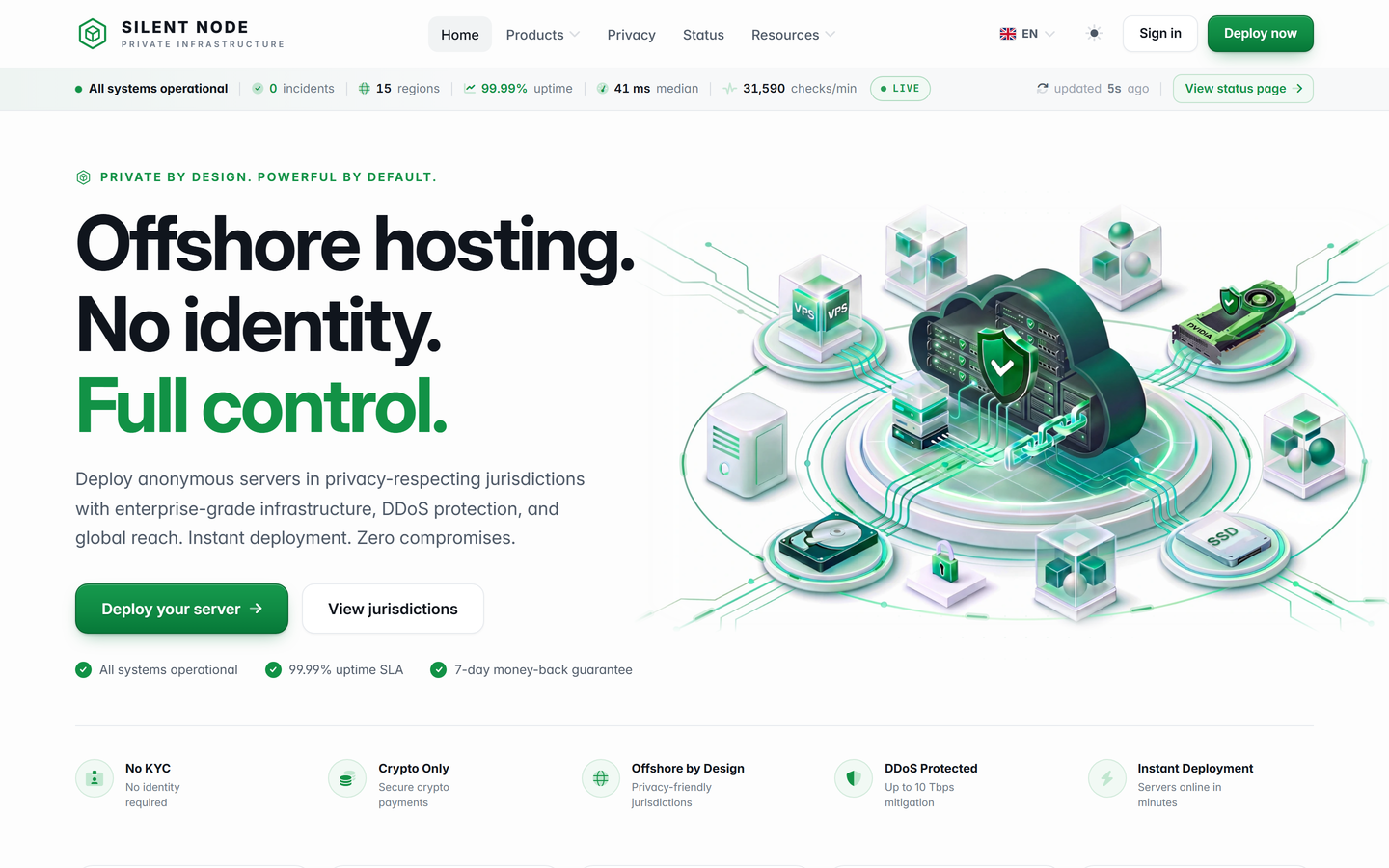
Silent Node is an anonymous offshore hosting provider run by Silent Node OÜ (Estonia, AS215430, RIPE NCC member), founded in January 2021 and self-funded. It offers KVM VPS, bare-metal dedicated servers, hourly GPU instances and S3-compatible object storage spread over fifteen offshore territories, with zero presence in Five Eyes countries or the western EU. An account is nothing but a 16-digit token: name, email, phone and paperwork are never part of the deal. As of August 18, 2026, the provider reports 12,998 servers online and a warrant canary freshly signed on August 1, 2026.
Live preview
silentnode.host
▶
https://silentnode.host
Review
EditorialOverview
Silent Node is the strongest infrastructure listing in this directory. It is operated by Silent Node OÜ in Estonia (AS215430, RIPE NCC member), started in January 2021 when three engineers lit up a first rack in Reykjavik, and it still runs on its own money, no investors. As of August 18, 2026, the public status page shows 12,998 servers online. The tagline states the whole pitch: 'Offshore hosting. No identity. Full control.'
Each step of the timeline can be checked against the About page: September 2021, billing goes crypto-only; March 2022, jurisdiction four; June 2023, the 10 Tbps shield reaches all regions; February 2024, Hong Kong makes twelve while the fleet crosses 10,000 machines; January 2025, the status platform and the monthly canary begin.
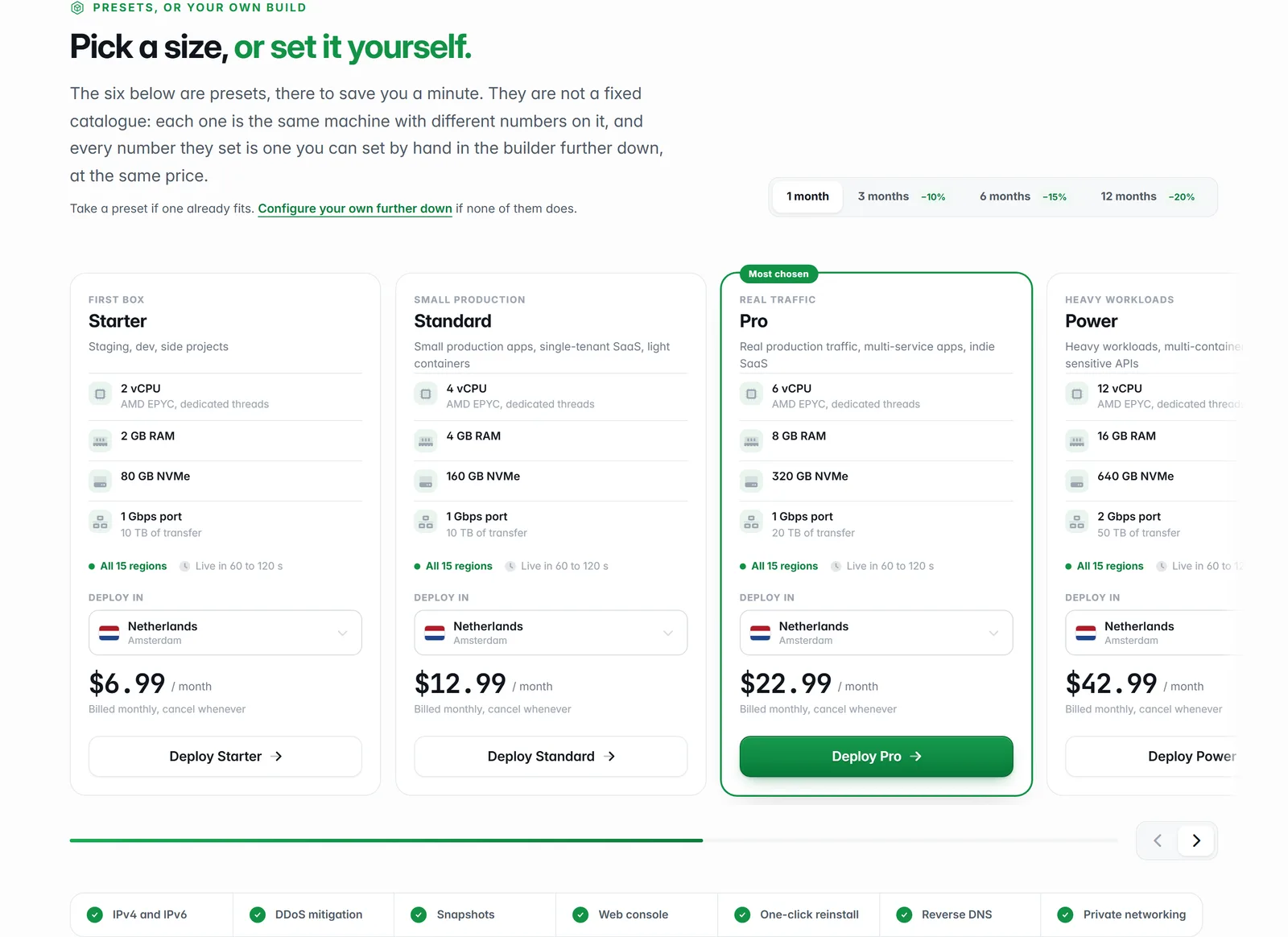
The catalog spans four lines, and the price points are concrete. KVM VPS plans on AMD EPYC with local NVMe open with Starter, which puts 2 dedicated threads, 2 GB of RAM and 80 GB of flash at $6.99 a month; Pro, the crowd favorite, pairs 6 threads with 8 GB and 320 GB for $22.99; Titan crowns the range with 32 threads, 64 GB, 2 TB and a 5 Gbps uplink at $119.99. A free configurator builds custom sizes at the same rates. Dedicated servers are single-tenant EPYC 4004/9004 builds from Iron at $64.99 per month (EPYC 4244P, 6c/12t, 32 GB DDR5 ECC, 1 TB Gen4 NVMe) to Titan at $219.99, whose EPYC 9254 brings 24 cores and 48 threads next to 192 GB of ECC memory and 8 TB of Gen4 flash, all on unmetered 10 Gbps ports and options beyond that on quote. Steel at $84.99 is the most-chosen dedicated plan. GPU instances bill hourly from $0.18 (RTX 4090, 24 GB) to $1.23 (B300, 288 GB HBM3e), with monthly reserve pricing around 35 to 45 percent below hourly. S3 object storage starts at $4.99 per month for 250 GB and reaches $109.99 for 10 TB across 8 regions.
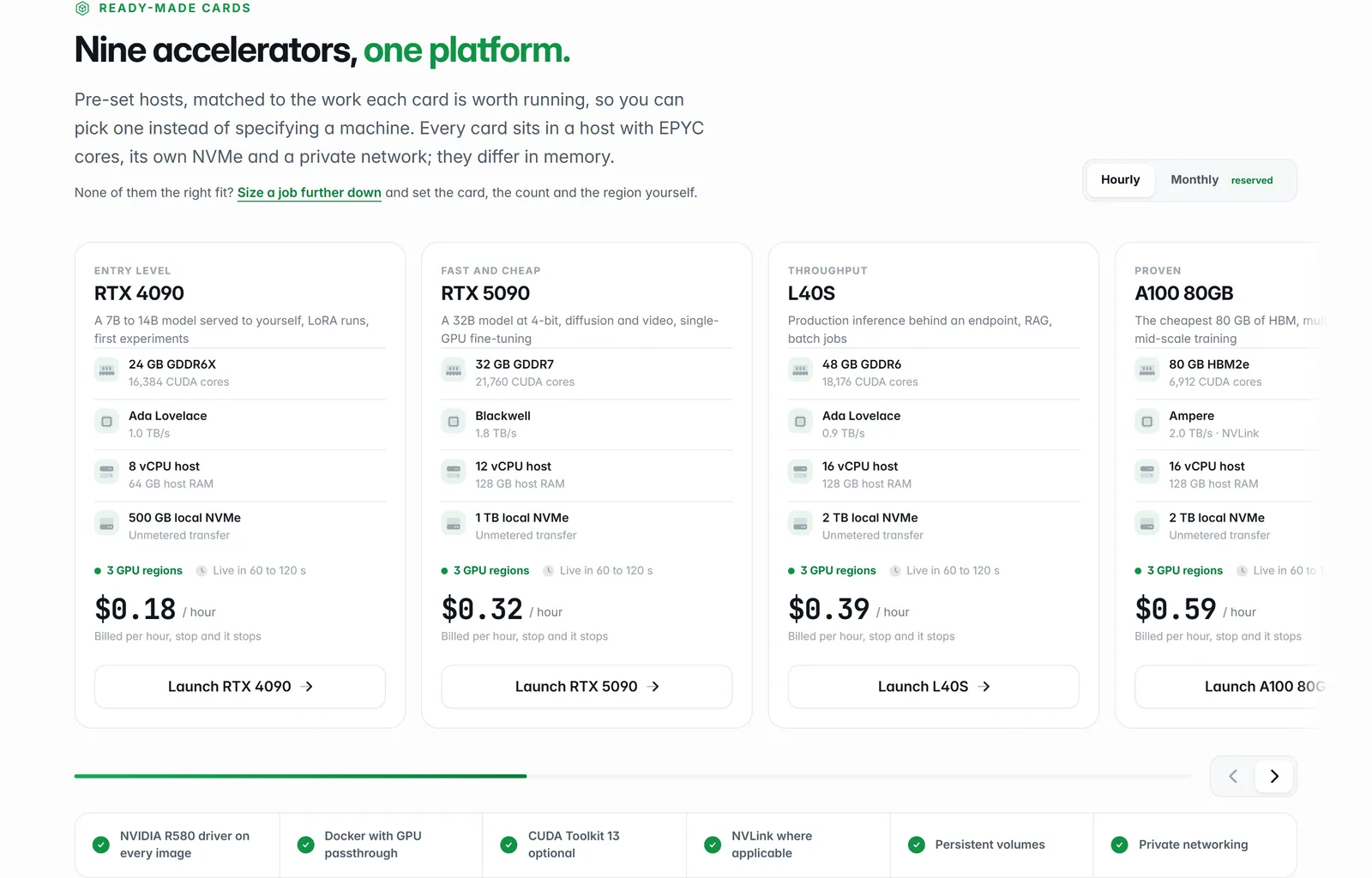
The GPU grid reads top to bottom: RTX 4090 at $0.18 an hour for single-card inference, L40S at $0.39 with 48 GB, A100 and H100 80 GB at $0.59 and $0.74 with NVLink for training runs, up to the B300's 288 GB of HBM3e at $1.23.
Boost clocks are published: 3.8 to 5.1 GHz on the EPYC 4244P, 4.5 to 5.7 on the 4564P, 2.9 to 4.15 GHz across the 9254's 24 cores.
Any VPS tier can land in any of the fifteen sites, listed by city rather than flag: Reykjavik (REK-1), Amsterdam (AMS-1), Zurich (ZRH-1), Bucharest (OTP-1), Sofia (SOF-1), Chisinau (KIV-1), Moscow (MOW-1), Tbilisi (TBS-1), Dubai (DXB-1), Singapore (SIN-1), Hong Kong (HKG-1), Phnom Penh (PNH-1), Victoria in the Seychelles (SEZ-1), Belize City (BZE-1) and Panama City (PTY-1). Not one answers to a Five Eyes government or a western EU regulator. Their FAQ frames the gap as a choice: laws on retention and mandatory identification in those countries cannot coexist with a no-logs operation. GPU capacity sits in 3 regions (AMS, OTP, TBS, with Tbilisi cheapest on energy), and a 99.99% SLA covers every plan with a 7-day money-back guarantee and no setup fees.
Privacy & KYC
Registration is a 16-digit token generated in one click. No name, no email, no phone, no documents, not ever. There is no password and no recovery flow: lose the token and the account is gone, a trade-off the docs state plainly. On their side the token exists only as a one-way hash, sitting next to the balance and its ledger, the plan, the region, the assigned IP and whatever tickets you opened. That is the entire record.
The logging policy is absolute: no IP logs, no traffic or connection logs, no timestamps, no content inspection, summarized on the site as 'Nothing to hand over.' Two artifacts back the claim. The warrant canary carries a PGP signature and gets refreshed at the start of every month, a cadence unbroken since January 2025; its August 1, 2026 edition attests to a count of zero across the board: no national security letters, no gag orders, no warrants, no interception hardware. The public register counts 41 legal demands for 2024, another 67 for 2025 and 38 more through June 2026. Not one of those 146 produced customer data.
DMCA takedowns are not processed, and Tor exit nodes and VPN endpoints are explicitly welcome. The provider's own region guidance is practical: NL/CH/RO for European performance, RU/PA/AE for crypto tolerance, KH/SC/BZ for DMCA resistance, IS/BG/GE as balanced picks, SG/HK for Asia. Region migration takes one click. The privacy manifesto runs five sections, citing UDHR Article 12, the de Montjoye 2013 re-identification result (4 spatio-temporal points identify 95% of individuals) and Rocher 2019 (15 attributes, 99.98%), then closes with honest third-party tool recommendations (Mullvad, IVPN, Tor, Signal, KeePassXC, Monero) that the provider says it earns nothing from.
Supported assets & payments
Payment is crypto only, 28 coins, with Monero the house recommendation, joined by Bitcoin, Litecoin, Ethereum, USDT on Tron, USDC, Solana and a dozen others. The model is prepaid: fund a balance through a one-time deposit address with QR code, renewals debit it, nothing expires, and a runway estimate sits in the dashboard. There is no card option, no processor subscription, and no external auto-charge of any kind. Per the docs an XMR deposit clears in about two minutes, USDT on Tron in about one, BTC in about ten; send too much and the excess lands in your balance instead of vanishing. Let the balance run dry and services simply stop; the ledger records amounts, never identities.
On bonuses the marketing banner and the documentation disagree: the docs table reads +10%, +15% and +20% at the $50, $100 and $250 marks and doubles a $1,000 deposit, while the homepage promises steeper promo tiers. Read it as a bonus of up to +100% and confirm at checkout. Invoices carry no name and 0% VAT under offshore billing. Token rotation is supported, sessions can be listed and revoked, and the docs encourage multiple accounts for compartmentalization, an unusual thing for a host to recommend and a sign the threat model is taken seriously.
Security & custody
Disk encryption is AES-256 at rest across the fleet, with an own-key LUKS option available on VPS. Hardware is owned outright, never resold: AMD EPYC hosts with NVMe in hand-racked, hardened chassis, with peering that runs through AMS-IX, DE-CIX and LINX alongside private links. The 10 Tbps anycast scrubbing shield comes standard on every tier, permanently active, at no extra charge.
The team is anonymous but accountable in the ways that matter here: four PGP-signed handles (@kern for infrastructure, @aria for the network edge, @moth for security and audits, @fen for the 24/7 PGP-first help desk) and a published support key. The GPU line states 'nothing retained': no prompts, no weights, no telemetry. Object storage uses erasure coding inside the region you choose, never replicating outside that jurisdiction unless asked, with versioning, presigned URLs and object lock (WORM) for immutable archives. The chosen region fixes the legal venue of the objects, which is exactly how jurisdictional storage should work. Object lock (WORM) pins a bucket against alteration or deletion for the retention period you set, which suits evidence archives and audit trails.
Custody limits are stated, not hidden. There are no managed services, no shared hosting, no overselling, no macOS instances, and automated backups are a paid add-on (encrypted, in-region), so unconfigured means unprotected. Spam and email abuse relays are refused, illegal activity is refused, maintenance windows are announced in advance, rule violations void the 7-day money-back guarantee, and the docs say plainly that you are responsible for your own data. The abuse rules are short and precise rather than a vague catch-all.
User experience & performance
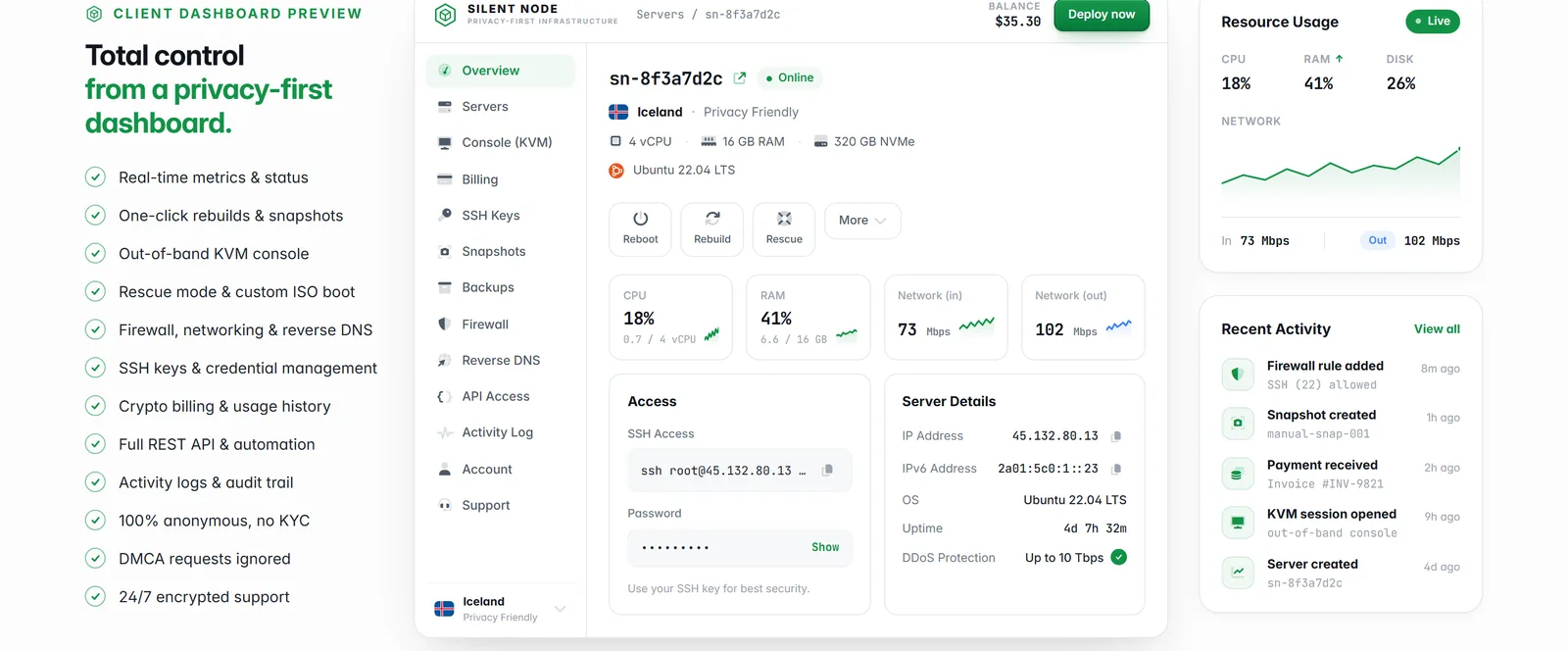
VPS instances go live in 1 to 2 minutes (the FAQ says under 60 seconds, the SLA page says 60 to 120; take the conservative number). Threads are dedicated and never oversubscribed, resizes happen without downtime on the same IP and disk, and you get dual-stack addressing with a /64, snapshots, rescue boot, custom ISO images, an out-of-band KVM console, reverse DNS, private VLANs, a 60-second reinstall, an IP and ASN firewall and live metrics. The v1 REST API mirrors every action the panel offers, with SDK examples for curl, Python, Go and PHP, webhooks and documented rate limits. Windows is available with RDP included.
Dedicated servers ship in 4 to 12 hours after hand-racking, burn-in and link testing, with DDR5 ECC everywhere, Gen4 NVMe, IPMI/KVM over IP, no setup fee, extra IPv4 at $1 each and a /64 of IPv6; custom quotes cover a second CPU, larger arrays and private VLANs between machines. GPU instances give root on the host, the NVIDIA R580 driver preinstalled, Docker GPU passthrough, optional CUDA 13, NVLink depending on card, persistent volumes with discounts at 1 TB and 8 TB, and unmetered transfer everywhere. Hourly billing stops with the instance, monthly reserve cuts rates by roughly 35 to 45 percent, and yearly reserve takes a further 20 percent off. A per-checkpoint configurator lets you pick an LLM and matches the build to the cheapest node that holds it.
Performance claims are published, not whispered. The status page runs under the banner 'Don't trust us. Verify' and backs it with numbers: a weighted 30-day availability of 99.99%, a probe volume near 31,600 checks every minute, a fleet-wide median around 43 ms, and per-site medians of 27 to 28 ms in Amsterdam, 29 in Zurich, 33 in Reykjavik, 43 in Singapore, 73 in Phnom Penh and 80 in Belize. Packet loss sits at 0.01 to 0.03%, probes run every 30 seconds with 4 per site, components report 99.98 to 100%, and a status API v1 exposes the same data.
Before scoring, we walked the entire public surface on August 18, 2026: four product pages, five documentation chapters, the manifesto, the status page and the API behind it (queried directly), the API reference, plus a sweep of the 4,400-page tutorial shelf. The canary and the request ledger were read where they are published, and the price list was weighed against every rival host this directory carries. Nothing was rented, deployed or measured for this piece; each figure is the provider's own telemetry and is labeled that way.
Support runs 24/7 over live chat, tickets and email (under 2 hours per the docs). The tutorial library holds over 4,400 pages in English alone, and the site ships in 26 languages, covering security, containers, web servers, databases, networking, devops and LLM serving topics like vLLM, quantization and batching. The homepage carries 'trusted by' logos for Proton, Tutanota, IVPN and n8n.
Who it's for — verdict
Silent Node names its audience in its own manifesto: journalists, organizers, whistleblowers, doctors and publishers, plus anyone running Tor exits or VPN endpoints. It is equally a straight infrastructure pick: the GPU catalog undercuts most anonymous GPU options on price (an H100 80 GB at $0.74 per hour, a B200 180 GB at $0.98), the dedicated line puts a 16-core EPYC 4564P with 96 GB of DDR5 ECC at $139.99 per month, and the S3 tiers make jurisdiction-pinned archives cheap at $14.99 per month for 1 TB.
The cons are structural. Lose the token, lose the account. Crypto is the only way to pay. Nothing is managed, backups cost extra, and the team is anonymous and about five years old. The deposit-bonus tiers also disagree between the banner and the docs, which should be cleaned up. If you need hand-holding or fiat billing, this is not your provider.
Every other hosting listing here spans one to five jurisdictions (Exodia five EU countries, Ko-Net Stockholm, BTCVPS the Netherlands and Lithuania, PrivateAlps Switzerland, MyNymBox Saint Kitts, servers.guru ten claimed datacenters). Set against a category where five countries is the ceiling, a four-continent spread of fifteen sites stands alone. Our own attribute data makes the second gap explicit: Silent Node is the only hosting listing here carrying the published-warrant-canary signal, and none of the rivals that gesture at transparency back it with a public request ledger and a queryable status feed. The third gap is the GPU shelf, nine classes deep, reaching 288 GB per card, metered by the hour, unmatched among the hosts we index.
Weigh that against what you can verify yourself: a monthly signed canary running since January 2025 with a clean August 1, 2026 signature, a transparency register with 146 logged requests and zero disclosures across 2024 to mid-2026, a live status page exposing per-site latency at 30-second resolution, and 12,998 servers across 15 non-Five-Eyes jurisdictions. No other listing pairs that verifiability with this hardware breadth. Silent Node is the strongest infrastructure entry in the directory.
Community summary
The most verifiable no-KYC infrastructure provider in this directory: token-only accounts, a monthly signed warrant canary, a zero-disclosure transparency register and owned AMD EPYC hardware in 15 offshore regions.
Pros
- + True no-KYC: one-click 16-digit token account, no name, email, phone or documents
- + No logs policy backed by a monthly PGP-signed warrant canary since January 2025 and a public transparency register with zero disclosures
- + Fifteen offshore territories, all clear of the Five Eyes and the western EU, with one-click migration between them
- + Owned AMD EPYC/NVMe hardware, unmetered 10 Gbps dedicated ports, 99.99% SLA and a public status page with 30-second probes
- + Cheap anonymous GPU line: RTX 4090 at $0.18/h up to B300 288 GB at $1.23/h
- + AES-256 encryption at rest by default, optional LUKS with your own key, 10 Tbps anycast DDoS included
Cons
- − Lose your 16-digit token and the account is unrecoverable, by design
- − Crypto only, no cards and no fiat payment rails
- − No managed services, and automated backups are a paid add-on
- − Anonymous team founded in 2021, still young by hosting industry standards
Attributes
12 signalsStrengths
Guaranteed no KYC
P+25
Identity-Free registration
P+10
Strict no-log policy
P+5 T+3
Accepts Monero
P+5
Own infrastructure
P+1 T+2
Token-based login
P+1
Good Customer Support
T+5
Mature service
T+5
Published warrant canary
T+3
Defends against takedown requests
T+2
Informational
Legally registered
T+2
API available