 eigenwallet
Exchange · DEX
eigenwallet
Exchange · DEX

SilentSwap
Communitysilentswap.com
Effortlessly swap tokens while safeguarding your privacy.
Live preview
silentswap.com
▶
https://www.silentswap.com
Review
EditorialOverview
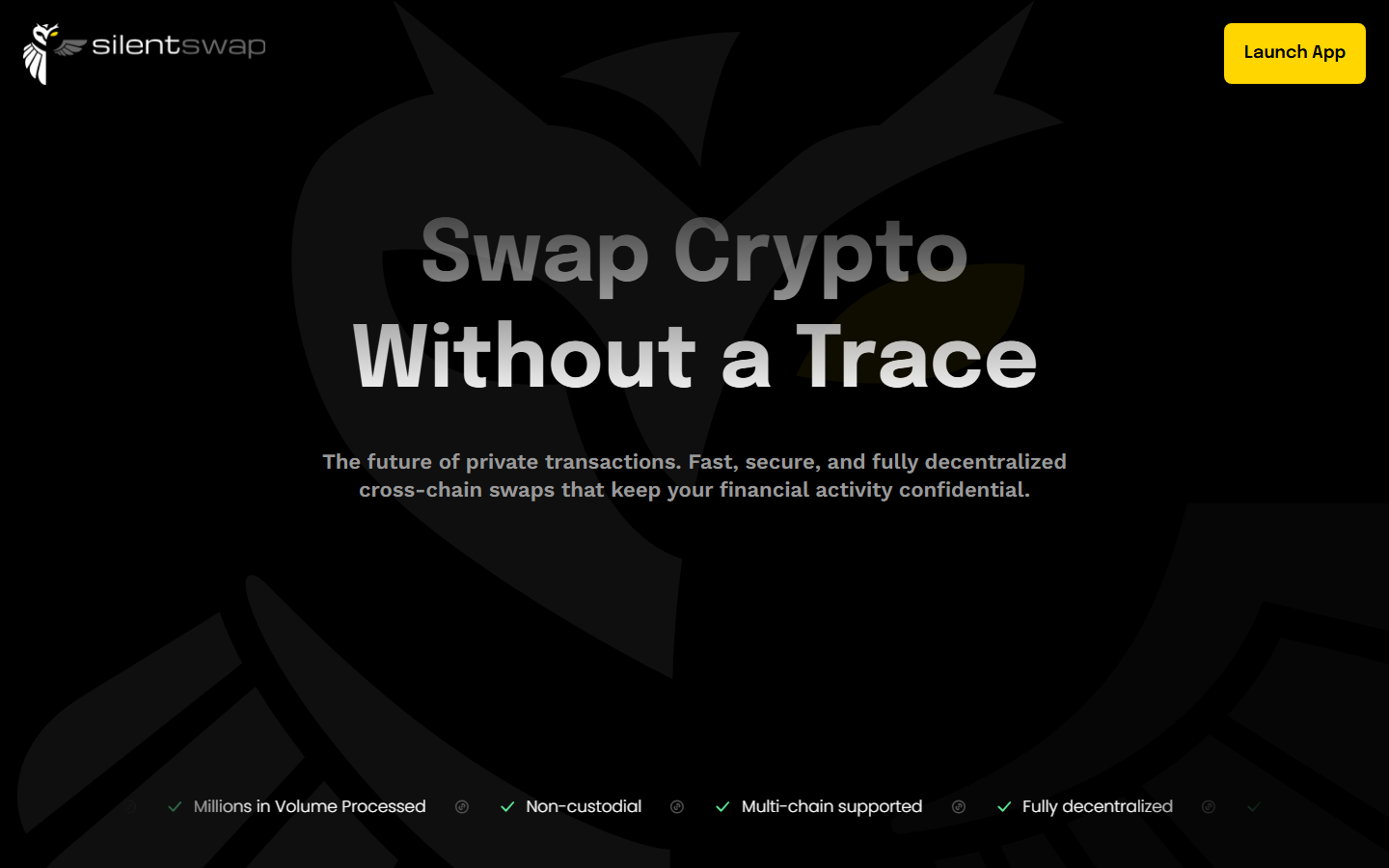
SilentSwap positions itself as a privacy-first, non-custodial aggregator for cross-chain cryptocurrency swaps. The platform advertises "complete anonymity," "no KYC and registration," and settlement times averaging one to three minutes. Users connect an existing wallet, select source and destination chains, and can split outputs across up to sixteen destination wallets for obfuscation. A 1% fee is quoted for swaps, and the service emphasizes US legal compliance with two domestic legal opinions on file. The interface is streamlined for ease of use, with real-time progress tracking and two privacy tiers: "Semi-private" and "Max Privacy."
Despite these privacy-oriented surface features, our editorial assessment assigns SilentSwap a 4 out of 10 overall score, driven by a rock-bottom privacy rating of 30/100 and a middling trust score of 51/100. The disconnect between marketing language and operational reality is stark enough that prospective users should scrutinize the platform carefully before committing funds.
Privacy & KYC
The most significant tension in SilentSwap's offering lies between its public messaging and its actual KYC posture. The homepage repeatedly states "No KYC and Registration" and "No identity checks or sign-ups are needed." Yet our authoritative classification places SilentSwap at KYC Tier L5 — Mandatory, indicating full identity verification is required. This contradiction is not a minor footnote; it is a fundamental misalignment that undermines the service's core value proposition for privacy-seeking users.
Further complicating the privacy picture, SilentSwap is explicitly OFAC and AML compliant in the United States. While compliance can signal legitimacy to institutional participants, it functionally eliminates the possibility of genuine anonymity. The platform's algorithms may "unlink" old and new coins on-chain, but that technical obfuscation is rendered moot when a verified identity sits behind every transaction.
- KYC Tier: L5 Mandatory — full identity verification required
- Logging: IP logging status unclear from disclosed materials; compliance framework suggests retention
- Email required: Unclear; "no registration" claim implies wallet-only connection
- Compliance: OFAC and AML compliant with two US legal opinions
Supported assets & payments
SilentSwap operates as a multi-chain aggregator and exchange, supporting swaps, sends, and bridges across multiple blockchains. The exact roster of supported chains and tokens is not exhaustively itemized in available materials, though the marketing emphasizes "countless possibilities" and "your favorite blockchains." The platform handles settlement natively rather than requiring wrapped assets or manual bridging, with output distribution available to as many as sixteen wallets.
Payment rails are wallet-based only — users fund transactions directly from connected self-custody wallets. There is no fiat on-ramp evident in the reviewed materials, keeping the service strictly crypto-to-crypto. The quoted 1% fee is positioned as competitive, though without transparent fee breakdowns for network costs versus platform take, users should verify final amounts before confirming transactions.
Security & custody
SilentSwap adopts a non-custodial architecture, meaning user funds are never held by the platform itself. Transactions execute trustlessly through smart contracts or similar mechanisms, with users retaining signing authority throughout. This design eliminates the counterparty risk associated with centralized exchanges that pool deposits.
However, non-custodiality does not equate to trustlessness in practice. The compliance overlay — mandatory KYC, OFAC screening, and AML monitoring — introduces a permission layer that contradicts the typical non-custodial ethos. Users must trust SilentSwap's backend systems to route funds correctly, apply privacy algorithms as described, and not flag transactions based on undisclosed heuristics. The platform's "24/7 Support" and legal opinion documentation suggest operational maturity, but the 51/100 trust score reflects residual uncertainty about execution reliability and policy consistency.
Who it's for — verdict
SilentSwap occupies an awkward middle ground that will satisfy almost no one completely. Privacy purists seeking genuinely anonymous, no-KYC crypto swaps will be immediately disqualified by the mandatory identity verification. Institutions and compliance-conscious traders, meanwhile, have little reason to prefer a 1%-fee aggregator with modest trust scores over established regulated venues with deeper liquidity and clearer regulatory standing.
The service may appeal to users who value on-chain obfuscation for plausible deniability within a compliant framework — essentially, those who want transaction history unlinking but do not mind identity disclosure to the platform itself. This is a narrow niche. For the broader no-KYC crypto exchange audience that NoKYC Directory serves, SilentSwap's marketing claims are sufficiently misleading that we cannot recommend it as a privacy solution. The 30/100 privacy score reflects this structural failure: a service cannot simultaneously promise "complete anonymity" and enforce full identity verification.
Community summary
SilentSwap markets itself as a frictionless, anonymous cross-chain swapper, yet enforces full identity verification despite its 'no KYC' homepage claims.
Pros
- + Non-custodial architecture keeps user funds under personal wallet control
- + Cross-chain swaps with up to 16 destination wallets for output splitting
- + Streamlined interface with real-time transaction tracking
- + No account registration required for basic interface access
- + Two privacy modes (Semi-private and Max Privacy)
Cons
- − Mandatory L5 KYC directly contradicts "no KYC" marketing claims
- − OFAC and AML compliance eliminates genuine anonymity
- − 1% fee without transparent cost breakdown
- − Low trust score (51/100) and very low privacy score (30/100)
- − Narrow practical use case given the identity verification requirement
Attributes
5 signalsStrengths
No registration needed
P+5
Aggregator provides guarantees
T+4
Red flags
Mandatory KYC
P-25
Cautions
Can't analyse ToS
T-3
Community contributed
Related
4 services
eigenwallet
Exchange · DEX
 Bisq
Exchange · P2P
Bisq
Exchange · P2P
 BasicSwap
Exchange · P2P
BasicSwap
Exchange · P2P
 RoboSats
Exchange · P2P
RoboSats
Exchange · P2P