 Crypton.sh
SMS · e-SIM
Crypton.sh
SMS · e-SIM

simsup
Verifiedsimsup.net
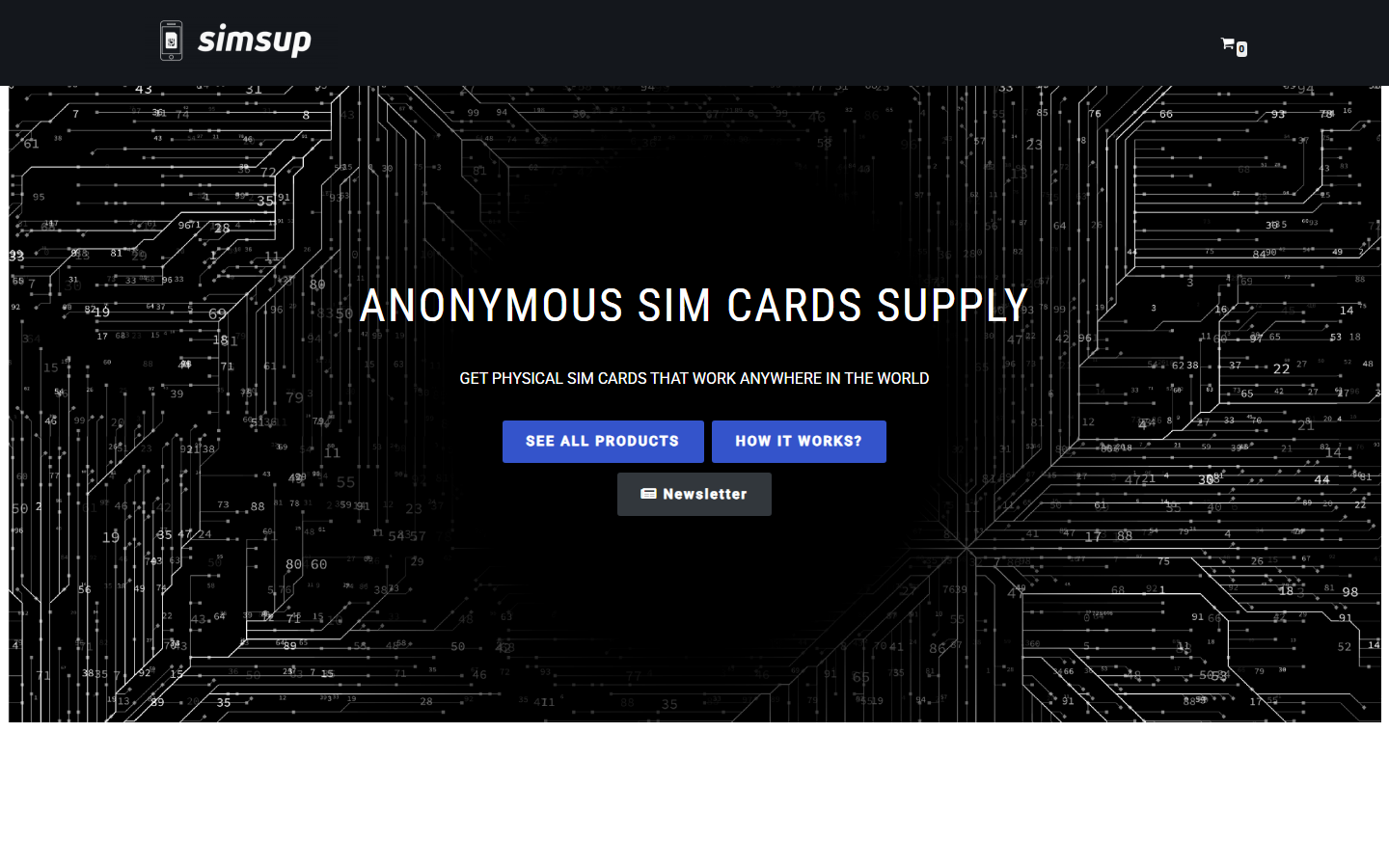
Anonymous SIM cards supply. Own your phone numbers, get SIM cards in a matter of days anywhere on the globe.
Live preview
simsup.net
▶
https://simsup.net
Review
EditorialOverview
Simsup is a privacy-focused telecom retailer operating at simsup.net that supplies anonymous physical SIM cards and eSIM profiles to users worldwide. The service emphasizes ownership over rental: instead of subscribing to a carrier that ties your identity to a number, you buy a SIM outright and control it directly. Products span data-only eSIM plans, anonymous physical SIMs, and dedicated eSIM profiles with phone numbers, with prices ranging from roughly €1.80 for basic data eSIMs up to €413 for premium tiers. Physical anonymous SIMs fall between €8.95 and €38.95. The merchant targets travelers, journalists, crypto-native users, and anyone seeking telecommunications without paperwork.
The ordering process is deliberately minimal. You select a product, pay with cryptocurrency, and receive a SIM card via post or an eSIM QR code through your account interface. Activation is advertised as automatic upon insertion, with no contracts or recurring identity checks. However, community feedback reveals a split experience: physical SIM buyers often praise delivery speed and support responsiveness, while eSIM purchasers report mixed results around number functionality and QR code delivery delays.
Privacy & KYC
Simsup operates at KYC Tier L0 — Trustless, meaning no account creation is required to purchase. This places it among the most permissive options in the anonymous telecom space. You can complete a transaction without submitting government ID, proof of address, or even an email address, depending on your chosen payment path.
- No identity verification at point of sale; the homepage explicitly states "no identity verification, no papers, no invasion of privacy."
- Cryptocurrency-first payments with Monero accepted, providing transactional privacy that Bitcoin alone cannot guarantee.
- Data retention limited to 3 months per the privacy policy, after which personal identifiers are deleted and only anonymized accounting records remain.
- Icelandic server hosting for stored order data, placing it under EU data protection jurisdiction with generally stricter standards than US or Five Eyes alternatives.
One caveat: the privacy policy acknowledges collection of "personal identification information (name, email address, phone number, etc.)" when voluntarily provided during orders or newsletter signups. The contradiction between this boilerplate language and the no-account marketing is unresolved. Users seeking maximum anonymity should avoid optional contact fields and use Monero without providing email.
Supported assets & payments
Simsup accepts Monero (XMR), Bitcoin (BTC), and fiat currency. Monero is the standout option here—its ring signatures and stealth addresses obscure sender, receiver, and transaction amount, making it the logical choice for buyers who want to sever the financial trail entirely. Bitcoin acceptance provides convenience for users already holding BTC, though on-chain transparency means additional privacy steps like coinjoin or Lightning may be warranted. Fiat payment options exist for those without crypto holdings, though this likely introduces conventional financial surveillance through payment processors.
The product catalog covers three main categories: data-only eSIM for internet connectivity without a phone number; anonymous physical SIM for voice, text, and data with global delivery; and anonymous eSIM with dedicated number for users needing a digital-only profile. Notably, several community reports indicate the eSIM with dedicated number functions for internet and some messaging apps but fails for traditional calls and SMS, suggesting a data-centric routing architecture rather than full mobile network integration.
Security & custody
As a non-custodial service in the telecom context, Simsup does not hold user funds in wallets or control private keys. You pay, they ship or provision—there is no deposit mechanism or balance to secure. This eliminates exchange-style custody risks entirely. The security model instead hinges on operational privacy and supply chain integrity.
Physical SIM buyers receive a tangible product that activates upon insertion, reducing remote attack surfaces. eSIM users depend on QR code delivery through SimSup's infrastructure; community reports of delayed or initially missing codes suggest this channel has experienced technical friction. The privacy policy's mention of browser cookies and voluntary data collection implies standard web analytics are in use—users should browse with JavaScript restricted and cookies cleared if minimizing fingerprinting.
There is no evidence of multi-factor authentication for any account portal, nor public security audit documentation. The trust score of 59/100 reflects this opacity: while no major breaches are documented, the operation lacks the transparency markers—incident response disclosures, third-party testing, open-source tooling—that would elevate confidence.
Who it's for — verdict
Simsup occupies a specific niche: no-KYC phone numbers for privacy-conscious users willing to trade institutional trust for anonymity. It suits journalists operating in sensitive regions, crypto traders needing SMS verification for exchanges, travelers wanting local numbers without passport surrender, and activists requiring compartmentalized communications. The Monero integration and absence of mandatory accounts are genuine differentiators in a market where even "privacy" competitors often demand email verification.
The 7/10 overall score reflects this utility against reliability concerns. Physical SIM purchasers report higher satisfaction; eSIM buyers face functionality limitations and occasional provisioning hiccups. The apparent resale of numbers from underlying carriers like Onesimcard—with reported 180-day validity windows and significant markups—suggests buyers should verify expiration terms before purchase. For 2026, SimSup remains a viable option if you prioritize anonymity over convenience, need a number for Signal or Telegram verification, and can tolerate support-dependent resolution. Those requiring guaranteed voice calling or enterprise-grade uptime should consider alternatives or stick to the physical SIM offering.
Community summary
Simsup sells anonymous physical SIM and eSIM cards with no account required, accepting Monero and Bitcoin for users who want phone numbers without identity verification.
Pros
- + No account or KYC required for purchase
- + Monero accepted for maximum payment privacy
- + Global shipping with automatic activation
- + Iceland-based data retention with 3-month deletion policy
- + Responsive support according to multiple user reports
Cons
- − eSIM with dedicated number lacks reliable voice/SMS functionality
- − Some reports of QR code delivery delays for eSIM
- − Possible 180-day number expiration with marked-up resale pricing
- − Trust score reflects limited operational transparency
Attributes
6 signalsStrengths
Guaranteed no KYC
P+25
Accepts Monero
P+5
No registration needed
P+5
Verified
T+10
Informational
Source code is private
T-1
JavaScript needed
Related
4 services


User reports
★ 4.7/5 · 8 ratings
admiring_luminary_575
2/5
Zero kyc, you can pay in privacy, quick activation, BUT... the eSim with dedicated number only works for the internet, but not for calls and text messages...
governmental_token_5522
5/5
Very nice provider for physical SIMs. I had an issue with SMS but the support was quick and helpful. Shipment was fast, i coudnt recommend it more.
invading_atom_8819
5/5
Very nice provider for eSIMs. No KYC and paid with XMR. Pretty cheap.
manifest_opposite_4221
4/5
The number worked for Signal and Telegram, but not for WhatsApp.
questionable_ingenue_238
3/5
Great if you want to pay with Monero and save time, but it seems like they just resell numbers from Onesimcard, at a 10x markup, since they only last for 180 days, instead of $9.95 for 2 years at onesimcard.
innocent_lullaby_1293
5/5
very happy with everything. Had an issue to begin with but every was resolved straight away. Admin if you a reading this please delete the previous negative comment I have made, There should be options to be able to do this.
populist_payoff_812
5/5
Very satisfied. Initial setup had slight issues because the esim link didn't work immediately but support was able to resolve this issue in no time. iMessage, calls and sms all work.
demanding_kingmaker_1866
5/5
Pretty good. Had no issues. I can see why the other review thought it was a scam. The e-sim QR code did not appear after I paid. It only showed up in a link inside the temporary email address I used.