 eigenwallet
Exchange · DEX
eigenwallet
Exchange · DEX

Swaply
Communityswaply.to
#1 anonymous crypto exchange platform. Private, fast and with minimal fees!
Live preview
swaply.to
▶
https://swaply.to
Review
EditorialOverview
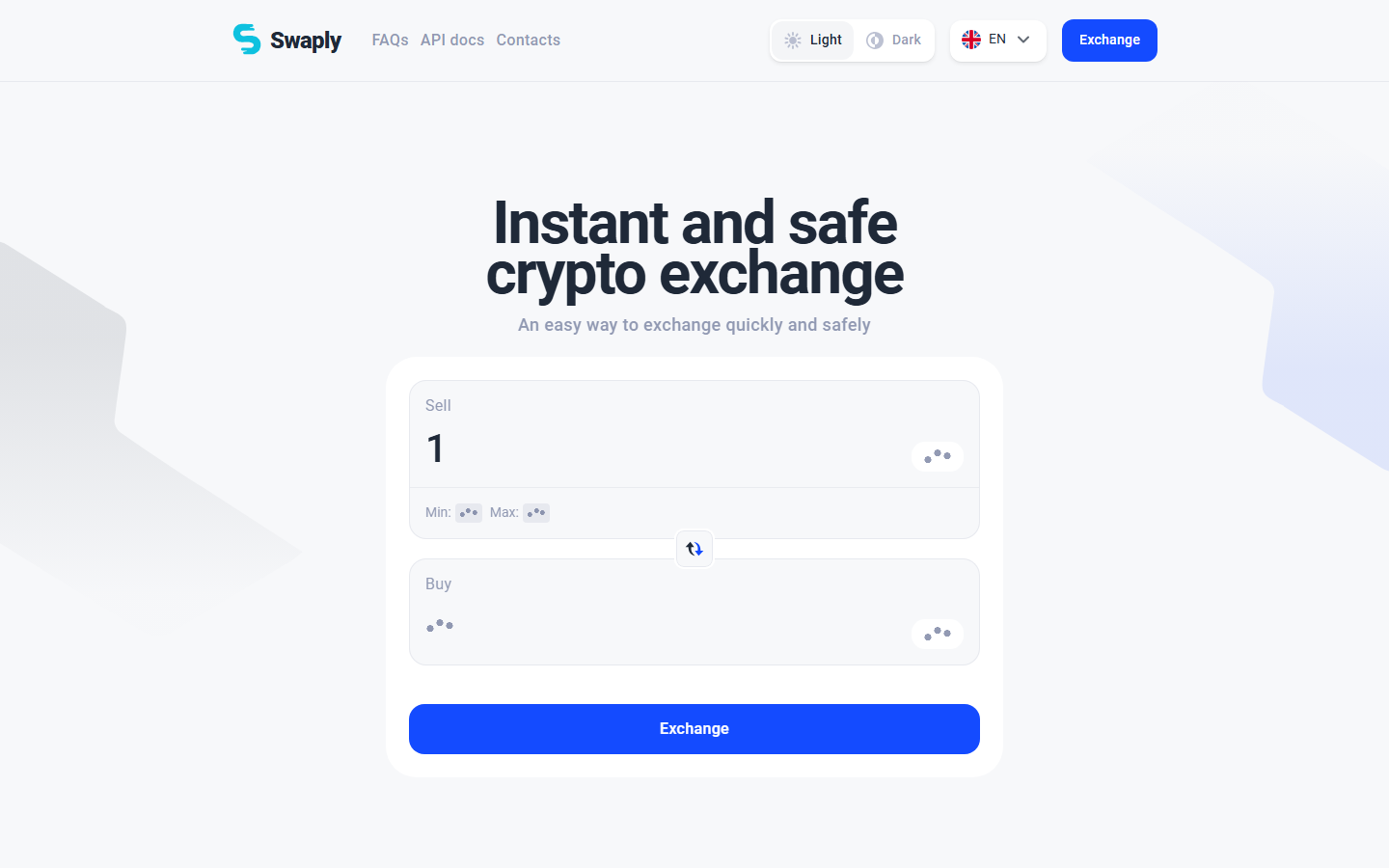
Swaply pitches itself as a streamlined portal for instant cryptocurrency exchanges, emphasizing speed and minimal friction over account creation. The platform operates as a web-based swap service where users select a trading pair, deposit funds, and receive converted assets without registering a username or password. Its marketing leans heavily on convenience, promising average completion times around five minutes and a flat 0.7% commission baked into each transaction. For privacy-focused traders, this no-signup model initially appears attractive—especially given support for Monero, the privacy-centric coin often shunned by mainstream exchanges. However, NoKYC Directory's scoring reveals a stark disconnect between Swaply's branding and its operational reality: an overall score of 4/10, with privacy and trust metrics sitting at 38 and 35 respectively out of 100. These numbers signal that the service's architecture contains significant compromises for users seeking genuine anonymity.
Beyond the consumer-facing interface, Swaply maintains a Partner API ecosystem aimed at affiliates and wallet integrations. The API documentation outlines endpoints for coin listings, rate quotes, transaction creation, and status polling, complete with API-key authentication and a required userDeviceId parameter for initiating swaps. This infrastructure suggests Swaply is positioning itself as a backend liquidity provider rather than merely a retail front-end, which raises additional questions about how partner-originated traffic is correlated and logged. The dual identity—simple swapper for users, data-hungry integration layer for developers—creates tension that permeates every aspect of the service.
Privacy & KYC
Swaply's KYC classification as L3 — Tiered means identity verification is technically optional below certain transaction thresholds, but the platform retains broad discretion to demand documents as volumes increase. This model represents one of the most treacherous categories for privacy seekers: the boundary where KYC kicks in is often opaque, shifting, or selectively enforced based on undisclosed risk algorithms. The FAQ explicitly states that Swaply "strictly adheres to legal regulations" and denies involvement in "cryptocurrency laundering," language that typically precedes aggressive compliance behavior. For traders accustomed to non-custodial, no-questions-asked swaps, this regulatory posture is a red flag masquerading as consumer protection.
The privacy policy excavates deeper concerns. Swaply's declared data appetite encompasses not merely transactional metadata but extensive personal identifiers: email addresses, IP addresses, location data, device fingerprints, service interaction history, cookies, and Google Analytics tracking. The policy explicitly classifies IP addresses as personal data subject to collection, confirming that users are logged and traceable from their first page visit. The mandatory acceptance clause—"By using our Services, you automatically agree"—offers no opt-out mechanism for data collection beyond total abstention. For a service promoted in anonymous crypto circles, this architecture is functionally indistinguishable from surveillance-first exchanges that happen to skip username registration.
- Tiered KYC: Identity demands triggered at unspecified volume thresholds
- IP logging: Explicitly confirmed in privacy policy
- Device tracking: Google Analytics, cookies, and device details harvested automatically
- API surveillance: userDeviceId required for partner-originated transactions
- No consent granularity: Binary accept-or-leave terms with no data minimization option
Supported assets & payments
Swaply's current asset roster is notably narrow, centering on Bitcoin and Monero as its headline trading pair. The homepage interface presents a simplified two-field swap form with minimum and maximum limits, though specific thresholds per coin are dynamically calculated rather than statically displayed. The FAQ acknowledges that received amounts may deviate from quoted figures due to cryptocurrency volatility during the 2–15 minute processing window—a standard disclaimer for instant swap services, but one that places execution risk squarely on the user. The 0.7% flat fee is disclosed transparently, which is commendable in an industry rife with hidden spread markups, though whether this represents the total cost of trading or excludes network fees remains ambiguous in the documentation.
The Partner API's coin endpoint suggests theoretical expandability beyond BTC and XMR, but the crawled consumer interface offers no evidence of additional assets being actively promoted. For Monero enthusiasts specifically, Swaply represents a rare on-off ramp that doesn't immediately demand passport scans, but this accessibility must be weighed against the extensive non-KYC data collection that could enable retroactive transaction linking. The absence of fiat on-ramps or off-ramps in the visible interface keeps the service firmly in the crypto-to-crypto lane, which limits utility for users needing to enter or exit traditional financial systems without identity exposure elsewhere.
Security & custody
Swaply operates as a custodial swap intermediary, meaning user funds temporarily reside in platform-controlled addresses during the exchange process. The FAQ outlines a critical timeout mechanism: if blockchain confirmation exceeds two hours, the automated balance-checking system halts, and users must manually contact support to resurrect their order. This design introduces counterparty risk during transaction delays—users cannot self-escalate or recover funds without intervention from Swaply's team. The policy of "promptly restoring" orders after contact provides no service-level guarantee, leaving traders vulnerable to support responsiveness during network congestion or platform downtime.
The API documentation reveals additional security considerations for integrated users. API keys are partner-specific and rotatable upon compromise, which is baseline competent, but the requirement to embed a userDeviceId in transaction creation requests enables persistent cross-session tracking. The authentication model assumes HTTPS transport security, with no mention of additional safeguards like request signing or IP whitelisting. For a service handling irreversible cryptocurrency transfers, this security posture feels minimal rather than robust. The absence of any discussion of cold storage ratios, multisignature arrangements, or insurance funds in crawled materials further erodes confidence in asset protection during the custody window.
Who it's for — verdict
Swaply occupies an uncomfortable middle ground that satisfies neither privacy purists nor compliance-seeking institutional users. The no-signup consumer experience and Monero support will attract casual traders seeking quick, low-friction swaps without immediate document uploads. For this audience—users making infrequent, small-volume exchanges who accept that their IP, device, and behavioral data will be logged—the 0.7% fee and ~5 minute average completion time may justify the privacy trade-off. The service is technically functional and presents a cleaner interface than many competitors in the instant-swap space.
However, NoKYC Directory cannot recommend Swaply for users whose threat model includes state-level surveillance, forensic blockchain analysis, or simply the principle of minimizing data footprints. The L3 tiered KYC model creates a Sword of Damocles over larger transactions; the privacy policy's explicit IP and device harvesting contradicts anonymous exchange marketing; and the custodial timeout mechanism cedes too much control to an opaque support process. The 38/100 privacy score and 35/100 trust score reflect these structural deficiencies rather than transient operational issues. Traders serious about no-KYC cryptocurrency exchange in 2026 should treat Swaply as a convenience option for trivial amounts, not a cornerstone of their privacy stack.
Community summary
Swaply offers instant, no-signup cryptocurrency swaps between Bitcoin and Monero, but its L3 tiered KYC model and extensive data harvesting make it a poor fit for serious privacy advocates.
Pros
- + No account registration required for basic swaps
- + Transparent 0.7% commission structure
- + Monero and Bitcoin supported for privacy-focused traders
- + Average ~5 minute transaction completion
- + Partner API available for integration developers
Cons
- − Tiered KYC policy with unclear activation thresholds
- − Aggressive IP, device, and behavioral data logging
- − Custodial timeout risk after 2 hours without self-recovery
- − Narrow asset selection beyond BTC/XMR
- − Low trust score (35/100) indicates systemic reliability concerns
Attributes
13 signalsStrengths
Accepts Monero
P+5
No registration needed
P+5
Red flags
May require KYC/SOF by policy/law
P-6 T-4
Cautions
May suspend your account
T-4
New service
T-4
May Freeze or Seize Funds
T-3
Community contributed
Third-Party Liquidity
Transaction monitoring
P-1
Shotgun KYC
P-15
Informational
Source code is private
T-1
Basic Customer Support
T+1
JavaScript needed
Related
4 services
eigenwallet
Exchange · DEX
 Bisq
Exchange · P2P
Bisq
Exchange · P2P
 BasicSwap
Exchange · P2P
BasicSwap
Exchange · P2P
 RoboSats
Exchange · P2P
RoboSats
Exchange · P2P