 Silent Node
VPS · Hosting
Silent Node
VPS · Hosting
Trilightzone
Communitytrilightzone.org
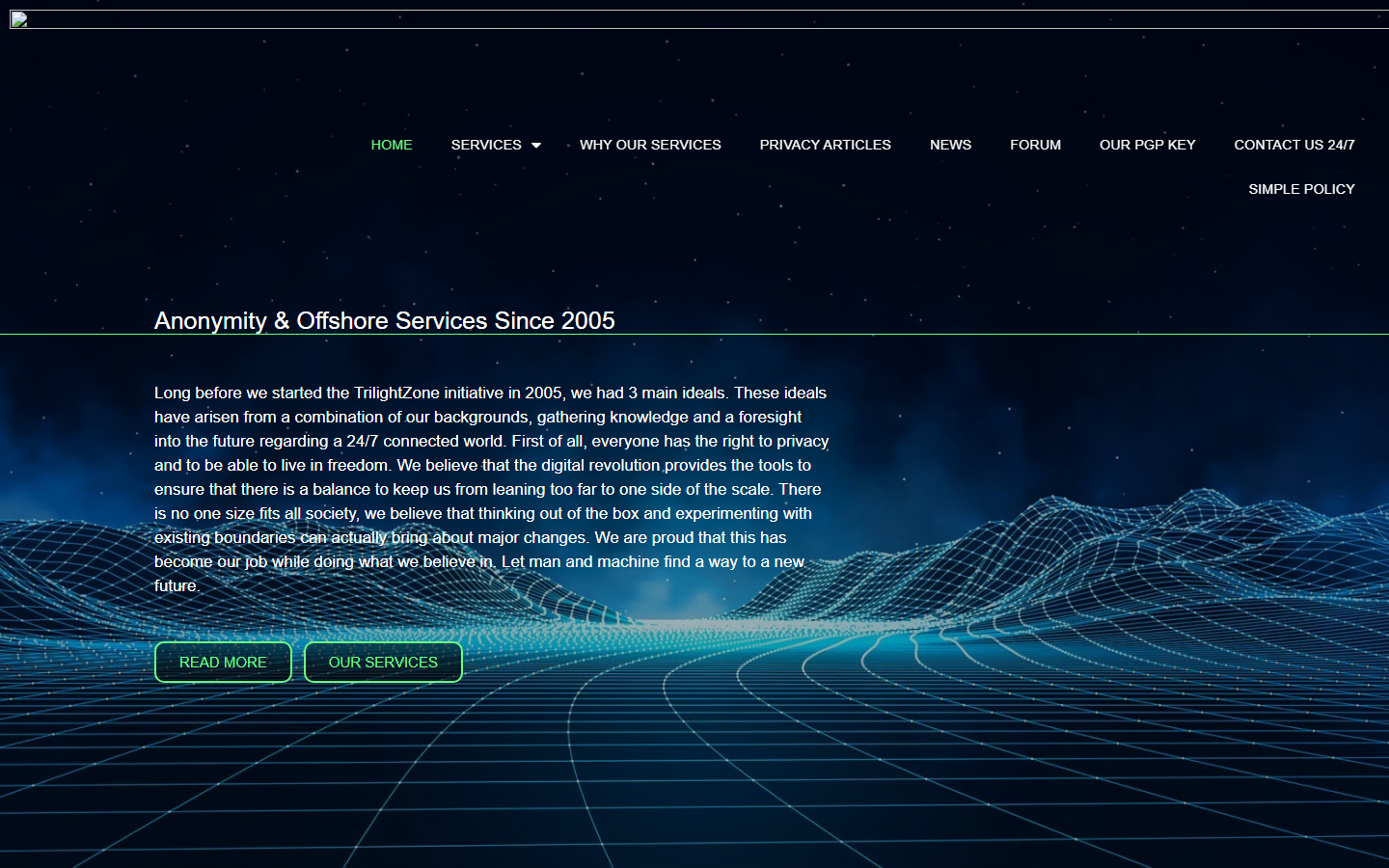
TrilightZone started operations in 2005. It offers various services that are offshore, like OpenVPN servers that are 24/7, email hosting, registering domain names anonymously and more. No personal information is asked for by them.
Live preview
trilightzone.org
▶
https://trilightzone.org
Review
EditorialOverview
Trilightzone has been a fixture in the offshore privacy space since 2005, predating mainstream awareness of digital surveillance and anonymity tools. The service operates under a clear ideological framework: privacy as a fundamental right, not a premium feature. Its portfolio spans 24/7 secure OpenVPN, offshore email with realtime encryption, anonymous domain registration, Linux shell accounts with proxies, shared and dedicated hosting, VPS solutions, premium DNS management, and even custom software development. This breadth makes it one of the more comprehensive no-KYC infrastructure providers still running, though its longevity does not automatically translate to modern usability or competitive performance.
The provider emphasizes philosophical consistency over slick marketing. Its homepage frames services as tools for "man and machine" to coexist freely, and it actively recruits contributors with "interesting skills or ideas." For privacy-conscious users seeking an old-school operator that has weathered two decades of regulatory pressure, this positioning resonates. For those wanting instant provisioning, modern dashboards, or transparent uptime metrics, the experience may feel deliberately retro.
Privacy & KYC
Trilightzone sits at KYC Tier L1 — Anonymous, meaning pseudonymous access with no personal data collection. This is the strictest no-verification tier in our framework and increasingly rare among hosting providers. The operator repeatedly states across every service description: "We do not ask you for personal details." This is not limited to marketing copy; it appears as a standardized disclaimer on VPN, email, shell, hosting, domain, and DNS offerings alike.
- No identity documents required for any service tier
- IP logging absent on email; no connection logs on VPN
- No backups created for email data, reducing third-party exposure
- Domain ownership proven via unique code rather than personal details
- PGP/GPG preferred for support communication, reinforcing cryptographic identity over legal identity
Despite these strong claims, our privacy score of 65/100 reflects opacity rather than proven compromise. There is no published transparency report, no third-party audit of no-logging claims, and no warrant-canary mechanism. The provider's offshore status offers jurisdictional distance from EU and US data demands, but "offshore" itself is not a technical guarantee. Users must weigh stated policy against verifiable practice.
Supported assets & payments
Trilightzone accepts Monero (XMR) and Bitcoin (BTC), aligning with its privacy-first positioning. Monero in particular is emphasized implicitly through the provider's audience and explicitly through our verified payment data. The site notes a "wide range of payment methods" beyond these two cryptocurrencies, though fiat options are not detailed in available materials. For no-KYC users, the cryptocurrency rails are the critical feature: Monero's ring signatures and stealth addresses make transaction tracing functionally impossible, while Bitcoin offers broader exchange liquidity at the cost of on-chain transparency.
Pricing structures are not published in crawled materials, consistent with the provider's bespoke, inquiry-driven model. Prospective customers should expect to negotiate or request quotes rather than click through standardized tiers. This friction suits users running sensitive projects who value human vetting over automated signups, but it adds overhead for casual buyers.
Security & custody
Trilightzone operates a non-custodial model for user content and a self-custodial approach to identity: you hold your keys, your domains, and your operational security. The provider supplies infrastructure; you retain control. All hosting and email systems are described as realtime encrypted, though specific cipher suites, key management practices, and server hardening details are absent from public documentation.
The VPN offering uses OpenVPN rather than newer protocols like WireGuard, a conservative choice that prioritizes auditability over speed. Server selection spans multiple countries, though exact locations and counts are not listed. Shell accounts include system proxies, suggesting SOCKS or HTTP proxy chaining for additional traffic obfuscation. Dedicated servers and VPS options grant root-level control, shifting security responsibility fully to the user.
Our trust score of 50/100 acknowledges the provider's 20+ year track record while flagging missing verifiability. No SOC 2, ISO 27001, or independent penetration test results are referenced. The absence of a modern status page or public incident log means users must trust operator communication through PGP-signed emails or forum posts. For some, this is acceptable. For mission-critical deployments, it is a gap.
Who it's for — verdict
Trilightzone serves a specific archetype: the digital hermit or privacy maximalist who values operational longevity and ideological consistency over convenience. Journalists in hostile jurisdictions, anonymous publishers, cryptocurrency project founders, and researchers requiring clean infrastructure fit here. The 2005 founding date matters—it means the operator has navigated multiple waves of regulatory pressure, payment processor blacklisting, and technical evolution without folding or pivoting to KYC compliance.
It is less suited for users wanting instant deployment, transparent SLAs, or modern UX patterns. The inquiry-based sales process, absence of public pricing, and lack of protocol diversity (no WireGuard, no IMAP/SMTPS specifics) create friction that commercial competitors have eliminated. Our 6/10 overall score reflects this tension: exceptional on anonymity fundamentals, competent on service breadth, underwhelming on verifiability and modernization.
For no-KYC hosting in 2026, Trilightzone remains a viable niche option. Pair it with personal operational security—separate Monero wallets, hardened endpoints, and independent backup strategies—to compensate for its opacity. It is a foundation, not a complete solution.
Community summary
Trilightzone is a veteran offshore privacy provider operating since 2005, offering anonymous hosting, VPN, email and domains with no KYC requirements and cryptocurrency payments.
Pros
- + True L1 anonymous signup with no personal data requested
- + Accepts Monero and Bitcoin for pseudonymous payment
- + 20+ year operational history since 2005
- + Broad service stack: VPN, email, domains, hosting, shells, DNS
- + Offshore jurisdiction outside EU/US direct regulatory reach
- + PGP-preferred support communication culture
Cons
- − No published transparency report or third-party audit
- − No public pricing or instant provisioning
- − Trust score of 50/100 due to unverifiable no-logging claims
- − OpenVPN-only; lacks modern protocols like WireGuard
- − No warrant canary or automated status monitoring
Attributes
3 signalsStrengths
No KYC mention
P+15
Accepts Monero
P+5
Cautions
Community contributed
Related
4 services
Silent Node
VPS · Hosting
 Ko-Net
VPS · Hosting
Ko-Net
VPS · Hosting
 MyNymBox
VPS · Hosting
MyNymBox
VPS · Hosting
 BTCVPS
VPS · Hosting
BTCVPS
VPS · Hosting
User reports
★ 5/5 · 1 ratings
Swapuz ✅ (Support at Swapuz)
5/5
Trilightzone is old-school offshore for digital hermits. Since 2005, holding the line: VPN, email, domains — no names, no traces. Privacy that outlived trends.