 Mixtum Bitcoin mixer
Other services
Mixtum Bitcoin mixer
Other services

VoipSpoof
Communityvoipspoof.com
Reliable SMS and VoIP infrastructure for global teams.
Live preview
voipspoof.com
▶
https://voipspoof.com
Review
EditorialOverview
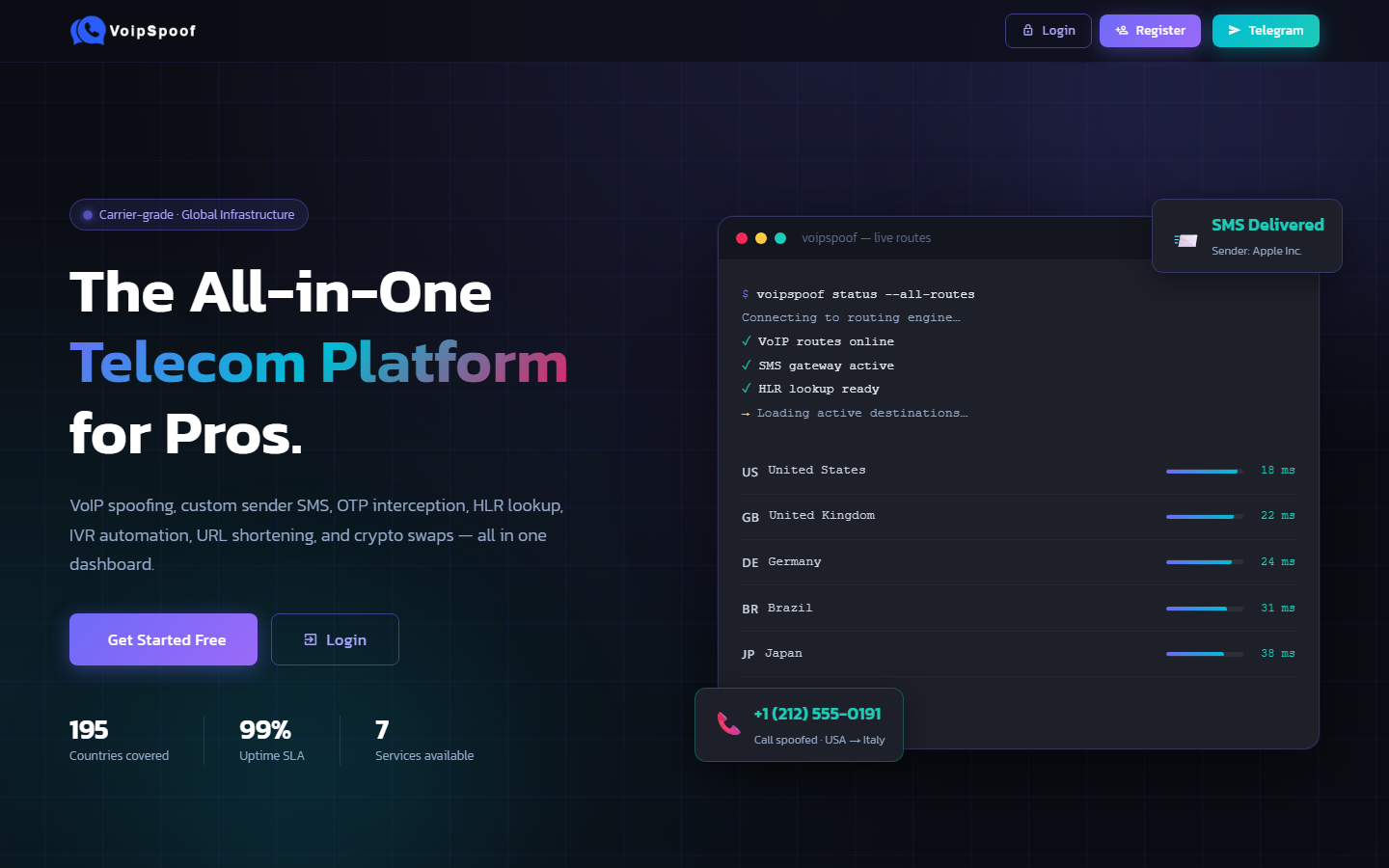
VoipSpoof positions itself as an all-in-one telecom carrier for users who demand operational privacy. The platform bundles seven distinct services—VoIP caller ID spoofing, custom-sender SMS, virtual number OTP reception, IVR automation, HLR lookup, URL shortening, and an internal cryptocurrency swap—behind a single pay-as-you-go dashboard. With coverage across 195 countries and a claimed 99 percent uptime SLA, it targets global teams, penetration testers, and privacy-conscious individuals who need telecom infrastructure without surrendering identity documents.
The onboarding flow is deliberately minimal: create an account without a credit card, fund the balance with Bitcoin or Monero, then select a service and launch. No contracts, no subscription tiers, and no mandatory personal data collection. This frictionless entry is rare in the telecom sector, where most providers demand government-issued ID and proof of address.
Privacy & KYC
VoipSpoof operates at KYC Tier L1 — Anonymous, meaning pseudonymous access is the default. Users need only an email address to register; no name, no phone number, no address verification. This makes it one of the few telecom platforms genuinely accessible without identity disclosure.
- Email required: Yes, one email address for account recovery and notifications.
- IP logging: Policy not explicitly stated in available documentation—caution advised for users routing through VPN or Tor.
- Tor access: Available, which strengthens anonymity for users who combine it with the platform's already-light data requirements.
The privacy score of 77 out of 100 reflects solid pseudonymous architecture, though the ambiguity around IP retention and the absence of published data-handling specifics prevent a higher rating. For users who compartmentalize email and access the site via Tor, VoipSpoof offers meaningful anonymity.
Supported assets & payments
VoipSpoof accepts Bitcoin and Monero for balance top-ups. The inclusion of Monero is particularly noteworthy—XMR's default privacy protections align closely with the platform's no-KYC ethos and offer stronger transactional anonymity than Bitcoin's transparent ledger. The internal Coins Swap feature allows conversion between supported cryptocurrencies at competitive rates, meaning users can deposit one coin and spend in another without leaving the dashboard.
Billing runs on a strict pay-as-you-go model. Voice calls are metered in 60-second blocks: each block charges in full at the start of the call and again at each subsequent 60-second interval, regardless of actual seconds used within that window. This is standard carrier practice but worth budgeting for on shorter calls. The platform explicitly states no refunds under any circumstances, including unused balances and failed deliveries—an unusually rigid policy that demands careful fund management.
Security & custody
VoipSpoof is a custodial platform by necessity: user balances sit on the service until spent. There is no self-custody option for deposited crypto. The trust score of 48 out of 100 signals significant reservations—likely driven by the no-refund policy, lack of published ownership or audit history, and the inherently sensitive nature of telecom services that could attract regulatory scrutiny.
Security positives include carrier-grade routing with automatic failover, real-time analytics with full usage history, and API access for automated workflows. Users can monitor live route status across 195 countries, with latency and availability displayed transparently. However, the absence of two-factor authentication details in available documentation and the unknown IP logging posture leave gaps that security-conscious users should account for.
Who it's for — verdict
VoipSpoof fills a narrow but genuine niche: privacy professionals, red teams, journalists, and crypto-native operators who need telecom capabilities without identity exposure. The combination of caller ID spoofing, custom SMS sender IDs, and OTP interception makes it especially relevant for security researchers testing authentication flows, though the same features carry obvious abuse potential that users must navigate responsibly.
The platform's strengths are its pseudonymous onboarding, Monero support, Tor compatibility, and global reach. Its weaknesses are a rigid no-refund stance, opaque trust credentials, and custodial balance risk. The 7 out of 10 overall score reflects this tension—VoipSpoof delivers exactly what it promises for anonymous telecom, but users should fund conservatively and operate with the awareness that recourse is minimal if service degrades or disputes arise.
Community summary
VoipSpoof delivers carrier-grade VoIP, SMS spoofing and OTP interception tools through a pseudonymous, crypto-funded dashboard aimed at privacy-focused professionals.
Pros
- + True pseudonymous signup with only email required
- + Monero acceptance plus internal crypto swapping
- + Tor availability for hardened anonymity
- + 195-country coverage with live route monitoring
- + Pay-as-you-go pricing without subscription lock-in
- + Broad telecom toolkit: VoIP, SMS, IVR, HLR in one dashboard
Cons
- − Strict no-refund policy on all deposits and unused balances
- − Trust score of 48/100 indicates unverified operational credibility
- − Custodial balances with no self-custody withdrawal option
- − IP logging policy not transparently disclosed
- − Voice billing in rigid 60-second blocks can waste funds on short calls
Attributes
11 signalsStrengths
No KYC mention
P+15
Identity-Free registration
P+10
Accepts Monero
P+5
Has Onion or I2P URLs
P+5
Good Customer Support
T+5
Cautions
New service
T-4
Unclear refund policy
T-4
Community contributed
Third-Party payment processor
P-2 T+1
Informational
JavaScript needed
Account required
P-1
Related
4 services
Mixtum Bitcoin mixer
Other services
 AnonUsers
Other services
AnonUsers
Other services
 Crawlbase
Tool · Proxy store
Crawlbase
Tool · Proxy store
 Crypton.sh
SMS · e-SIM
Crypton.sh
SMS · e-SIM