 Kusama Shield
Tool · Exchange
Kusama Shield
Tool · Exchange

WolvPay.com
Communitywolvpay.com
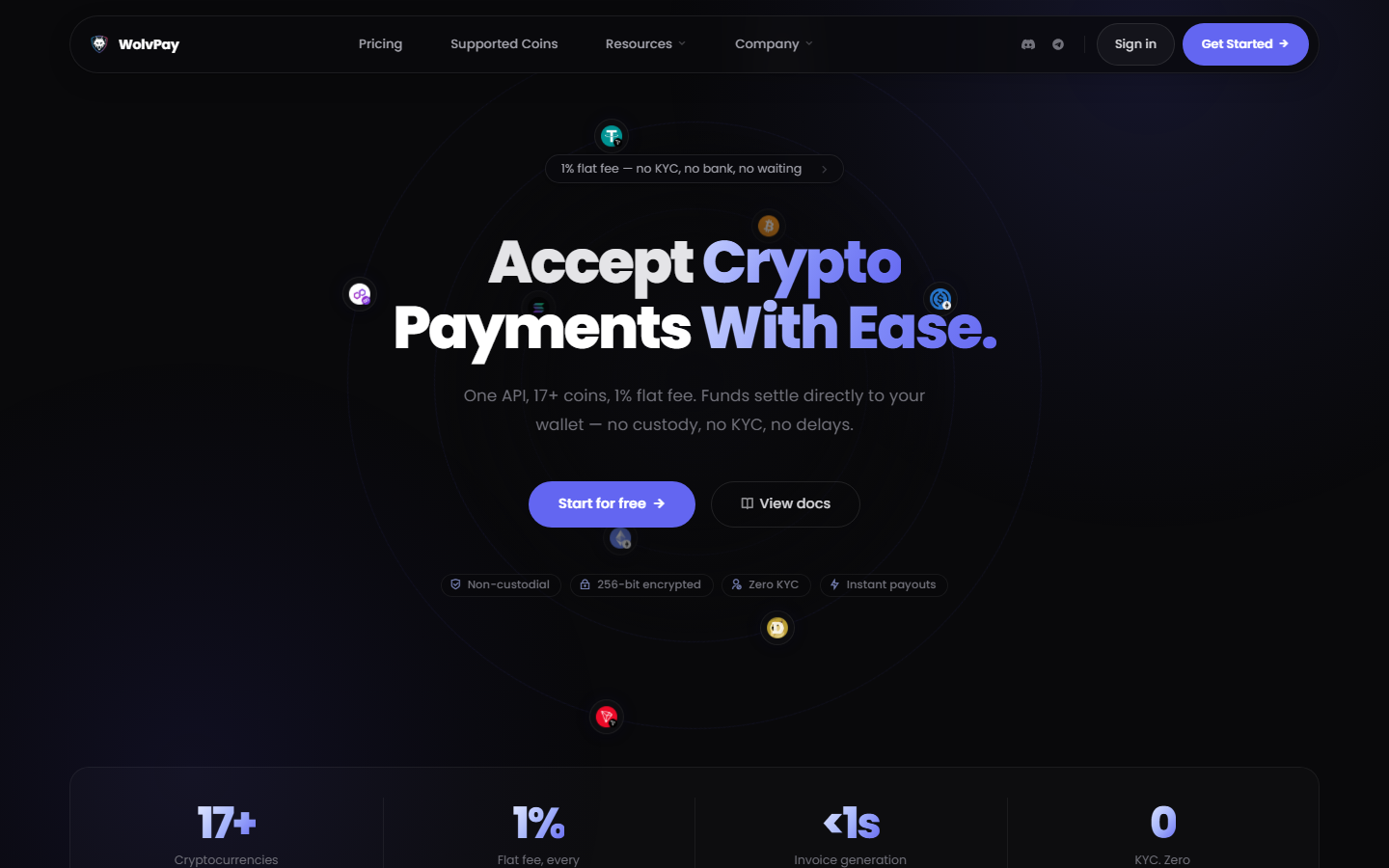
A simple, powerful crypto payment gateway that lets you accept crypto currencies easily.
Live preview
wolvpay.com
▶
https://wolvpay.com
Review
EditorialOverview
WolvPay positions itself as a no-KYC cryptocurrency payment processor built for merchants and developers who want to accept digital assets without surrendering personal information or ceding custody of funds. Launched with a friction-first philosophy, the platform strips away the bureaucratic layers that dominate traditional payment gateways: no bank account linking, no document uploads, no multi-day approval queues. Users create an account with nothing more than an email and password, connect their own wallets, and begin generating invoices in under a second.
The service operates on a 1% flat fee per transaction with no setup costs, monthly subscriptions, or hidden markups. It targets a broad spectrum of use cases—from e-commerce stores and SaaS platforms to independent creators and privacy-conscious retailers—offering both a hosted checkout solution and a white-label option for full brand control. WolvPay's infrastructure emphasizes speed, claiming sub-one-second invoice generation and near-instant settlement once transactions confirm on-chain.
Privacy & KYC
WolvPay sits at KYC Tier L0 — Trustless, meaning no account is fundamentally required to interact with core payment flows. The platform explicitly advertises "Zero KYC, no identity checks, no document uploads" as central selling points. For merchants prioritizing anonymity, this represents a genuine differentiator in a market where competitors increasingly enforce identity verification at even modest volume thresholds.
- Email required: Yes — a single email address and password constitute the entire registration barrier.
- IP logging: Undisclosed in public documentation; assume standard server logging applies.
- No KYC escalation: The service does not appear to tier verification requirements by transaction volume or cumulative value.
Privacy-conscious users should note that while WolvPay itself demands minimal identifying data, the hosted checkout pages and API callbacks inherently expose transaction metadata to the platform. For maximum anonymity, merchants can route through the white-label deployment on their own domain, though this requires technical sophistication to configure properly.
Supported assets & payments
WolvPay supports 17+ native cryptocurrencies across multiple blockchain networks, with coverage extending well beyond Bitcoin-only niche processors. The asset list includes major Layer-1s, stablecoins, and established altcoins: BTC, ETH, SOL, LTC, DOGE, BCH, TRX, MATIC alongside stablecoin variants—USDT on Ethereum (ERC-20), Tron (TRC-20), BSC, and Polygon; USDC on Ethereum, Polygon, and BSC; plus additional network integrations.
The fee structure is aggressively simple: 1% flat per transaction, period. No volume discounts are advertised, but equally no minimums, setup fees, or monthly retainers exist. Settlement occurs directly to merchant-configured wallets with no holding period; the platform emphasizes "instant withdrawals" forwarding funds the moment on-chain confirmation finalizes. This direct-rail architecture eliminates the counterparty risk of pooled accounts while preserving cash-flow velocity for operating businesses.
Security & custody
WolvPay operates on a strictly non-custodial model — a critical architectural choice for privacy advocates. Every customer payment routes directly to the merchant's pre-configured wallet address; WolvPay infrastructure never takes possession of funds at any point in the transaction lifecycle. This design removes the honeypot risk that plagues custodial gateways, where pooled balances attract attackers and regulatory seizure.
Technical safeguards include 256-bit encryption for data in transit and HMAC-signed webhooks for API callback integrity. The REST API supports programmatic invoice creation with standard HTTP authentication, and documentation provides code examples in PHP, Node.js, and Python. However, merchants bear full responsibility for securing their own private keys and wallet infrastructure; WolvPay provides the payment rail, not asset protection.
The platform's trust score of 63/100 reflects its relative newcomer status and limited operational track record rather than identified security failures. Users should conduct appropriate due diligence, start with lower-value transactions, and verify webhook signatures independently to prevent spoofed payment notifications.
Who it's for — verdict
WolvPay earns its 8/10 overall score by delivering exactly what privacy-focused merchants need: a functional, low-friction payment rail without surveillance capitalism's usual documentation demands. The service suits developers seeking clean API integration, small-to-medium merchants avoiding KYC exposure, and content creators or domain sellers who value payment pseudonymity over feature breadth.
The 86/100 privacy score reflects genuine structural commitment to minimal data collection, though the mandatory email requirement and unclear IP logging policies prevent a perfect rating. The 63/100 trust score suggests cautious optimism warranted—WolvPay hasn't demonstrated failure, but neither has it weathered years of adversarial pressure.
Merchants processing high volumes or requiring fiat off-ramps will find WolvPay incomplete; the platform offers no native conversion to traditional currency and no banking integration. For crypto-native businesses comfortable holding digital assets, however, WolvPay represents one of 2026's more compelling anonymous payment gateway options—particularly at its transparent 1% price point.
Community summary
A streamlined, developer-friendly crypto payment gateway that lets merchants accept 17+ digital assets with zero identity verification and direct-to-wallet settlement.
Pros
- + True zero-KYC onboarding with only email required
- + Non-custodial settlement eliminates counterparty risk
- + Transparent 1% flat fee with no hidden costs
- + Sub-second invoice generation and instant payout forwarding
- + 17+ supported cryptocurrencies across multiple networks
- + Developer-friendly REST API with webhook signatures and multi-language SDK examples
Cons
- − Mandatory email registration prevents fully anonymous merchant signup
- − No fiat conversion or banking integration available
- − Limited public track record and community discussion
- − IP logging policy not clearly disclosed in public documentation
Attributes
17 signalsStrengths
Guaranteed no KYC
P+25
Identity-Free registration
P+10
Refunds do not require KYC
P+5 T+5
Strict no-log policy
P+5 T+3
Non-custodial wallet
P+3 T+5
Good Customer Support
T+5
Red flags
Service Termination Policy
T-4
Cautions
Community contributed
Third-Party payment processor
P-2 T+1
Soft KYC
P-3 T-1
Data Sharing
P-3
Refunds may need personal information
P-3
Informational
Source code is private
T-1
API available
Email required
Some countries are restricted
Account required
P-1
Related
4 services
Kusama Shield
Tool · Exchange
 Mixtum Bitcoin mixer
Other services
Mixtum Bitcoin mixer
Other services
 MyNymBox
VPS · Hosting
MyNymBox
VPS · Hosting
 NightTrader Exchange
Aggregator · Exchange
NightTrader Exchange
Aggregator · Exchange