 SHOPINBIT
Shopping
SHOPINBIT
Shopping

XKard
Communityxkard.io
USDT Visa Card Without KYC. To register you will need an invitation code.
Live preview
xkard.io
▶
https://xkard.io
Review
EditorialOverview
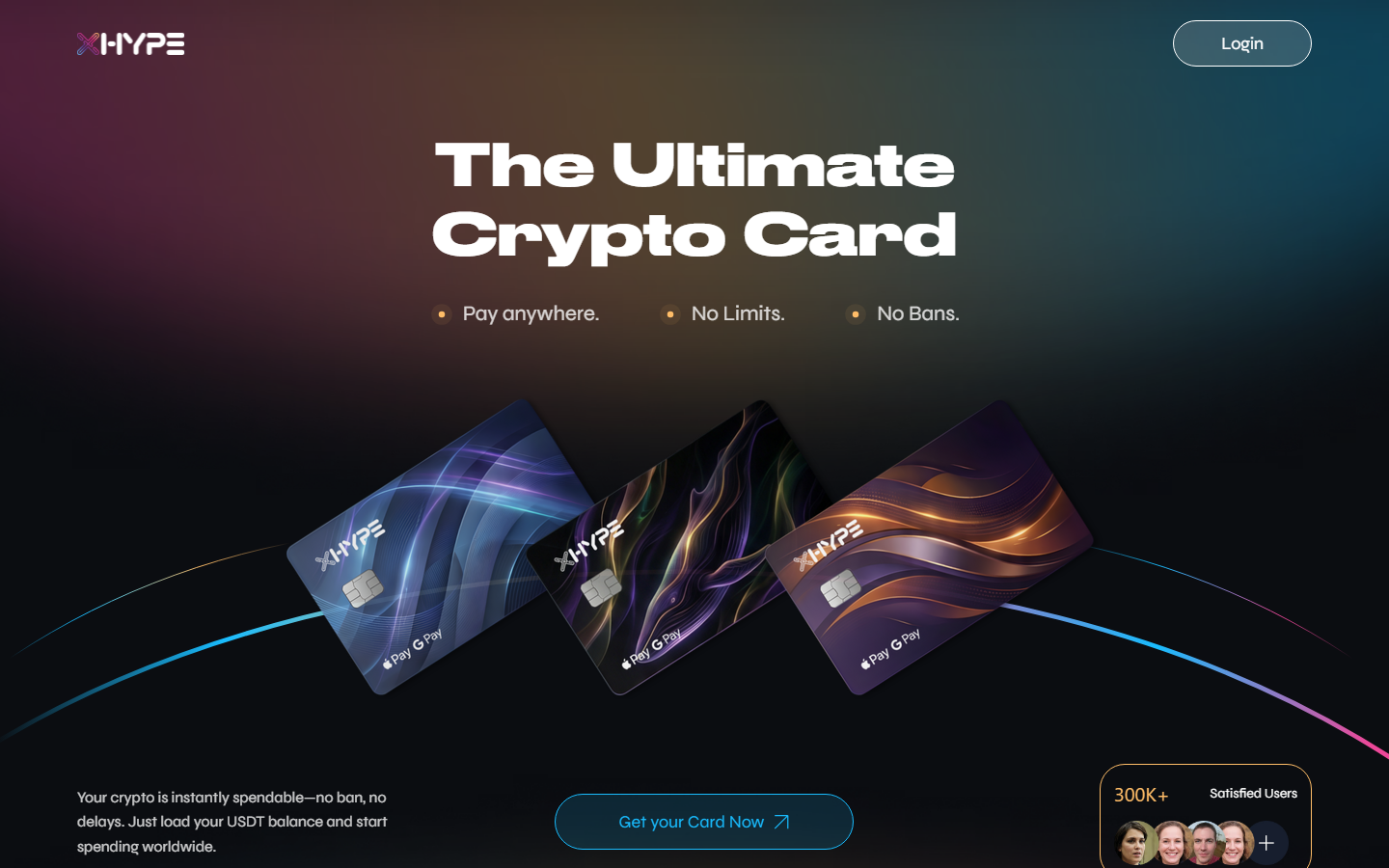
XKard pitches itself as a no-KYC crypto spending card that converts USDT into fiat at the point of sale. Operating under the tagline "Pay anywhere. No Limits. No Bans," the service promises virtual card issuance within minutes, Apple Pay and Google Pay compatibility, and acceptance at over 80 million merchants globally. The onboarding flow is deliberately lightweight: users need only an email address and an invitation code to get started—no passport scans, no proof of address, no banking paperwork.
The model is straightforward: deposit USDT (Binance Smart Chain is commonly used), pick a card tier, pay a monthly subscription, and spend. XKard offers three annual plans—Essential ($9/month), Premium ($19/month), and Whale ($49/month)—each with different recharge limits and commission rates. The top-tier Whale plan caps annual reloading at $100,000 and cuts the recharge commission to 2.3%, while the entry-level Essential plan charges 4.5% per top-up and limits annual spending to $25,000. New users receive small instant credits ($5–$40 depending on tier) as a signup incentive.
Despite the slick marketing, XKard sits in a crowded and volatile corner of the crypto-card market. Our assessment gives it a 4/10 overall score, dragged down by a 46/100 privacy score and a 42/100 trust score. The service works for some, but the cost structure and operational opacity demand caution.
Privacy & KYC
XKard occupies a middle ground on the KYC spectrum. We classify it as L2 — Discreet: minimal data collection, typically just an email address. No government ID, no selfie verification, no address confirmation. For users seeking anonymous crypto spending, this is a genuine selling point. The platform also claims to respect financial privacy, stating "Your financial data remains yours alone. No sharing data. No tracking."
However, the privacy picture is not pristine. XKard is custodial—you do not hold private keys to deposited funds—and the service logs IP addresses. The combination of email-based accounts, IP logging, and third-party payment network integration creates a footprint that sophisticated adversaries could potentially trace. Users who demand full anonymity should layer additional operational security (VPNs, dedicated emails) or consider non-custodial alternatives.
- KYC tier: L2 — Discreet (email only)
- IP logging: Confirmed
- Email required: Yes
- Invitation code: Required for registration
Supported assets & payments
XKard's ecosystem is narrow but functional. The primary—and effectively only—supported crypto asset for loading is USDT. The official site emphasizes "instant" conversion from USDT to fiat spending power, and user reports confirm deposits via BSC (Binance Smart Chain) are standard. Fiat off-ramping happens automatically at the point of sale; there is no native fiat wallet or bank withdrawal option.
The card operates on major Visa networks and supports contactless payments through Apple Pay and Google Pay. This makes it practical for everyday purchases—subscriptions, retail, dining—provided the merchant accepts standard Visa. XKard does not appear to support additional cryptocurrencies, stablecoins, or direct fiat-to-crypto onramps beyond the USDT loading mechanism. Users holding diverse portfolios will need to swap assets elsewhere before topping up.
Fees & transparency
Cost is where XKard stumbles most visibly. The fee structure is expensive and incompletely disclosed. Monthly subscriptions run $9–$49, recharge commissions span 2.3%–4.5%, and user reports suggest total costs from deposit to spend can reach approximately 10% when currency conversion and network spreads are factored in. One user noted a 10% all-in cost moving from USDT (BSC) to EUR spending.
Transparency gaps compound the pain. XKard's marketing promises "transparent fees," yet multiple users report difficulty locating complete fee schedules—particularly foreign exchange margins, decline fees, and other edge-case charges. The site lists recharge commissions by tier but omits detailed FX disclosures. This opacity clashes with the "competitive rates" claim and erodes trust for a service pitching itself as an alternative to predatory traditional banking.
Security & custody
XKard is fully custodial: deposited USDT sits on the platform's infrastructure, not in user-controlled wallets. The company touts security features including instant card lock/unlock, PIN changes, real-time transaction monitoring, two-factor authentication (2FA), and a 24/7 fraud team. These are table stakes for modern fintech, not differentiators.
The custodial model introduces counterparty risk that privacy-focused users must weigh seriously. If XKard faces insolvency, regulatory action, or operational failure, deposited funds are exposed. Community sentiment includes reports of frozen or blocked cards, unresponsive support, and missing refund transactions—one user described a terminal refund via Apple Pay that never arrived after six months of support tickets. While other users report 12+ months of smooth operation, the variance in outcomes suggests operational fragility.
Who it's for — verdict
XKard fills a specific niche: users who prioritize minimal-KYC crypto spending over cost efficiency and institutional trust. If you need a working USDT Visa card without uploading a passport, and you accept the trade-offs of high fees, custodial risk, and occasional support friction, XKard delivers functional utility. The Google Pay and Apple Pay integration, coupled with rapid virtual card issuance, makes it usable out of the gate.
However, the 4/10 overall score reflects real limitations. The 10% effective cost burden is steep against competitors. The trust and privacy scores (42 and 46 respectively) flag concerns about transparency, IP logging, and fund safety. For users with larger balances or lower risk tolerance, exploring non-custodial cards, decentralized alternatives, or established fintechs with stronger audit trails may prove wiser. XKard is a viable secondary or experimental option—not a primary financial hub.
Community summary
XKard is a low-KYC USDT-powered Visa card targeting privacy-minded users, though steep recharge fees and transparency gaps temper its appeal.
Pros
- + Minimal KYC — email and invitation code only
- + Fast virtual card issuance with Apple Pay/Google Pay support
- + Functional USDT-to-fiat spending at Visa merchants globally
- + Three tier levels accommodate different spending volumes
- + 24/7 support channel (availability varies in practice)
Cons
- − High all-in fees (~10% reported from deposit to spend)
- − Custodial model — users do not control private keys
- − Incomplete fee transparency, especially FX and decline charges
- − Mixed trust signals: frozen cards, missing refunds, unresponsive support reported
- − IP logging undermines privacy claims for advanced threat models
Attributes
12 signalsStrengths
Personal info is not verified
P+9
Cautions
May suspend your account
T-4
Community contributed
Custodial wallet
P-3 T-5
Phone number is required
P-4
Rare KYC
P-5
Informational
Source code is private
T-1
Legally registered
T+2
Email required
JavaScript needed
Some countries are restricted
Account required
P-1
Related
4 services


User reports
★ 3.1/5 · 7 ratings
strong_tracker_380
What happened: Received legitimate payment from a client. Transferred USDT from my TrustWallet to Xkard. System accepted deposit without warning. Tried to load card → funds frozen. Support: "mixer activity in transaction chain" - now demanding KYC to release MY money. The problem: I never used a mixer. Someone paid me for work, I moved it from my wallet to Xkard. If someone three transactions back used privacy tools, how is that my responsibility? I can't audit entire blockchain history of every payment. Marketing vs Reality: Homepage advertises (18 times): "No KYC" FAQ says: "zero-knowledge model — we never collect, request, or store personal data" Reality: Funds frozen, KYC mandatory, or lose your money. Their excuse: "It's the provider's AML policy, we can't help." But their T&C say they're "just a technology platform" that "doesn't manage funds." So why advertise "No KYC" if you don't control it? The real issue: If AML flags deposits as problematic, reject them upfront. Don't accept first, freeze later, demand KYC after. That's not "zero-knowledge" - that's bait and switch. They told me: "Migrate to V3, this doesn't happen there." Translation: They KNOW V2 has this problem but still accept deposits on it. Why I'm pissed: I work hard for my money. Received legitimate payment. Acted in good faith. Now funds held hostage because someone unknown, somewhere in chain, valued privacy. Xkard advertises privacy but punishes users for... privacy. The core contradiction: T&C: "We're just a technology interface, don't manage funds" But YOU: Accept my deposit Advertise "No KYC" Freeze my money Demand KYC Control if I get funds back Can't hide behind "just a platform" when convenient, then act like financial institution when it benefits you. What should happen: Reject problematic deposits upfront (your AML runs on deposit, right?) Stop advertising "No KYC" if exceptions exist Return my funds - I didn't break rules
impeccable_questioning_3141
4/5
The cards really work but there is a leak of transparency (I suppose due the automation of the service). I used it for more than 12 months.
smoldering_clustering_7161
2/5
expensive charging fees, and then just randomly blocked my unused card after a month of not using it, luckily just 60$ on it. Support unresponsive. While I was using it it worked fine, maybe service will resume normal at some point I guess. Better to use prepaid cards and just load them for the amount you need, wouldnt trust this provider with a loaded card.
accidental_guess_8754
1/5
Cashed old giftcard out in store -> refund to card on terminal using applepay, funds never arrived, 6+ months, been in contact with the support, tried to get it refunded using their support, keeps saying i have to wait 30 business days, then fill out a form, i never recieved it 500$ worth... Tells me to fill out form for getting it and then another form and etc.... Had no issues with cashing out to revolut and it came from the store on my other giftcard within 2 days... Giftcard was cashed out 25. may...
self-confident_heater_4264
2/5
they are not issuing cards now. whats the point of having this here?
ferocious_proclamation_1628
4/5
I've spent a fairly large amount via Google Pay over the past month and tried 3D Secure as well. Apart from slightly high fees, everything worked smoothly. The website UI is also excellent. However, there have been issues over the past few days. Currently, I can't move the funds already loaded onto the card, but based on their detailed updates on Telegram, I trust they're handling the situation sincerely.
dominant_homicide_9989
2/5
I looked everywhere for information about fx fees, it just state that the basic card charges 4.5% and no other information whatsoever about decline fees and other stuff. I get that no-kyc comes with downsides but this is just not transparent to buy a 230$ card just to find out you are paying 10-15% in total fees...
suspect_bellyache_2013
Overall, a solid option if you value privacy. I experienced around a 10% total cost from deposit (in USDT on BSC) to spending (in EUR), mostly due to currency conversion and associated fees. The card worked reliably both in physical stores and online. No KYC required, but comes at a premium.
omnipotent_disappointment_3329
5/5
I registered and got the smallest card they offer. I was able to add it to Google Pay, and I paid for my ChatGPT subscription with it. The only thing is, the fees seem a bit high. For the most basic card, they take 4% for deposits (which must be in USDT). On top of that, they charge another fee (~2%) to change it into Hong Kong Dollars (which is the card's currency). It's still a pretty neat tool if you want to buy stuff online anonymously, so 5 stars.