 Kusama Shield
Tool · Exchange
Kusama Shield
Tool · Exchange

xmr.ist
Communityxmr.ist
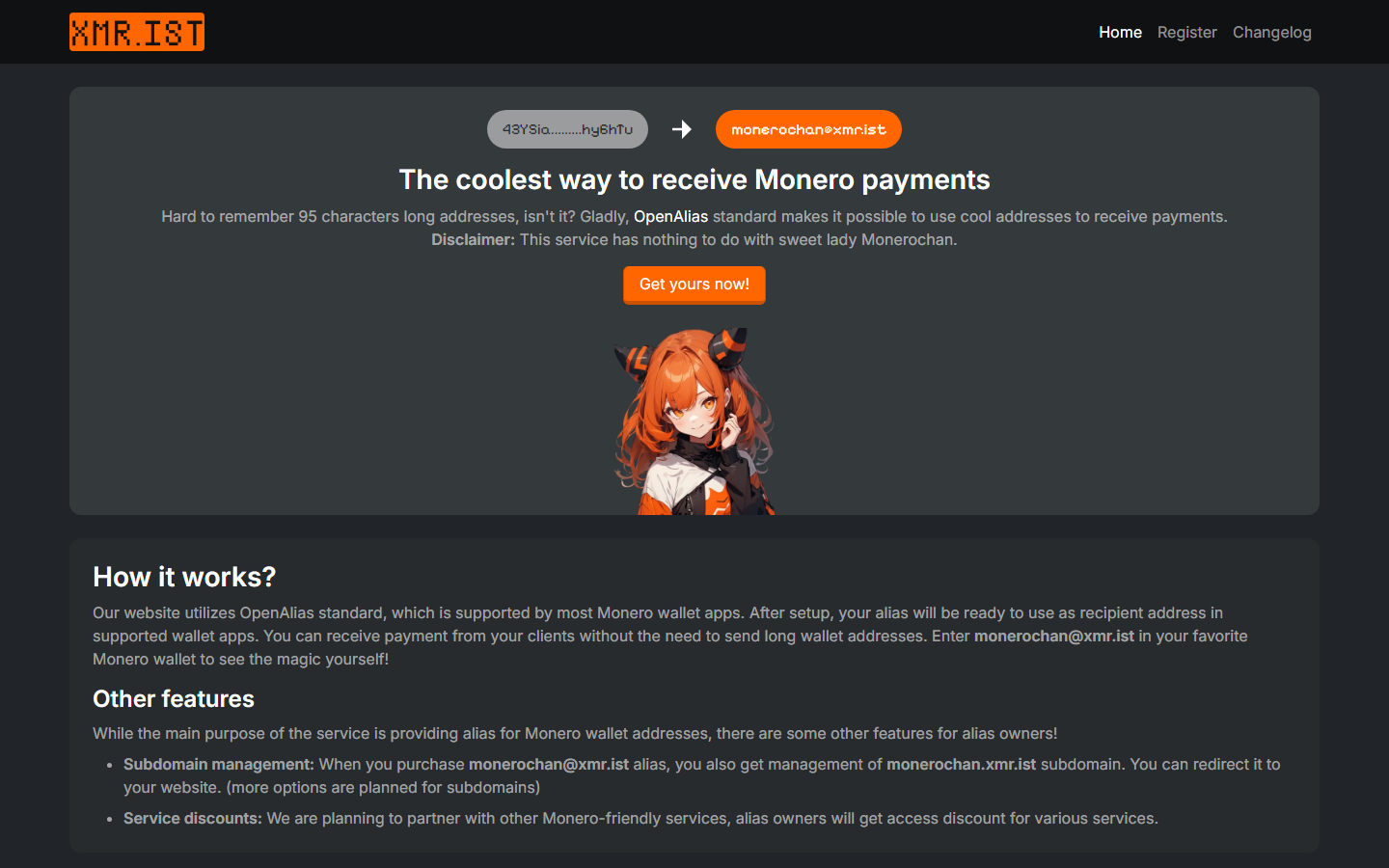
Our website utilizes OpenAlias standard, which is supported by most Monero wallet apps. After setup, your alias will be ready to use as recipient address in supported wallet apps. You can receive payment from your clients without the need to send long wallet addresses. Enter [email protected] in your favorite Monero wallet to see the magic yourself!
Live preview
xmr.ist
▶
https://xmr.ist
Review
EditorialOverview
xmr.ist is a niche privacy tool built exclusively for the Monero ecosystem. Rather than functioning as an exchange, wallet, or mixer, it solves a practical usability problem: Monero's standard addresses run roughly 95 characters, making them painful to copy, share, or verify. The service leverages the OpenAlias standard to map memorable, email-style handles—such as [email protected]—to underlying XMR addresses. Once configured, anyone with a compatible wallet can send funds to that alias instead of the raw string. The project positions itself as "the coolest way to receive Monero payments," and its 2026 site emphasizes automation, DNSSEC protection, and future subdomain perks.
Beyond aliasing, xmr.ist bundles subdomain management (redirecting youralias.xmr.ist to an external site) and teases service discounts through future Monero-friendly partnerships. It is strictly a Tool category entry, not a financial service, which shapes how users should evaluate its risks and utility.
Privacy & KYC
xmr.ist sits at KYC Tier L1 — Anonymous, the most permissive classification in our framework. The operator explicitly states that the only required input is a Monero wallet address. No email, no name, no phone number, no government ID. Access is pseudonymous by design, and the signup flow generates a unique dashboard URL that serves as both authentication and account recovery mechanism. Users must save this link themselves; there is no password-reset email chain because no email is collected.
- IP logging: The service does not disclose its logging policy in detail, so privacy-conscious users should assume standard server logs may apply and route traffic accordingly.
- Data minimization: With only a wallet address on file, the attack surface for personal data breaches is minimal compared to custodial exchanges.
- Alias exposure: Remember that OpenAlias lookups are public by nature; anyone can query whether an alias exists, though this reveals only the mapped XMR address, not identity.
Our privacy score of 65/100 reflects this lean data collection, tempered by the uncertainty around IP retention and the inherent visibility of alias-to-address mappings on the DNS layer.
Supported assets & payments
xmr.ist is Monero-only. Every alias resolves to a single XMR address, and pricing is denominated exclusively in XMR. Alias costs scale by character length, with the shortest handles commanding the highest premiums; the entry-level price starts at 0.05 XMR. Payment is a one-time fee, not a subscription, and the alias remains active for the service's lifetime. Activation is fully automated post-payment, so there is no manual approval bottleneck. Users can later update the wallet address tied to an alias without purchasing a new handle, preserving the alias's social continuity if they rotate keys.
Security & custody
Because xmr.ist never takes custody of funds—it merely publishes DNS records—there is no custodial risk in the traditional sense. The service does not hold private keys, process transactions, or intermediate payments. Funds flow directly from sender to recipient's wallet. The operator has enabled DNSSEC on the xmr.ist domain, which mitigates cache-poisoning attacks that could redirect an alias to an attacker's address. However, users must still trust that the xmr.ist infrastructure is not compromised and that DNS records are not altered maliciously. Our trust score of 50/100 acknowledges the lack of transparency around infrastructure hardening, incident history, or operator identity. The 2026 site lists contact through [email protected], but there is no public audit, bug-bounty program, or source-code repository linked.
Wallet compatibility is broad among Monero-native clients: Monero GUI Wallet, Feather Wallet, Cake Wallet, and MyMonero Web are all demonstrated on the homepage with demo videos. Community reports confirm Cake Wallet and Feather function reliably after DNS propagation, which can take a few hours post-purchase.
Who it's for — verdict
xmr.ist suits privacy-purists who transact frequently in Monero and want a professional, memorable receiving identifier. Freelancers, merchants, and donors who previously had to paste unwieldy strings into invoices or social bios gain a cleaner workflow. The no-KYC, pseudonymous signup aligns perfectly with Monero's ethos. Conversely, users seeking multi-coin support, fiat on-ramps, or yield-bearing custody should look elsewhere—this tool does one thing and one thing only.
Our overall score of 6/10 balances genuine utility against limited scope and middling trust transparency. The alias concept is elegant, the execution is automated and affordable, but the project's long-term resilience depends on a single operator's continuity. For low-stakes, high-frequency XMR receiving, xmr.ist is a pragmatic addition to the privacy toolkit. For life-savings or large settlements, continue sharing raw addresses verified through out-of-band channels.
Community summary
xmr.ist replaces unwieldy 95-character Monero addresses with human-readable OpenAlias handles, letting users receive XMR payments pseudonymously without sharing raw wallet strings.
Pros
- + True no-KYC signup with no email or personal data required
- + One-time XMR payment, no recurring subscription
- + DNSSEC-enabled domain reduces spoofing risk
- + Compatible with major Monero wallets (Cake, Feather, GUI, MyMonero)
- + Subdomain management included with alias purchase
Cons
- − Monero-only with no multi-asset support
- − Trust score hampered by opaque operator identity and infrastructure
- − Unique dashboard URL is sole access method—lose it, lose control
- − No source code or third-party audit publicly available
Attributes
3 signalsStrengths
No KYC mention
P+15
Accepts Monero
P+5
Cautions
Community contributed
Related
4 services
Kusama Shield
Tool · Exchange
 Crawlbase
Tool · Proxy store
Crawlbase
Tool · Proxy store
 Kuno
Tool
Kuno
Tool
 SimpleLogin
Tool · Email alias
SimpleLogin
Tool · Email alias
User reports
★ 4.5/5 · 2 ratings
Swapuz ✅ (Support at Swapuz)
5/5
xmr.ist is like @handles for Monero. Forget long addresses — just drop an alias and it works. Private, simple, elegant. Monero done right.
intoxicating_samovar_4245
4/5
I just tried, you can try to send me pennies here [email protected] Wait a few hours after post for DNS propagation. Cake Wallet and Feather should work, for the rest I don't know. They only accept XMR. Price is 0.05. It can be sexy but it implies DNS so additional attacks be aware.