 Silent Node
VPS · Hosting
Silent Node
VPS · Hosting

xUID
Communityxuid.ru
xUID provides offshore hosting services and private domain registrations.
Live preview
xuid.ru
▶
https://xuid.ru
Review
EditorialOverview
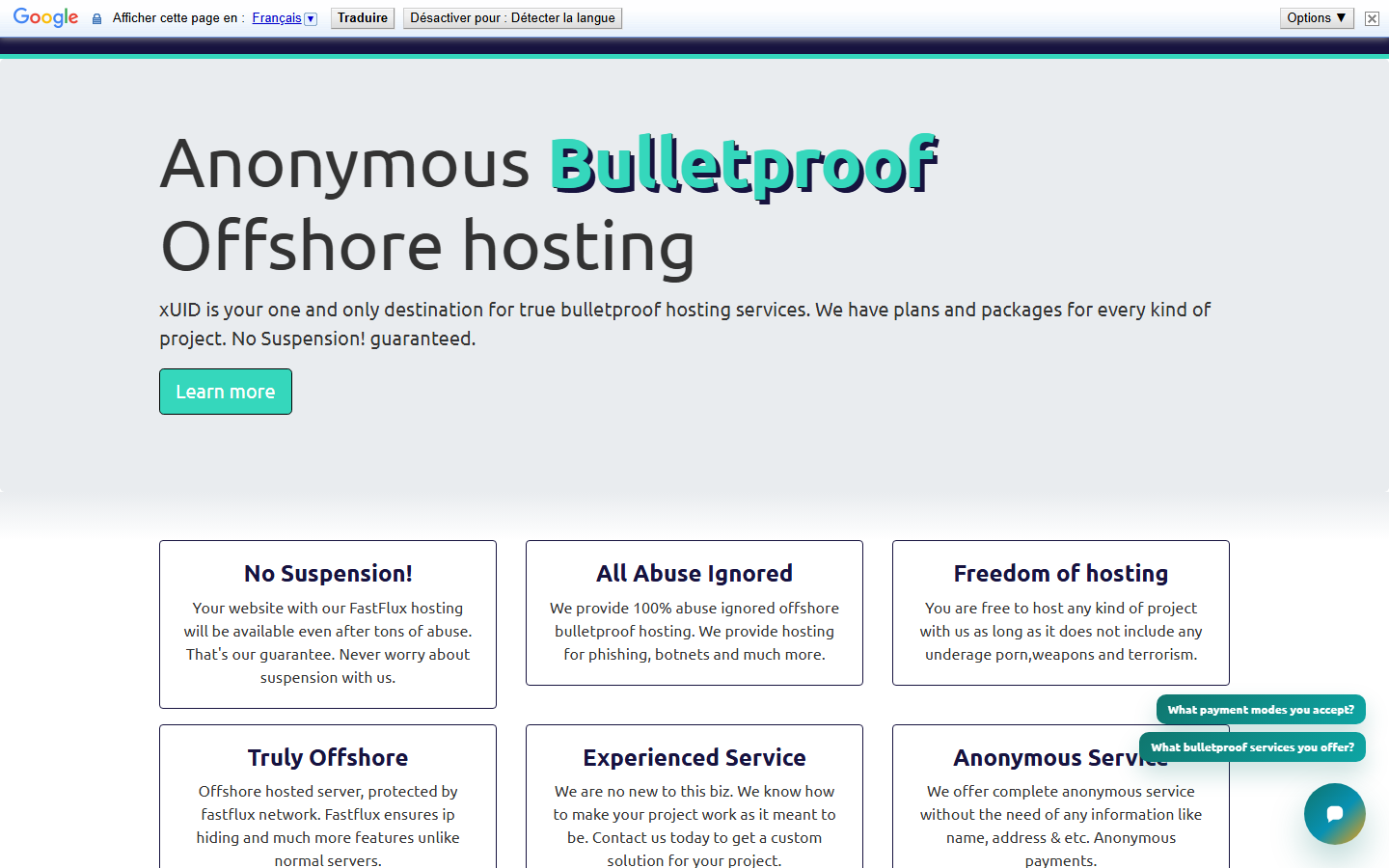
xUID positions itself as a bulletproof offshore hosting provider targeting users who prioritize anonymity and censorship resistance above all else. Operating from Russian and Ukrainian-adjacent infrastructure, the service offers three core products: anonymous private domains (starting at $18/year), shared FastFlux hosting ($169/month), and dedicated FastFlux servers ($550/month). The provider aggressively markets abuse-ignored infrastructure with explicit guarantees against suspension, even under heavy complaint volume. Unlike conventional hosts, xUID openly courts controversial use cases while drawing a hard line at underage content, weapons, and terrorism.
The service's defining characteristic is its complete elimination of identity requirements—no name, address, or contact details are collected during purchase. This makes xUID a rare trustless hosting option in an industry where even privacy-focused competitors typically demand an email address. However, this radical anonymity comes with significant trade-offs in accountability and recourse, which partly explains the service's middling trust scores.
Privacy & KYC
xUID operates at KYC Tier L0—Trustless, the most permissive classification in our framework. No account creation is required whatsoever. Users interact with the service pseudonymously through cryptocurrency payments and presumably Jabber/XMPP or Telegram for support, with no identity verification at any stage.
- No email required: Unlike virtually every competitor, xUID does not demand an email address for domain registration or hosting setup.
- Anonymous payments: Bitcoin and Monero are the sole accepted methods, with Monero offering superior privacy for the truly paranoid.
- IP logging status unclear: The provider claims "logless hosting" in SEO tags, but no explicit no-logging policy is published on the main site. Treat this as unverified marketing language.
- FastFlux IP hiding: Their custom FastFlux technology rotates DNS records across multiple servers, complicating attribution and takedown efforts.
The privacy score of 80/100 reflects excellent structural anonymity, docked for opacity around actual logging practices and the provider's willingness to host outright malicious infrastructure—which increases collateral risk to legitimate users.
Supported assets & payments
xUID accepts only two cryptocurrencies: Bitcoin and Monero. This narrow but privacy-aligned selection reinforces the service's no-KYC positioning. Notably, community signals suggest Monero may be restricted for domain purchases, with some users reporting that sub-$500 transactions default to Bitcoin or higher-tier FastFlux plans. The $18/year domain entry point and $169/month shared hosting represent significant premiums over clearnet competitors, reflecting the cost of abuse-ignored infrastructure and FastFlux redundancy. Dedicated FastFlux at $550/month targets serious operators requiring full server control with rotating IP protection.
Security & custody
xUID's security model diverges sharply from conventional hosting. Rather than emphasizing user data protection, the architecture prioritizes service availability and operator anonymity. Their custom FastFlux implementation uses "robust servers with high speed uplink" rather than botnet-compromised nodes, with claimed traffic encryption during transport, load balancing, and header preservation. Users retain full root access on dedicated plans, placing operational security entirely in their hands—classic self-custody for infrastructure.
However, the trust score of 50/100 signals substantial concerns. Community reports describe non-delivery of purchased domains and selective payment method enforcement. With no corporate entity to pursue, no terms of service to enforce, and no identity on either side of the transaction, users have zero recourse for disputes. This is the inevitable trade-off of trustless architecture: maximum deniability, minimum accountability.
Who it's for — verdict
xUID serves a narrow, high-risk tolerance niche: journalists in hostile jurisdictions, censorship-resistant publishers, privacy absolutists, and yes—actors operating gray-area projects who calculate that bulletproof infrastructure outweighs reputation risk. The no-KYC, no-account structure is genuinely rare and technically well-implemented. The FastFlux offering, while expensive, delivers genuine anti-takedown resilience unavailable from mainstream hosts.
For typical privacy-conscious users seeking anonymous WordPress hosting or a personal blog, xUID is overkill and likely overpriced. The lack of recourse, opaque support channels, and association with outright criminal hosting create reputational and potential legal exposure. The overall score of 7/10 reflects a service that executes its specific mission competently but carries inherent risks that no technical architecture can eliminate. Use Monero if possible, verify delivery before major commitments, and assume all interactions are final.
Community summary
xUID is a zero-KYC offshore hosting provider specializing in bulletproof FastFlux infrastructure and anonymous domain registration, accepting only Bitcoin and Monero with no account required.
Pros
- + True zero-KYC with no account or email required
- + Custom FastFlux tech provides genuine anti-takedown resilience
- + Monero and Bitcoin payments for pseudonymous transactions
- + Anonymous domain registration without passport or ID
- + Explicit abuse-ignored policy with no-suspension guarantee
Cons
- − Very high pricing compared to conventional hosting
- − Unverified logging claims and opaque operational security
- − Community reports of non-delivery and selective payment enforcement
- − No recourse mechanism for disputes or refunds
- − Significant reputational risk from association with criminal clientele
Attributes
3 signalsStrengths
Guaranteed no KYC
P+25
Accepts Monero
P+5
Cautions
Community contributed
Related
4 services
Silent Node
VPS · Hosting
 Ko-Net
VPS · Hosting
Ko-Net
VPS · Hosting
 MyNymBox
VPS · Hosting
MyNymBox
VPS · Hosting
 BTCVPS
VPS · Hosting
BTCVPS
VPS · Hosting
User reports
shadowy_sojourn_6089
1/5
Do not trust, at all cost. I bought a domain and I never got to use it. Here's the many redflags: They said no Monero for domains only their 500usd+ fast flux. I used Bitcoin, but the gateway almost doubled the price, ended up being 50usd for a domain. Can't change nameservers and they never replied to my ticket. Do of it what you will, don't be surprised if you get scammed.